Common Privacy Concerns in Custody Apps
Custody apps help co-parents manage schedules, expenses, and communication, but they also handle sensitive family data that could be at risk. These apps store personal details like messages, addresses, financial info, and even GPS data, making them potential targets for breaches. Courts often require these apps, so every interaction may become part of a legal record. Survivors of domestic violence face added risks if private data is exposed. Protecting your privacy requires understanding these risks and taking steps like enabling two-factor authentication, using strong passwords, and limiting the data you share.
Key Risks:
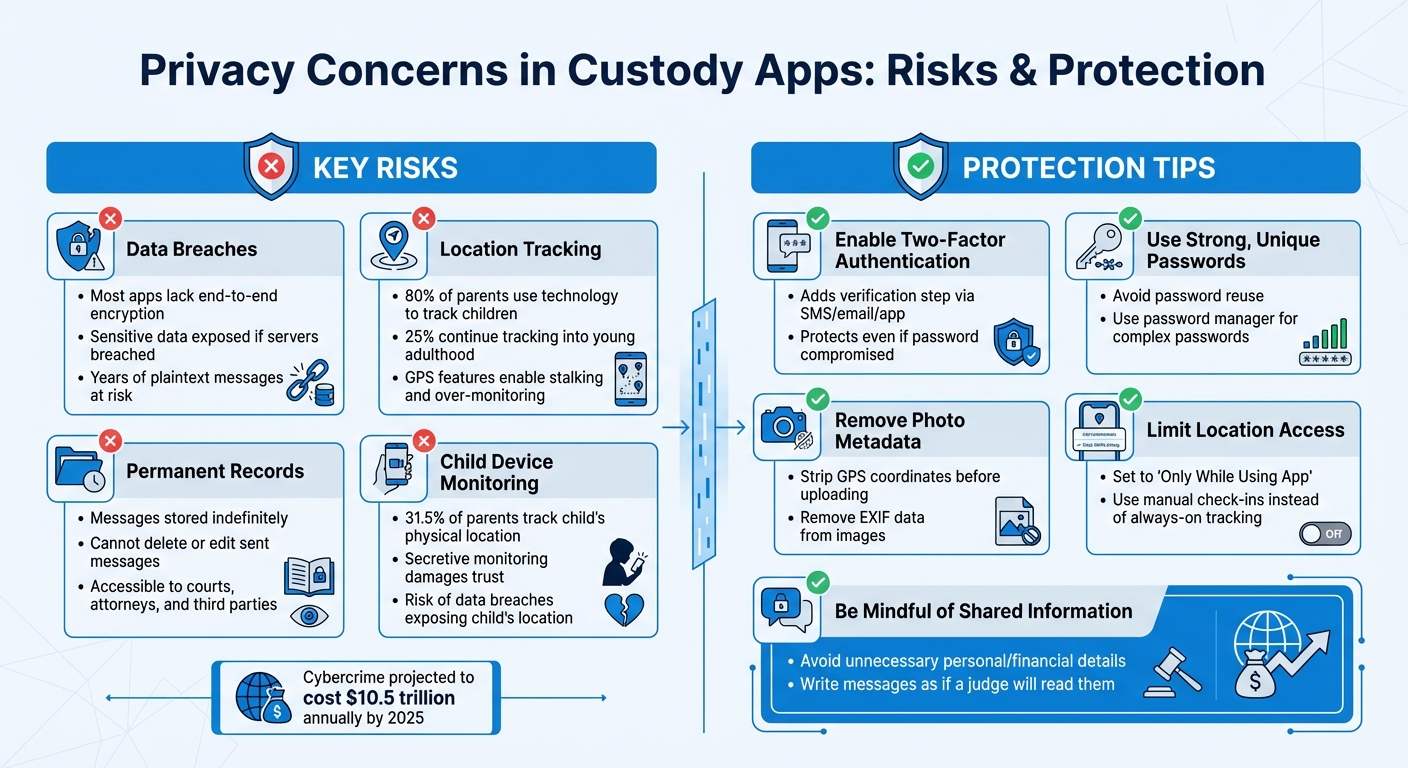
- Data breaches: Many apps lack end-to-end encryption, exposing sensitive data.
- Location tracking: GPS features can lead to over-monitoring or stalking.
- Permanent records: Messages and logs are stored indefinitely and accessible to courts or third parties.
- Child device monitoring: Excessive surveillance can harm trust and privacy.
Tips for Protection:
- Use two-factor authentication and unique passwords.
- Avoid sharing unnecessary personal or financial details.
- Strip metadata from photos before uploading.
- Choose apps with strong encryption and privacy-focused features.
Platforms like Coflo prioritize privacy by encrypting data locally and minimizing what they store, offering a safer way to manage co-parenting responsibilities.
Privacy Risks and Protection Tips for Custody Apps
Data Breaches and Security Vulnerabilities
Common Security Weaknesses
Custody apps collect and manage a wealth of personal information, including messages, custody planning data, and other sensitive family information. Many also store financial details such as Social Security numbers and bank account information, often relying on third-party processors to handle this data. This centralization of private information makes these apps an appealing target for cybercriminals.
A major concern is that most custody apps rely on server-side encryption instead of end-to-end encryption. This means that if the servers are breached, years of plaintext data could be exposed. On top of that, photos and videos uploaded to these apps often retain metadata, like EXIF data, which can reveal GPS coordinates, dates, and times when the media was captured.
For individuals in high-conflict custody cases, the risks are even greater. Hackers or malicious actors may attempt to access accounts to uncover private messages or other sensitive details, such as evidence of mental health struggles, which could be used in court. Survivors of domestic violence face heightened dangers if breaches reveal hidden addresses, routines, or other personal information meant to stay confidential. Maintaining consistent routines is vital for stability, but their exposure in a breach can compromise safety.
Recognizing these vulnerabilities is crucial, and taking proactive measures can help protect your sensitive data. Here are some practical strategies to reduce the risk of breaches.
How to Reduce Breach Risks
- Enable two-factor authentication (2FA). Adding a verification step - such as a code sent via SMS, email, or an authenticator app - provides an extra layer of security, even if your password is compromised.
- Create strong, unique passwords. Avoid reusing passwords across accounts, and use a password manager to generate and securely store complex passwords.
- Remove metadata from photos and videos before uploading. Use trusted tools to strip GPS coordinates and other identifying details from your media files.
- Avoid public Wi-Fi or use a VPN. A virtual private network (VPN) encrypts your internet connection, making it harder for hackers to intercept your data.
- Be mindful of the information you share. Limit discussions of sensitive family matters or financial details within the app unless absolutely necessary.
sbb-itb-a09457a
Location Tracking and Over-Monitoring
Problems with GPS Tracking Features
Real-time location tracking in custody apps can easily shift from being a helpful tool to a form of surveillance. Since young children are rarely without supervision, tracking a child's device often ends up revealing the location of the parent currently spending time with them. What’s marketed as a feature to ensure child safety can quickly become a way to monitor an ex-partner’s movements.
Statistics show that 80% of parents use technology to track their children, with 25% continuing this practice into their children's young adulthood. In custody disputes, this tracking can be exploited to follow a former partner without their consent, leading to harassment and emotional harm. Courts are increasingly aware of this issue, and judges now receive training to identify when digital tracking crosses the line into harassment or stalking.
"While parents have the right to know what is going on with their children, they do not have the right to get continuous location of the other parent." - Hangley Aronchick Segal Pudlin & Schiller
Another concern is the security of the apps themselves. If the servers lack strong protections like multi-factor authentication or end-to-end encryption, sensitive location data becomes vulnerable to hacking or unauthorized access.
Next, let’s look at location tools designed to balance safety and privacy.
Location Features That Respect Privacy
Some apps are tackling the issue by offering privacy-conscious alternatives to constant GPS tracking. Instead of continuous background tracking, these apps rely on manual "check-ins." This feature allows users to confirm their presence at specific locations - such as during custody exchanges - only when they choose to do so. Additionally, some apps implement proximity-based restrictions, ensuring location tags are limited to within 500 feet of the actual location. This ensures accuracy without enabling real-time surveillance.
The core difference lies in control. Privacy-respecting apps only access GPS data when you actively create a record or tag a location. They provide options like scheduled check-ins or location pings during specific times, such as custody transitions, rather than enabling "always-on" tracking. You can also adjust your device settings to limit location access to "Only While Using the App" instead of "Always", which can significantly reduce exposure to unwanted monitoring.
Message Records and Third-Party Access
Risks of Permanent Message Logs
Every message you send becomes a lasting record. Apps like TalkingParents and OurFamilyWizard are specifically built to create tamper-proof communication logs that can hold up in court. This means you can’t fix a typo, delete an impulsive reply, or erase something you later regret. While this can protect you from false claims, it also means every word you write could end up scrutinized in a legal setting.
Another major concern is who else can access these records. Most custody apps don’t use end-to-end encryption, which means the platform itself can access your messages to generate court-ready reports. Beyond that, attorneys, mediators, and Guardians ad Litem can often gain access by linking accounts or being added to your "circle". Courts can subpoena your entire message history, and agencies like law enforcement or child protective services could request records if there are allegations of harm.
"By virtue of using the app, coParents agree that their messaging, activity and agreements made on the app can be shared." - Eric Weiss, COO of coParenter
TalkingParents takes things a step further by claiming shared ownership of all records. According to their privacy policy, "We will never delete a record at the mere request of a user". Even if you deactivate your account, your messages remain stored indefinitely. This means private conversations - whether about finances, personal struggles, or new relationships - remain accessible for years.
There’s also a risk to attorney-client privilege. If you use these apps to communicate with your lawyer or share legal documents, you might lose privilege protections because the data is stored on a third-party platform. Family law attorney Jonathan Steele highlights this trade-off: "The priority has been on integrity (unchangeable records) over confidentiality (secrecy from all third parties)". This makes it even more important to weigh transparency against privacy.
Given these risks, it’s critical to approach your communications with caution.
Finding the Right Balance
As mentioned in earlier sections on encryption and device security, it’s best to treat these apps as if they’re public forums. Write every message as though a judge might read it someday. Stick to practical topics like pickup times, schedule updates, and child-related expenses. Steer clear of venting about your ex or bringing up issues that aren’t essential to co-parenting.
To safeguard your account, use multi-factor authentication, especially if your ex-partner might guess your password. Also, unlink the app from shared devices like family tablets or children’s phones to minimize accidental exposure of your data.
Finally, make sure you fully understand your app’s policies on data retention and sharing before you start using it. Some apps let you control who can view your messages through permission settings, while others allow broad access to anyone involved in your case. Knowing these details can help you navigate the balance between transparency and privacy.
Child Device Monitoring and Consent Issues
Dangers of Device Surveillance
While custody apps aim to secure communication and location data, they can cross a line by monitoring children's devices. A survey of parents with children aged 5–18 revealed that 31.5% track their child's physical location, and 95% of these children are aware of the tracking. But awareness doesn't always mean consent - especially when kids don't have a genuine choice in the matter.
Secretive monitoring, such as recording video calls or collecting metadata without permission, can damage trust. Family law attorney Jonathan D. Steele explains:
"If Lily discovers that her mother is spying on her, it may lead to feelings of betrayal and rebellion, driving her further away from open communication".
This breakdown in trust can strain co-parenting relationships and create lasting emotional rifts.
Courts have taken a firm stance against invasive monitoring. In Gray & Smith [undefined] FamCA 90, a judge deemed the use of monitoring software to record parent–child conversations an unacceptable breach of privacy, stating:
"While parental control is crucial for a child's protection, it should not be abused to intrude upon relationships with other family members or used manipulatively in legal proceedings".
Similarly, rulings in D & E (Shared Parental Responsibility) [undefined] FamCA 207 stress that such measures should only be a last resort.
Another risk of monitoring apps is hacking, which could expose a child's sensitive data and real-time location. This concern is echoed by 35% of parents, who worry about third parties accessing their child's location data. Many apps share metadata with data brokers or advertisers, raising additional privacy concerns. Shifting to consent-based tools can help avoid these risks.
Consent-Based Alternatives
Instead of invasive tracking, consider tools that rely on mutual consent. For instance, some co-parenting apps include "check-in" features, where a child or parent manually logs their location at specific times rather than enabling constant GPS tracking. The National Network to End Domestic Violence notes:
"An app feature that prompts a user to upload a location at a scheduled time presents more safety options than an app that requires location to be constantly on".
Experts also suggest adjusting monitoring practices using age-specific custody schedules. For younger kids (ages 6–9), stricter controls might be suitable, but for teens (ages 13–15), tools like usage summaries or collaborative communication work better. By the time children reach 16, the focus should shift toward teaching self-regulation. Educating kids on digital safety and responsible device use often proves more effective - and less harmful to the parent-child bond - than heavy surveillance.
Most importantly, involve children in conversations about digital safety. When kids see these tools as supportive rather than invasive, it fosters trust and encourages responsible behavior.
How Coflo Protects Your Privacy
Coflo's Security Features
Coflo addresses privacy concerns head-on by ensuring your sensitive data stays secure and is used only for custody planning purposes. The platform employs AES-GCM encryption to protect your information and processes data locally on your device rather than relying on central servers. This approach significantly reduces risks tied to server-side vulnerabilities.
The Safety Net Project underscores a guiding principle behind Coflo’s design: "If they do not collect the data, it cannot be breached or shared". Staying true to this, Coflo collects only the essential custody-related information. Data is stored temporarily and deleted once it's no longer needed, keeping the window for potential breaches as small as possible.
Beyond its strong security foundation, Coflo also offers tools to make collaborative custody planning easier and safer.
Privacy-Focused Collaboration Tools
Coflo’s collaboration tools are built with privacy as a priority, giving co-parents the ability to work together without compromising sensitive information. For example, when you adjust priority sliders for factors like stability, equal parenting time, or school consistency, all processing happens directly on your device.
The platform also provides age-specific developmental psychology insights and detailed roadmaps to help implement custody plans - all while keeping your family’s data strictly under your control.
With Coflo, you get access to affordable, research-based custody planning tools that balance your children’s wellbeing with a commitment to safeguarding your privacy.
Conclusion
Privacy concerns surrounding custody apps remain a pressing issue. Cybercrime is expected to cost the global economy a staggering $10.5 trillion annually by 2025. Risks such as data breaches, permanent message logs, and invasive location tracking pose serious dangers, especially for survivors of abuse. As Chicago Divorce Attorney Jonathan D. Steele aptly states:
"Vigilance is not just a choice; it's a necessity."
To address these challenges, prioritizing robust data protection strategies is crucial. Thankfully, you don't need to compromise your family's privacy to manage custody effectively. Platforms like Coflo use advanced measures such as AES-GCM encryption, multi-factor authentication, and local data processing. By retaining only essential custody-related information, Coflo ensures your data stays secure while offering powerful tools for co-parenting.
Coflo takes privacy seriously by processing data locally and minimizing stored information. At the same time, it provides features like age-specific developmental insights and priority-driven schedule recommendations, offering research-based guidance without creating a permanent digital footprint that could be exploited.
This focus on privacy doesn’t come at the expense of functionality. Coflo allows seamless collaboration with your co-parent, real-time priority adjustments, and access to detailed implementation plans - all while keeping your family's sensitive information firmly under your control.