
AI Tools for Custody Planning
AI tools are changing custody planning by focusing on children’s needs instead of parental disputes. These platforms analyze data like school schedules, medical appointments, and extracurricular activities to create schedules that prioritize stability and consistency for kids. By reducing emotional conflicts and offering practical solutions, AI helps parents make informed decisions.
Key Features of AI Custody Tools:
- Child-Centered Scheduling: AI suggests routines that minimize stress and prioritize children’s well-being.
- Low-Conflict Communication: Tools include features like neutral messaging assistance to keep conversations productive.
- Customizable Priorities: Parents can adjust preferences using sliders to balance school stability, parenting time, and transitions.
- Data-Driven Recommendations: Algorithms analyze family dynamics and provide evidence-based custody plans.
- Ongoing Adaptability: AI evolves with feedback, ensuring schedules meet changing family needs.
Benefits:
- Faster Decisions: AI generates custody plans in minutes, avoiding lengthy negotiations.
- Cost-Effective: Affordable compared to legal or mediation services.
- Objective Insights: Reduces emotional bias in decision-making.
- Transparency: Clear explanations of how custody plans are created.
Challenges:
- Privacy Concerns: Sensitive family data must be securely protected.
- Complex Family Dynamics: Certain situations, like domestic issues, still need professional input.
- Legal Recognition: AI-generated plans may require court validation in some cases.
AI custody tools like Coflo simplify the process, save time, and reduce stress for parents. While not a replacement for professional advice in complex situations, these platforms offer a practical way to prioritize children’s well-being during custody planning.
How AI Custody Planning Tools Work
AI custody planning tools use advanced data analysis to generate practical custody recommendations tailored to each family. By merging machine learning algorithms with child development insights, these tools create schedules that align with a family's specific circumstances. They process a vast array of variables - evaluating countless scheduling possibilities in an instant - to find custody arrangements that prioritize the child's wellbeing. This approach offers families a way to explore thoughtful custody options without getting bogged down in logistical complexities.
Algorithms That Create Custody Recommendations
At the heart of these tools are algorithms designed to act as decision-making engines, capable of weighing multiple factors at once. They begin by gathering key information about the family’s priorities, such as maintaining a stable school routine, ensuring equitable parenting time, or reducing travel demands. This data is then analyzed alongside established principles of child development to produce recommendations that foster healthy outcomes.
These algorithms rely on pattern recognition to identify what works best in custody arrangements. By analyzing thousands of real-world family scenarios, they discern patterns that are effective for different age groups and circumstances. For example, the system might determine that younger children thrive with shorter, more frequent transitions between parents, while older kids often prefer extended stays with each parent to maintain their social lives and routines.
A core feature of these tools is priority weighting. Parents can indicate their most important considerations - using tools like sliders or ranking systems - and the algorithm assigns numerical values to these preferences. For instance, if school consistency is a top priority, the system will prioritize schedules that minimize disruptions to the child’s education, even if it means slightly uneven parenting time.
These algorithms also account for real-world constraints, such as work hours, extracurricular activities, and travel distances. They provide instant updates when circumstances shift, like a new work schedule or added activities, ensuring that the recommendations remain practical and adaptable. This dynamic approach ensures that custody arrangements are not only well-reasoned but also feasible for families juggling busy lives.
Custom Recommendations Through Data and Feedback
AI custody tools also refine their recommendations through ongoing user feedback. By incorporating continuous learning, these systems adapt to meet the evolving needs of each family. They track how well suggested schedules work in practice, using parent input and usage patterns to fine-tune future recommendations. If parents report that certain arrangements are stressful or impractical, the AI adjusts its approach for that family.
Feedback loops are central to this process. Parents can evaluate how well a schedule worked, flag challenges, or highlight successes. The AI processes this feedback to better understand the family’s unique dynamics, ensuring future recommendations align more closely with their needs. Over time, the system builds a detailed profile of the family, leading to increasingly precise and effective suggestions.
As children grow, these tools also adapt to their changing developmental needs. For example, the system might adjust recommendations as a child transitions from elementary to middle school, accounting for shifts in sleep patterns, academic demands, and social priorities. By factoring in these developmental milestones, the AI ensures custody arrangements remain supportive of the child’s overall wellbeing.
Using Priority-Based Decision Systems
Priority-based decision systems let parents input their family priorities - like equal parenting time, school stability, or fewer transitions - into an AI platform that creates custody schedules tailored to what matters most for their unique situation.
What makes this approach stand out is its ability to balance multiple needs instead of forcing parents into an "either-or" scenario. Parents no longer have to choose between their preferences and their child's wellbeing. Instead, they can define their priorities, and the AI works to craft solutions that address several factors simultaneously. This process flows seamlessly into interactive tools, such as sliders, which fine-tune proposed schedules even further.
Creating Schedules with Priority Sliders
Priority sliders translate family values into specific custody plans. Parents can adjust these sliders to show how much weight they want to give to different factors. For instance, one slider might emphasize the importance of maintaining consistent routines, while another could focus on balancing parenting time alongside practical considerations like work schedules or proximity to school.
For families with school-age children, a "school consistency" slider can help ensure that a steady routine during the school week plays a central role in the custody arrangement. Based on the chosen priorities, the AI might suggest schedules that simplify weekday responsibilities while offering extended time for weekends or holidays.
The system also provides real-time feedback, showing how adjustments to the sliders impact the proposed schedule. This makes it easy for parents to understand trade-offs and tweak their priorities on the spot. Coflo’s platform supports a wide range of factors - like stability, equal parenting time, school consistency, and minimal transitions - ensuring that every recommendation prioritizes the child’s best interests.
Adding Child Development Knowledge
Beyond personalized scheduling, these tools incorporate insights from child development research to ensure that custody plans align with a child's changing needs. By factoring in areas like emotional attachment, cognitive growth, and social development, the system avoids suggesting arrangements that might work for adults but could be stressful or unsuitable for children.
For example, the AI might recommend short, frequent transitions for young children aged 3–5, recognizing that long separations can be tough for them. For older, school-age children, it might aim for a balance between maintaining routines and allowing enough flexibility for academic, social, and extracurricular activities.
Coflo: A Practical Example of AI-Powered Custody Planning
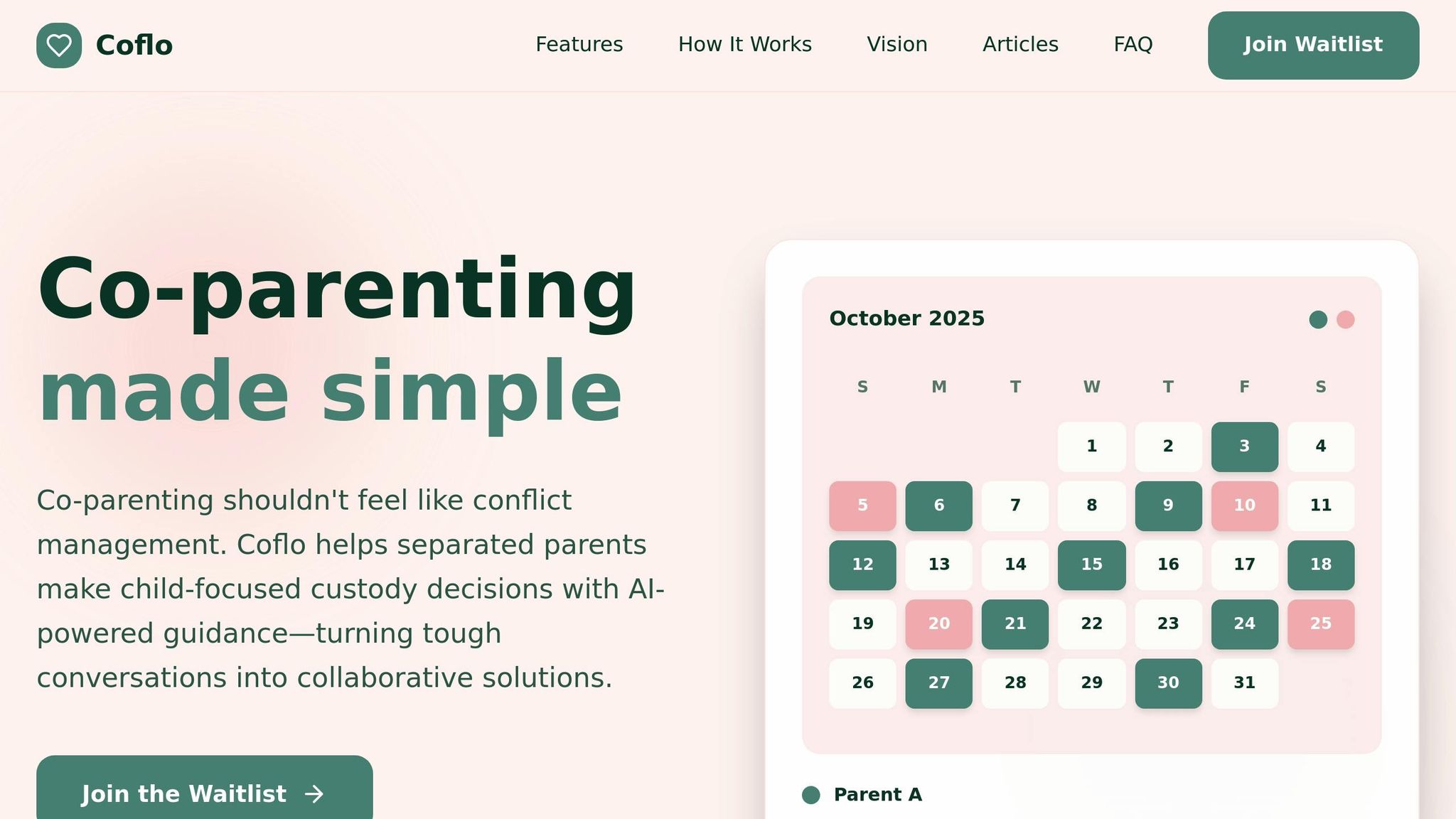
Coflo takes the concept of AI-driven custody planning and brings it to life, turning what is often a contentious process into one rooted in collaboration. By combining priority-based systems with insights into child development, Coflo provides a practical solution for real-world custody challenges.
The platform is designed to cut through the confusion that typically overwhelms parents during custody planning. It simplifies complex legal terminology and eliminates conflicting advice. Plus, it offers research-based guidance at a fraction of the cost of hiring an attorney or mediator - all while prioritizing the child's wellbeing.
Key Features and Benefits of Coflo
Coflo’s interactive system allows parents to set priorities using adjustable sliders, ensuring schedules that balance stability, fair time distribution, and school consistency. Its AI-powered engine evaluates over 10 proven custody patterns, tailoring recommendations to each family’s specific needs. As parents adjust their priorities, the system recalculates instantly, showing how changes impact the suggested custody arrangements. Every recommendation is centered on what’s best for the child.
The platform also adapts custody plans to match children’s developmental stages. Younger kids benefit from frequent contact with both parents, while older children gain the predictability of consistent routines. Each recommendation is paired with actionable guidance, explaining not just what works but also how to make it work effectively.
When it comes to privacy, Coflo takes no shortcuts. The platform uses strong encryption and limits data retention, ensuring that sensitive family information remains secure throughout the planning process.
How Coflo Improves Teamwork and Understanding
Beyond its technical capabilities, Coflo fosters cooperation by helping parents clarify and understand each other’s priorities. Instead of getting bogged down in emotional disputes, parents can rely on data-driven insights to focus on what’s best for their children.
By offering a transparent look at how different priorities shape custody recommendations, Coflo helps parents see where the other is coming from. This shared understanding can reduce conflict and encourage a more balanced, cooperative approach to decision-making.
Coflo also saves valuable time. Instead of spending hours in expensive mediation sessions, parents can quickly explore various custody scenarios using the platform’s user-friendly tools. This efficiency not only reduces stress but also encourages more productive discussions. As children grow and needs evolve, custody arrangements can be adjusted seamlessly - keeping the focus firmly on the child’s best interests.
sbb-itb-e357fb0
Benefits and Limits of AI-Driven Custody Planning
Building on earlier discussions about how AI is reshaping custody planning, this section dives into its advantages while addressing some critical challenges. AI-powered custody tools can simplify and improve the process for families navigating the complexities of separation and divorce, but they also come with important considerations.
Benefits of AI Tools for Custody Planning
One of the standout advantages of AI tools is their ability to reduce emotional bias. In traditional custody negotiations, emotions and unresolved conflicts often cloud decision-making. AI systems, on the other hand, rely on data and insights from child development research to provide recommendations that focus on what’s best for the children involved.
These tools also excel in terms of speed and efficiency. Traditional mediation or legal negotiations can drag on for weeks or months due to scheduling conflicts and prolonged deliberations. AI tools can generate multiple custody scenarios in minutes, giving parents the ability to explore options without the delays or steep costs tied to professional mediation or legal services.
Cost savings are another major draw. Conventional custody evaluations and mediation services can be expensive, while AI-powered platforms offer affordable, evidence-based solutions that are more accessible to a wider range of families.
AI tools are also adept at handling complexity. They can analyze numerous factors - such as school schedules, work commitments, children’s ages, extracurricular activities, and even geographic constraints - all at once. This capability often results in custody arrangements that might not have been considered through traditional methods.
Finally, the objectivity and consistency of AI recommendations can help reduce conflicts between co-parents. When both parties can see how specific priorities and constraints shape the suggested custody arrangements, it becomes harder to argue against the fairness of the results.
| Benefits | Traditional Methods | AI-Powered Tools |
|---|---|---|
| Cost | High expenses for evaluations | Affordable, evidence-based options |
| Time | Lengthy processes | Fast scenario generation |
| Bias | Emotionally charged decisions | Data-driven, objective insights |
| Complexity Handling | Limited factor consideration | Multi-variable analysis |
| Accessibility | Requires in-person meetings | Available anytime, anywhere |
Challenges and Privacy Issues
While the benefits are compelling, there are significant challenges to consider. One of the most pressing concerns is data privacy. Families using these tools share sensitive information about their relationships, finances, and children’s needs. A breach of this data could have serious consequences for their safety and privacy.
To address this, platforms like Coflo implement strong security measures, such as AES-GCM encryption and client-side processing. This ensures that sensitive information stays on users’ devices rather than being stored on external servers. Even so, parents should carefully review privacy policies to fully understand what data is collected and how it’s protected.
Another challenge is algorithm transparency. While AI systems can process vast amounts of data, the way they arrive at conclusions can often feel opaque. This lack of clarity can make it difficult for parents to fully trust the recommendations, especially if they conflict with their instincts or expectations.
AI also falls short in addressing the complexity of certain family dynamics. Situations involving domestic violence, substance abuse, mental health issues, or the needs of children with disabilities often require the nuanced judgment of professionals. In these cases, AI tools can provide support but should not replace expert intervention.
Legal recognition of AI-generated custody recommendations varies widely depending on jurisdiction. While these tools can help guide discussions and mediation, courts may still require formal documentation or oversight from legal professionals before approving custody arrangements.
Finally, technology limitations and input errors can undermine the reliability of AI recommendations. Families without reliable internet access or those unfamiliar with digital tools may find these platforms challenging to use.
Given these considerations, AI custody tools should be seen as complementary to professional guidance, particularly in situations with heightened conflict or complexity. They can streamline the process and provide valuable insights but are not a substitute for human expertise in more sensitive cases.
Conclusion: Changing Custody Planning with AI
AI is reshaping the way custody planning works. What was once a process riddled with conflict and inefficiency is now becoming more streamlined and focused on what truly matters: the wellbeing of children.
Take tools like Coflo, for example. These platforms use advanced algorithms to consider a variety of factors - school schedules, work commitments, and children's developmental needs - all at once. The result? Recommendations that are based on data and logic, offering solutions that might never emerge through traditional methods.
The benefits go beyond just better decisions. AI tools save both time and money. Traditional custody planning often involves lengthy mediations or costly legal consultations, sometimes dragging on for months. In contrast, AI platforms deliver tailored suggestions in minutes and at a fraction of the cost.
But perhaps the most impactful change is the reduction in conflict between co-parents. When both sides can see the data and understand how decisions are made, disputes over fairness tend to diminish. By removing emotional bias, AI creates space for meaningful discussions that prioritize what’s most important - the needs of the children.
The Future of Custody Planning
Looking ahead, AI's role in custody planning is set to expand even further. Emerging technologies, like sentiment analysis, could soon identify stress or tension in co-parent communications. Imagine real-time schedule updates triggered by factors like GPS data, school emergencies, or unexpected work obligations. These advancements promise to make co-parenting even more adaptive and responsive.
Integration with family courts is another area of rapid development. AI platforms are on track to seamlessly connect with judicial systems, streamlining tasks like document submissions, compliance tracking, and updating court orders. Tools like voice-activated legal assistants may soon help parents manage agreements on the go, while AI-driven mediation bots could facilitate instant negotiations during disputes. Some systems might even link with wearable devices to monitor children’s stress levels during custody transitions, offering insights into how arrangements are impacting their wellbeing.
As these technologies evolve, co-parenting is likely to become more collaborative and data-driven. Courts may even establish clearer rules for using AI, potentially requiring digital parenting plans that outline how apps are used for communication and scheduling.
For parents navigating custody decisions today, AI offers a way to make the process less contentious and more productive. The future of custody planning isn’t just about managing logistics - it’s about building adaptable, cooperative frameworks that grow with families. By keeping children's wellbeing at the forefront, these tools have the potential to transform custody planning from a source of conflict into a foundation for collaboration.