Step-by-Step Custody Plan Guide
When you're navigating a separation or divorce, creating a custody plan is essential for your child’s stability and well-being. A custody plan is a detailed agreement that outlines where your child will live, how time is divided between parents, and how decisions are made. It helps avoid conflicts, reduces stress, and ensures both parents remain active in their child’s life.
Key Takeaways:
- Types of Custody: Legal custody (decision-making authority) and physical custody (where the child resides). These can be joint (shared) or sole (one parent).
- Schedules: Options include alternating weeks, 2-2-3 schedules, every other weekend, or long-distance arrangements.
- Child’s Needs: Age, school stability, and extracurricular activities should guide decisions.
- Parent Factors: Work schedules, geographic distance, and communication abilities are critical.
- Legal Requirements: Custody plans must meet state laws and prioritize the child’s best interests.
Steps to Create a Plan:
- Identify your family’s priorities (e.g., stability, school consistency).
- Choose a custody schedule that fits your situation.
- Use tools like Coflo to explore tailored recommendations.
- Document everything clearly, including schedules, holidays, and decision-making roles.
- Prepare for legal or mediation review to finalize the plan.
A clear custody plan minimizes misunderstandings and ensures your child’s needs are prioritized. Platforms like Coflo simplify the process by offering personalized, research-backed schedules and insights tailored to your family’s circumstances.
Unlocking Joint Parenting: How to Create a Winning Custody Plan
Basic Custody Planning Terms
Having a grasp of key custody terms and legal guidelines is essential when navigating custody arrangements. These terms lay the groundwork for effective communication with legal professionals and co-parents, helping you make informed decisions.
Types of Custody Arrangements
Legal custody gives a parent the authority to make significant decisions about a child's life, including their education, healthcare, and religious upbringing. When both parents share this responsibility - referred to as joint legal custody - they have equal input on these major matters. On the other hand, sole legal custody grants one parent the exclusive right to make these decisions. This arrangement is less common and usually applies in cases where safety concerns or other circumstances prevent joint decision-making.
Physical custody determines where the child primarily lives. In cases of joint physical custody, the child splits time between both parents' homes, though it doesn't necessarily mean an equal 50/50 division. The schedule might be 60/40, 70/30, or another arrangement that suits the family. With sole physical custody, the child resides primarily with one parent, while the other parent typically has scheduled visitation.
The parent with whom the child lives most of the time is referred to as the custodial parent or primary residential parent. The other parent is known as the non-custodial parent or secondary residential parent. These designations can influence factors like child support, tax benefits, and decisions about school enrollment.
Visitation, sometimes called parenting time, refers to the time the non-custodial parent spends with the child. This can range from supervised visitation, where a third party oversees the visit, to unsupervised visitation, which allows for more flexibility. Visitation schedules may include overnight stays or be limited to daytime hours, depending on the child's needs and circumstances.
Legal and Court Requirements
In custody decisions, all U.S. states apply the "best interests of the child" standard. This means the court prioritizes the child's well-being above the preferences or convenience of either parent. Factors considered often include the child's bond with each parent, the stability of each parent's home, the child's current living situation, and, in some cases, the child's own preferences, provided they are mature enough to express them.
Custody laws vary by state. Some states favor joint custody arrangements, while others may require mediation to resolve disputes. Additionally, the age at which a child's opinion is considered can differ significantly - from as young as 12 in some states to as old as 16 in others.
Most states require parents to submit a parenting plan to the court, even if both parties have already agreed on the terms. This document outlines key details such as the child's living arrangements, visitation schedules, holiday plans, and decision-making processes for the child's care. The court reviews this plan to ensure it aligns with the child's best interests before approving it.
If circumstances change, custody arrangements can be modified. However, courts typically require proof of a "substantial change in circumstances" to justify altering an existing order. Examples include a parent's relocation, a significant change in work hours, or concerns about the child's safety. The process involves filing a petition and demonstrating how the changes would better serve the child's needs.
Understanding these terms and legal requirements equips you to create a custody plan that works for your family while meeting the court's standards. By mastering this foundational knowledge, you'll be better prepared to navigate the complexities of custody planning.
Key Factors for Your Custody Plan
Creating a custody plan that works well requires balancing your child’s needs with the realities of daily life. The best arrangements take into account your child’s developmental stage and ensure both parents can provide consistent, high-quality care. By understanding the important factors involved, you can craft a plan that genuinely supports your family’s unique situation.
Child-Focused Considerations
Your child’s age and developmental stage play a large role in determining the most suitable custody arrangement. For instance, infants and toddlers under 3 years old often do best with short, frequent visits rather than extended overnight stays. At this stage, stability and maintaining close bonds with their primary caregivers are essential.
For school-age children (6 to 12 years old), longer separations may be manageable, and they tend to thrive on predictable schedules that align with their school routines. Teenagers, on the other hand, often prefer having more say in their schedules. Their commitments - like extracurricular activities, part-time jobs, and social events - may require greater flexibility. In many states, courts begin to consider a child’s preferences starting around ages 12 to 14, though how much weight this carries varies.
School and educational stability are critical factors. Children generally perform better when they stay in the same school environment rather than frequently switching districts. If parents live in different school zones, decisions about which school the child will attend and how transportation will be handled need to be addressed.
Extracurricular activities and social connections also require thoughtful coordination. Whether your child is involved in soccer, piano lessons, or dance, both parents need to support these activities. For example, one parent might handle weekday practices while the other takes charge of weekend games, or these commitments could influence the custody schedule itself.
The frequency of transitions between homes can impact children differently based on their age and temperament. While some kids adapt well to frequent moves, others may find it stressful and disruptive. Younger children, in particular, benefit from fewer transitions to maintain a sense of security and routine.
If your child has special needs, it’s essential that both parents are equipped to manage medical routines and appointments without disruption.
Parent Circumstances
While your child’s needs are the foundation of the custody plan, the realities of each parent’s situation will shape what’s practical.
Work schedules play a major role. A parent with a traditional 9-to-5 job has different availability than someone who works nights, weekends, or has an irregular schedule. Healthcare workers, shift workers, or parents who travel frequently may need customized plans to accommodate their hours.
It’s also wise to consider future changes. For example, if one parent is planning to go back to school, change careers, or accept a promotion involving travel, these factors should be incorporated into long-term planning.
Geographic distance between parents’ homes can significantly impact logistics. If parents live more than 30 minutes apart, minimizing transitions and clearly defining transportation responsibilities is crucial. For long-distance custody - such as when parents live in different states or over 100 miles apart - plans often involve extended periods with each parent, such as spending the school year with one and summers with the other, along with alternating holidays.
Stable housing, financial resources, and support from extended family are also important for maintaining a functional custody arrangement.
Communication and co-parenting ability between parents can determine the complexity of the plan. Parents who work well together and make joint decisions easily can handle more flexible and shared arrangements. However, if there’s significant conflict or poor communication, a more structured plan with clear boundaries may be necessary to reduce friction.
Additionally, new relationships and blended family dynamics might require adjustments. When a parent remarries or introduces a new partner, children often need time to adapt. Some custody agreements include specific guidelines about introducing new partners or having overnight guests during parenting time.
The key to a successful custody plan lies in honestly evaluating these factors and keeping your child’s well-being at the forefront. A well-thought-out plan should address current challenges while allowing room for future changes as your family continues to grow and evolve. The next section will guide you through creating a step-by-step plan tailored to your family’s needs.
sbb-itb-e357fb0
5 Steps to Create Your Custody Plan
Using the basic custody terms and key factors we've covered, here's a step-by-step guide to help you create a custody plan tailored to your child's needs and your family's situation. Breaking it down into clear steps can make the process feel less overwhelming and more achievable.
Step 1: Identify Your Family's Needs and Priorities
Start by examining your family’s specific needs and what matters most for your child.
Think about your child’s need for stability. Some kids adapt well to frequent transitions between homes, while others thrive with longer stays in one place. Reflect on your child’s personality and how they’ve managed changes in the past.
Consider whether equal parenting time is a priority. While a 50/50 split may seem fair, it might not be practical if parents live far apart or have conflicting work schedules. Equal time doesn’t always mean an exact split of hours; it could mean ensuring both parents have meaningful involvement.
School consistency is another key factor. If staying in the same school is non-negotiable, the parent living in that district may need to handle weekdays, while the other parent might focus on weekends and school breaks.
Other considerations could include flexibility for work travel, minimizing transitions to reduce stress, or setting up alternating weekends to allow both parents some downtime. Write down your top three to five priorities and rank them by importance.
Once you’ve identified your priorities, discuss them with your co-parent. This conversation can reveal shared values or areas where compromise is possible, helping you avoid future conflicts.
Step 2: Review Custody Schedule Options
With your priorities in mind, explore common custody schedules to find one that aligns with your needs.
- The alternating weeks schedule gives each parent a full week with the child, offering stability but requiring parents and kids to go seven days without seeing each other.
- The 2-2-3 schedule alternates every two weeks, with two days with one parent, two days with the other, and three days back with the first parent. While it ensures frequent contact, it also involves more transitions.
- Every other weekend arrangements typically give one parent weekdays and the other parent alternating weekends, plus one weekday evening. This can work well when parents live far apart or have demanding work schedules.
- For long-distance parenting, extended periods are common - like the school year with one parent and summers with the other, along with alternating holidays.
- Holiday schedules are crucial regardless of your regular arrangement. Many parents alternate major holidays yearly or split them (e.g., Christmas Eve with one parent, Christmas Day with the other). Decide which holidays are most significant and try to accommodate each parent’s preferences.
Step 3: Get Personalized Schedule Recommendations
Instead of guessing which schedule might work best, consider using tools designed specifically for custody planning. Platforms like Coflo use AI to match your priorities with proven custody patterns, offering tailored recommendations.
By adjusting priority sliders for factors like stability, equal time, and school consistency, you can see how different schedules align with your family's needs. The platform also provides insights based on your child’s age, offering guidance rooted in developmental research. For instance, a plan for a preschooler might focus on routine and attachment, while one for a pre-teen might prioritize school and friendships.
Each recommendation includes detailed pros and cons, success tips, and transition plans, making it easier to choose the right path without feeling overwhelmed. Once you’ve selected a schedule, document it clearly to avoid misunderstandings.
Step 4: Write Down Your Custody Plan
After deciding on a schedule, it’s time to put everything in writing. A well-documented plan helps prevent disputes and provides clarity when questions arise.
Be specific about:
- Schedules: Include exact days, times, and locations for transitions (e.g., "Child is with Dad from Wednesday 6:00 PM to Friday 6:00 PM, with pickup and drop-off at school").
- Holidays and vacations: Outline dates for major holidays, school breaks, and special occasions like Mother’s Day, Father’s Day, and birthdays.
- Decision-making responsibilities: Clarify who handles education, healthcare, and extracurricular decisions, along with emergency protocols.
- Communication guidelines: Specify how parents will communicate, handle urgent matters, and request schedule changes.
- Special circumstances: Address work travel, extended family visits, or any unique needs your child may have.
Step 5: Get Ready for Legal or Mediation Review
Before your plan becomes official, it must meet legal standards and be approved by a court or incorporated into a mediation agreement.
Research your state’s custody plan requirements, as some states mandate specific language or formatting. Many courts provide templates or checklists to ensure compliance.
Gather supporting documents that demonstrate why your plan is in your child’s best interests. This could include work schedules, school information, housing details, or records of extracurricular activities.
Consider having a family law attorney review your plan to catch any potential issues. Many attorneys offer affordable, limited-scope services for document review.
If you’re working with a mediator, be prepared to explain how your plan addresses your child’s needs and both parents’ circumstances. Be open to adjustments if the mediator suggests changes.
Once finalized, keep copies of the plan easily accessible for both parents. While custody plans can be modified if circumstances change, focus on creating one that works for now while leaving room for flexibility in the future.
Using Technology for Custody Planning
Navigating your child's needs, managing work schedules, and meeting legal requirements can feel overwhelming. Thankfully, technology has stepped in to simplify custody planning, offering tools that make the process more organized and less stressful. These platforms use data and research to provide recommendations tailored to your specific circumstances, moving away from a reliance on guesswork or outdated examples. Let’s dive into how technology is reshaping custody planning into a clear, data-driven process.
How Coflo Helps Co-Parents
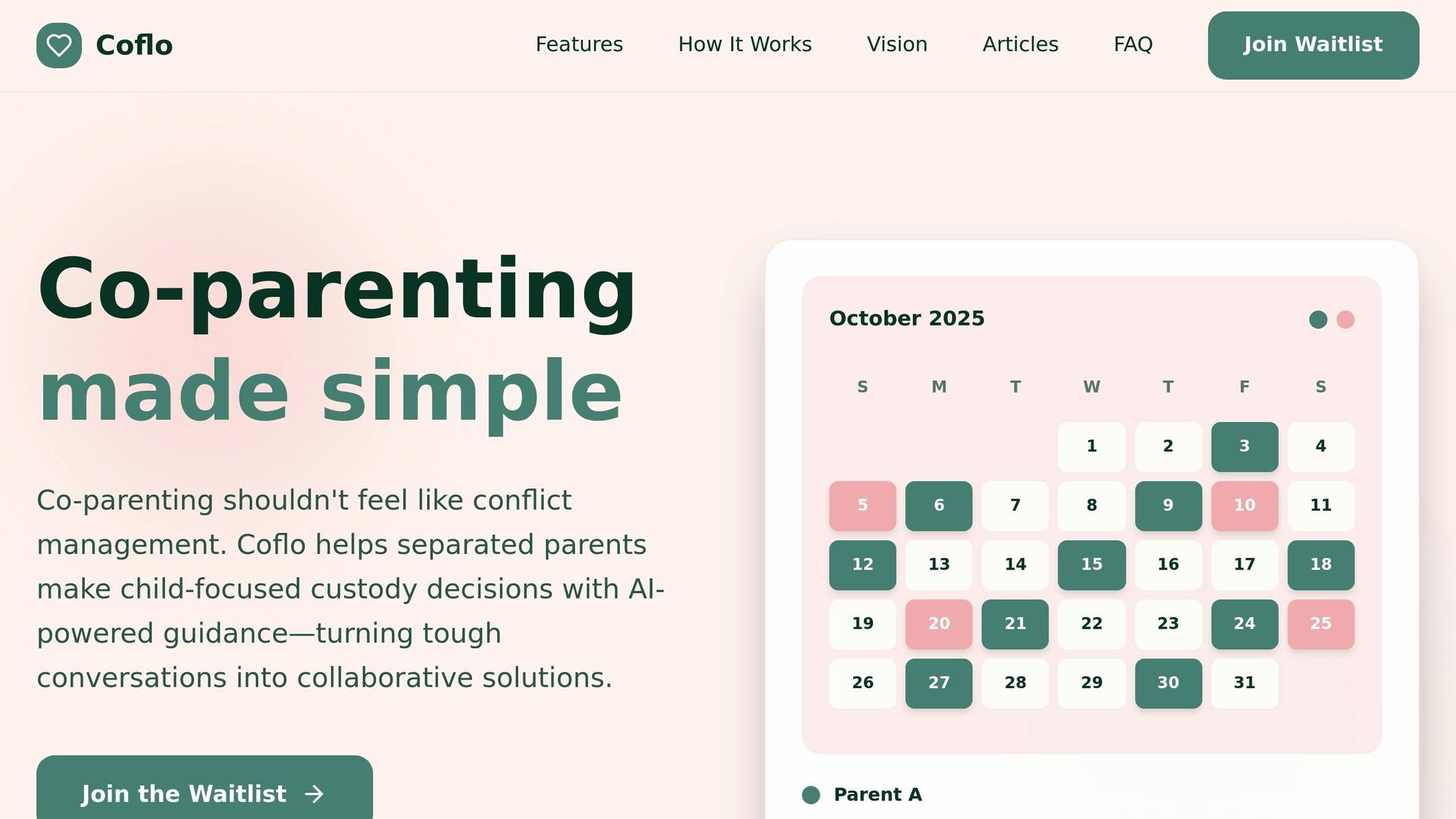
Coflo is designed to take the uncertainty out of custody planning by using artificial intelligence to align your family’s priorities with proven custody patterns. It starts with an intuitive feature: priority sliders. These sliders let you customize factors like stability, equal parenting time, school consistency, flexibility, minimal transitions, and alternating weekends. As you adjust these priorities, the platform instantly recalculates and suggests custody schedules that best match your family’s needs.
Coflo evaluates over 10 custody patterns, ranking them based on the priorities you’ve set. This personalized approach ensures the recommendations are tailored specifically to your situation. To make the process even more effective, Coflo incorporates age-specific developmental guidance, recognizing that a preschooler’s need for routine differs from a pre-teen’s focus on social activities. Whether your child is 3–5, 6–9, or 10–12 years old, the platform provides recommendations suited to their developmental stage. Each suggestion comes with a detailed implementation roadmap, broken down into five clear steps, so you not only choose the right schedule but also understand how to put it into action.
Privacy is another key feature. Coflo uses end-to-end encryption and processes most data directly on your device, ensuring your family’s sensitive information remains secure as you explore different options.
Why Technology Helps with Custody Planning
Traditional custody planning often involves endless research, difficult conversations, and second-guessing. Technology platforms like Coflo simplify this process by bringing structure and objectivity to what can otherwise be a contentious and emotional task. By quantifying priorities such as stability and school consistency, these tools help keep the focus on what’s best for your child. For many parents, the sheer number of custody schedule options can feel paralyzing. AI-driven recommendations narrow these choices down to a few that align with your family’s unique needs, making decision-making far more manageable.
Another major benefit is how these tools encourage cooperation between co-parents. Instead of arguing over personal preferences, you can work together using objective insights to find solutions that prioritize your child’s well-being. This approach not only reduces conflict but also ensures that both parents feel heard and involved in the decision-making process.
Technology also provides professional-level insights without the high cost. Platforms like Coflo help you document your decisions, the reasoning behind them, and the steps for implementation, creating a clear record that can be useful in legal or mediation settings.
Most importantly, these tools help ensure that your custody plan remains child-centered. The age-specific guidance and developmental insights serve as constant reminders to prioritize your child’s growth and emotional health. This leads to long-term arrangements that are not only effective but also adaptable as your child’s needs change. By integrating these tools into your custody planning process, you can create a schedule that works for everyone while keeping the focus where it belongs - on your child’s well-being.
Creating a Plan That Works for Your Family
A well-thought-out custody plan isn’t just about splitting time - it’s about crafting a stable, child-centered structure that reduces conflict and supports your child’s well-being. By considering factors like your child’s age, school schedule, and extracurricular commitments, parents can create an agreement rooted in teamwork rather than personal convenience. This shared focus helps build a custody plan that can adapt as your family’s circumstances evolve.
The secret to a successful plan lies in clear and detailed agreements. Ambiguity often leads to confusion and disputes, so having a precise parenting plan is essential. Tools like technology platforms can simplify this process by offering structured ways to manage schedules, track shared expenses, and maintain open communication. These tools provide a solid framework for co-parents to work together efficiently.
Coflo makes this process easier by using priority sliders to help parents focus on what matters most - whether it’s stability, equal parenting time, or school consistency. With over 10 research-backed custody patterns ranked instantly, the platform takes the guesswork out of planning and minimizes potential disagreements.
What sets Coflo apart is its age-specific developmental guidance, which ensures your custody plan evolves alongside your child’s needs. This feature allows parents to make informed decisions at every stage of their child’s growth, ensuring the plan remains practical and effective.
By shifting the focus from individual preferences to collaborative decision-making, technology helps parents align on what’s truly best for their child. When both parents have access to objective insights tailored to their child’s age and situation, discussions naturally become more child-focused. This shared understanding fosters trust and strengthens co-parenting relationships.
The result? A custody plan that not only prioritizes your child’s well-being but also works seamlessly in everyday life. With clear priorities and adaptable tools, you can create an arrangement that supports your family’s needs while reducing conflict. Together with the earlier outlined steps, these principles set the stage for a custody plan that truly works.