
Co-Parenting Tips For High-Conflict Families
Co-parenting in high-conflict situations can feel overwhelming, but it’s possible to reduce tension and prioritize your child’s well-being with the right strategies. Here’s a quick summary of actionable steps to make co-parenting smoother:
- Create a detailed parenting plan using age-specific schedules: Specify schedules, exchange locations, financial arrangements, and decision-making responsibilities to avoid misunderstandings.
- Set communication rules: Use written communication (texts, emails, or apps) focused only on child-related matters. Keep responses calm and factual.
- Establish boundaries: Protect your mental health by setting physical, decision-making, and emotional boundaries.
- Use third-party tools: Co-parenting apps can organize schedules, track expenses, and document communication to minimize conflict.
- Keep factual records: Document interactions and expenses with accuracy to avoid disputes and provide credible evidence if needed.
- Support your child emotionally: Respond calmly to their concerns, maintain consistent routines, and avoid involving them in conflicts.
- Practice parallel parenting: Minimize direct interactions with your co-parent while maintaining a stable environment for your child.
- Apply the BIFF method: Respond to messages briefly, informatively, and firmly while keeping a neutral tone.
- Track expenses and patterns: Use clear systems for shared costs and document recurring issues to ensure accountability.
- Leverage AI tools for planning: Platforms like Coflo can help create child-focused custody schedules based on developmental needs.
These steps focus on reducing conflict, fostering stability, and prioritizing your child’s emotional health. By staying organized and calm, you can navigate high-conflict co-parenting more effectively.
1. Build a Detailed Parenting Plan That Covers All Situations
When dealing with high-conflict situations, a detailed parenting plan can make a world of difference. It helps shield your child from unnecessary disputes and cuts down on potential arguments. The problem with vague terms like "reasonable access" or "splitting holidays" is that they leave too much room for interpretation - and, unfortunately, manipulation. A well-thought-out plan eliminates this ambiguity by addressing potential questions upfront, reducing the need for constant back-and-forth communication.
Clarity is everything. For example, instead of saying "a mutually agreed-upon location", name a specific pick-up spot, such as "the parking lot of the League City Police Department". Similarly, replace general phrases like "parents will split Christmas break" with specifics: "Parent A will have the child from December 24 at 5:00 p.m. to December 25 at 3:00 p.m. in even years". This level of detail not only prevents arguments but also ensures the plan is enforceable.
Your parenting plan should cover key areas, including:
- Exchange logistics: Specify neutral locations, exact pick-up and drop-off times, and who handles transportation.
- Financial details: Outline cost-sharing arrangements for extracurricular activities, sports equipment, and school trips, along with reimbursement deadlines.
- Decision-making authority: Clearly assign responsibilities for major decisions related to education, healthcare, and religion.
Experts emphasize how effective this approach can be. Philip M. Stahl, Ph.D., a forensic psychologist and author of Parenting After Divorce, highlights this in his work:
"If you create a careful and well-thought-out parenting plan, you can save considerable aggravation later".
To further reduce conflict, define what qualifies as an emergency and require at least 48 hours' notice for any non-emergency schedule changes. Including a dispute resolution clause - like appointing a parenting coordinator or mediator - can also help prevent minor disagreements from spiraling out of control.
Another practical tip? Use school-based exchanges. For instance, one parent can drop the child off at school, and the other can pick them up. This eliminates the need for direct contact between parents. Gary Gottlieb, a family lawyer in Toronto, explains:
"High-conflict people look for loopholes, so it's best to formulate a plan that minimizes parental contact when children are being dropped off or picked up".
sbb-itb-a09457a
2. Set Clear Communication Rules
In high-conflict situations, every interaction has the potential to escalate tensions. That’s why it’s so important to establish clear communication rules right from the start. Think of your co-parenting relationship as a business partnership, with the shared goal of prioritizing your child’s wellbeing. This mindset helps maintain boundaries and reduces emotional triggers, complementing the structured plan you’ve already created.
Just like a solid parenting plan, these communication rules are essential for reducing conflict and safeguarding your child’s emotional health.
Stick to written communication - email, text, or co-parenting apps - keeping exchanges brief and strictly focused on matters related to your child. This creates a documented record of your conversations and keeps the focus on logistics, health, and education. Avoid personal topics or revisiting past disagreements.
Attorney Tammy Valentine emphasizes the value of this approach:
"The goal is to keep communications clear and productive between co-parents, especially when emotions are high and a simple conversation can easily lead to arguing".
Before responding to any message, use a "No-Response" filter. If a message contains false accusations, insults, or unrelated personal attacks, and it doesn’t directly concern your child’s immediate needs, it’s better to avoid replying. Focus only on topics like confirming appointments, agreeing on pickup times, or meeting school deadlines.
How you phrase things also matters. For instance, instead of asking, "Why didn’t you pay the doctor’s bill?" try, "What other bills need to be addressed before we can handle the doctor’s bill?". Or instead of saying, "You always change plans without telling me", reframe it as, "I feel concerned when plans change at the last minute". Small adjustments like these can reduce tension while still addressing key issues.
Another helpful strategy is implementing a 24-hour waiting period for non-urgent messages. Unless it’s an emergency, give yourself a full day to reply. This pause ensures your response is calm, thoughtful, and focused on your child’s best interests. Always write messages as if they might later be reviewed by a judge, attorney, or mental health professional. Following these guidelines, alongside your parenting plan, creates a consistent and child-centered approach to communication.
3. Define and Maintain Firm Boundaries
After setting communication rules, the next step is to establish clear boundaries that safeguard your mental and emotional health while reducing unnecessary conflict. These boundaries aren't about being uncooperative - they're about creating a stable and predictable environment for everyone. Here's how physical, decision-making, and emotional boundaries can help achieve this balance.
Physical boundaries are a great starting point. Your home should remain a private space where your co-parent cannot enter without explicit permission. If needed, consider changing the locks to ensure your privacy. For child exchanges, curbside pickups - where you stay in your car - or neutral locations like schools or community centers are excellent options. These arrangements minimize face-to-face interactions, which can often lead to unnecessary tension.
Decision-making boundaries are just as critical. Each parent should maintain full control over household routines during their parenting time, including rules, chores, and bedtimes. This consistency is especially important when developing age-appropriate holiday custody plans to reduce seasonal stress. If your co-parent suggests changes to your routine, treat their input as a suggestion, not a requirement. As Bill Eddy, Chief Innovation Officer at the High-Conflict Institute, explains:
"The focus should always be on the children and what's in their best interest. Sometimes stronger boundaries are worth fighting for... and other times it's best to be flexible".
Emotional boundaries are essential for protecting yourself from manipulation and unnecessary drama. High-conflict personalities often thrive on creating chaos to maintain engagement. To counter this, consider using the Grey Rock Method, which involves responding with minimal, factual answers to diffuse conflict. The Weinberger Law Group emphasizes:
"High-conflict personalities (HCPs) love to steamroll over other people's boundaries, so you'll have to be vigilant about keeping yours".
Lastly, establish a communication schedule for non-urgent matters. For example, designate specific times, like Tuesday and Thursday evenings from 7:00 to 7:30 PM, for discussions that aren't emergencies. This approach minimizes disruptions and reinforces that your personal time is off-limits. Licensed psychotherapist Jennifer Weaver-Breitenbecher highlights the importance of this:
"Safety matters. Boundaries allow both parents to feel as safe as possible interacting for the sake of the child".
4. Use Third-Party Tools for Handoffs and Messages
Switching all co-parenting communication to a neutral, dedicated platform can help minimize conflict. These tools combine texts, emails, and calls into a single, secure log that’s tamper-proof. This way, every message is timestamped and locked, offering a dependable record in case disputes arise.
Beyond just keeping a record, these platforms often come with features that encourage respectful communication. For instance, some use AI to flag aggressive language and suggest more neutral alternatives, helping to keep conversations focused on your child’s well-being. They also streamline co-parenting logistics with shared calendars, expense tracking, and document storage, ensuring interactions stay grounded in facts.
To further reduce stress, these tools offer smart notification settings like silent modes or scheduled digests, so you can review messages when you’re in the right frame of mind. And if your co-parent refuses to use the platform, some tools provide an independent documentation mode to still keep things organized.
5. Keep Factual Records Without Adding Emotion
In high-conflict situations, maintaining factual records is essential. Courts place greater trust in documentation created on the same day an event occurs rather than accounts written weeks or months later. Bill Eddy, LCSW, Esq., from the High Conflict Institute emphasizes this point:
"Information that is written down the same day as it happens is considered far more credible than something written a week or a month later".
This underscores the importance of recording interactions with accuracy and detail.
Focus on specifics: note exchange times, capture screenshots with timestamps, and include witness names when applicable. For health-related matters, log medication dosages, administration times, symptoms, and details of doctor visits.
When it comes to co-parenting updates, think of them as business records rather than personal complaints. For example, document your child’s school performance or feedback from teachers. If you’re caring for an infant, track feeding schedules, sleep patterns, and even diaper changes to ensure consistent care.
Store these records securely, such as in a password-protected cloud or a dedicated email account. Keep phone bills as proof of calls or texts occurring at specific times. This isn’t about being overly meticulous - it’s about creating a reliable record that prioritizes your child’s well-being and highlights your co-parenting efforts. Courts are more likely to favor parents who demonstrate effective co-parenting through organized and factual documentation.
Stick to the facts. For instance, write: "Co-parent arrived at 4:30 PM, 30 minutes after the scheduled 4:00 PM exchange". Letting the facts speak for themselves helps you avoid unnecessary arguments and keeps the focus on what truly matters.
6. Respond to Your Child's Concerns with Calm Reassurance
How you respond when your child is upset plays a big role in shaping their emotional health. Instead of labeling your co-parent as "high-conflict" in front of your child, focus on teaching them the "Four Big Skills": flexible thinking, managing emotions, moderating behaviors, and self-checking. These skills empower your child to build resilience without involving them in any negativity toward the other parent.
If your child mentions their other parent's anger, try reframing the situation neutrally: "Some people find it harder to manage their emotions than others. What matters is that we can manage our own emotions, even when others can't." This approach avoids reinforcing negative perceptions while offering a constructive perspective. Similarly, when your child shares feelings of frustration, validate their emotions with empathy: "I can see why you felt angry in that moment." Acknowledging their experience in this way supports them emotionally without fueling conflict.
You can also model these skills in everyday life. For example, stay calm when stuck in traffic or take a moment to breathe before replying to a frustrating email. Research involving thousands of parents highlights stress management as one of the top three parenting skills.
Transitions between homes can be tough for kids, so creating consistent routines can help. Maybe you read a favorite book together or prepare a meal they love when they return. Simple rituals like these provide comfort and stability. Also, give your child some "down time" before diving into deeper conversations, as they may need space to decompress. If emotions run high despite these efforts, a quick "time-out" can help everyone regain their balance.
When discussions about the other parent become too intense, try the "time-out" technique: calmly let your child know you need a break and promise to revisit the conversation within 24 hours. Above all, keep adult issues like court disputes, financial disagreements, or legal documents completely out of your child's world. Share those frustrations with a trusted friend or therapist instead. Communicate directly with your co-parent through email or text, and avoid making your child a go-between.
7. Put Child Needs and Routines Before Arguments
Focusing on "winning" arguments with your co-parent can do more harm than good, especially when it disrupts your child's sense of stability. Research has shown that prolonged high conflict negatively impacts children of divorced parents, creating unnecessary stress and emotional strain. What your child truly needs isn’t a parent who always wins debates - they need consistency. Whether it’s arriving on time for soccer practice or maintaining a regular bedtime, sticking to routines provides them with a sense of security.
Instead of engaging in endless disagreements, focus on outcomes that benefit your child. Consistent routines help create a stable environment, even in the midst of high-conflict situations. This approach aligns well with the concept of parallel parenting, which allows you to minimize direct interactions with your co-parent while maintaining a strong relationship with your child.
Parallel parenting can be a game-changer. This model lets each parent manage their household independently, enforcing their own rules without constant negotiation. Bill Eddy, LCSW, Esq., Chief Innovation Officer at the High-Conflict Institute, explains:
"Each parent should have sole decision-making authority in his or her home regarding rules and responsibilities, bedtimes and chores, during his or her parenting time".
By reducing the need for direct communication, parallel parenting minimizes conflict and protects your child’s emotional stability. Consistent routines also help children adapt more easily, even when household rules differ. If your child expresses confusion about these differences, acknowledge their feelings without assigning blame. For example, you might say, "Different homes can have different rules, and that's okay."
The key is to make decisions based on what’s best for your child, rather than reacting to your co-parent’s actions. As Custody X Change advises:
"Make the decisions you believe are best for your child irrespective of what your co-parent is doing".
Whether it’s sitting far apart at your child’s basketball game or sticking to a bedtime routine that helps them feel secure, prioritizing their needs and emotional wellbeing over arguments can make all the difference.
8. Use the BIFF Communication Method
When it feels like every text from your co-parent is bait for an argument, the BIFF Communication Method can help you respond without escalating the situation. Created by Bill Eddy of the High Conflict Institute, BIFF stands for Brief, Informative, Friendly, and Firm. It’s a structured approach to written communication, specifically designed for high-conflict situations. By keeping responses clear and unemotional, this method aligns with rules for structured communication and avoids triggering unnecessary conflict.
The key is to strip away the emotional energy that high-conflict personalities often feed on. As BestInterest explains: "The BIFF method works by starving them of this 'narcissistic supply.' By keeping your response Brief (short), Informative (just the facts), Friendly (neutral tone), and Firm (clear boundary), you give them nothing to argue with, which often stops the conflict cycle". For instance, instead of a long explanation, you might say: "I can't switch weekends this month due to a prior commitment. I'm available to discuss makeup time on Tuesday or Thursday. Please reply by 5:00 PM on February 14th."
Before replying, ask yourself if a response is even necessary. If the message is filled with insults or baseless accusations and lacks actionable details like schedules or appointments, it’s often better to ignore it. When a reply is unavoidable, avoid the "Three A's": Admonishments (criticizing their behavior), Advice (telling them what to do), and Apologies (which can be misinterpreted as admissions of guilt in high-conflict dynamics).
Keep your messages concise - ideally just one paragraph - and stick to logistical topics like schedules, health updates, or school matters. Start with a neutral greeting and close with a polite sign-off to maintain a professional tone. It’s also helpful to include a clear boundary or deadline to avoid endless back-and-forth. For example, you could write: "Can you confirm pickup at 6:00 PM on Friday? Please respond by Wednesday at noon."
Before sending, review your message to remove any emotional language, justifications, or defensive explanations. Always write with the awareness that your communication might later be reviewed by a judge or attorney. By keeping your responses brief and structured, you not only protect your own peace of mind but also help maintain a stable emotional environment for your child. This disciplined approach reinforces the broader co-parenting strategies discussed earlier, ensuring a calmer, more focused way to navigate high-conflict interactions.
9. Track All Interactions and Expenses in Detail
Keeping detailed records of every interaction and expense is essential for protecting your interests. Relying on memory alone can lead to misunderstandings or disputes. By documenting everything, you create a clear and accountable system. Family law attorney Elizabeth Burchell emphasizes this point:
"A solid tracking plan detailed in the parenting plan in the first place will reduce conflict in the future".
Using a centralized platform that generates unchangeable, timestamped records for messages, expenses, and schedule changes can be a game-changer. Family law attorney Jon Stief highlights the challenges of communication in co-parenting:
"If it was easy to communicate, then many co-parents could avoid family law litigation. The evidence tells us communication is not easy, particularly around financial issues".
When managing shared expenses, organize them into clear categories like uncovered medical costs, extracurricular activities, educational expenses, and childcare. Upload receipts as soon as possible and establish reimbursement deadlines in your parenting plan. For example, you might require proof of payment within 30 days, with missed deadlines waiving the right to collect. These measures can eliminate confusion and avoid drawn-out arguments.
It’s also important to track patterns rather than isolated events. A single late pickup might not be a big deal, but consistent lateness over time can reveal a troubling trend. Record specifics like the date, time, details of the incident, witness names, and any follow-up actions to build a stronger case for recurring issues. If you’re taking screenshots of text messages, make sure the phone number (not just the contact name) is visible, along with the date and time.
Detailed documentation can encourage better behavior. As TalkingParents user Meghan Kelly explains:
"Because I'm able to regulate my responses and take a little bit more control of the communication with my ex-husband through the app, my kids aren't suffering like they used to".
10. Use Coflo for AI-Powered Schedule Recommendations
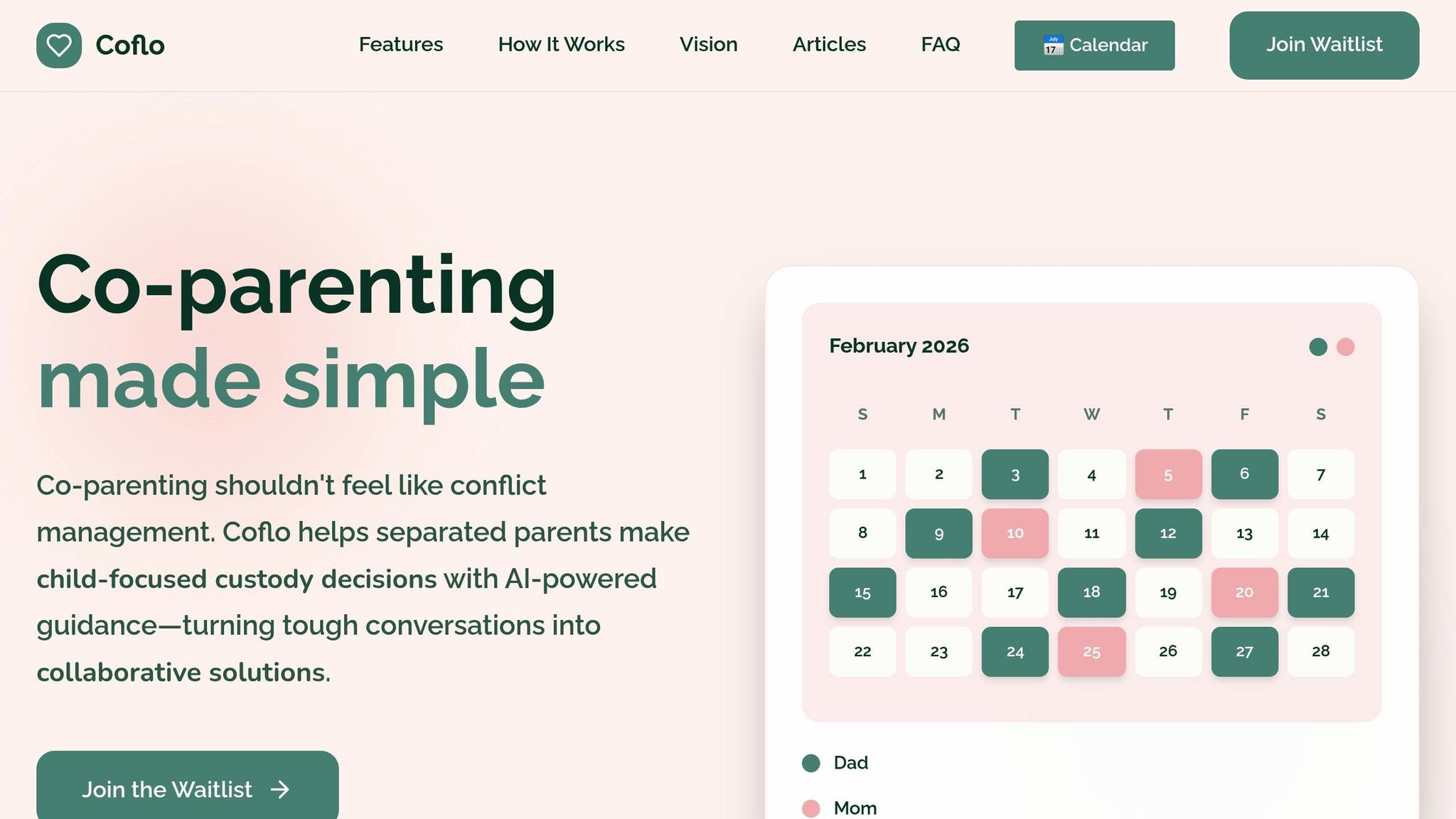
Once you've established detailed parenting plans and clear communication, tools like Coflo can take schedule management to the next level. This AI-powered platform analyzes your family's priorities - like stability, equal time, school routines, and fewer transitions - and quickly creates custody schedules tailored to your child's needs. Even better, each recommendation includes insights from developmental psychology, showing why a specific schedule might work better for a 4-year-old than for a 12-year-old.
These schedules don't just give you a plan - they outline the benefits, key considerations, and actionable steps for implementation. By removing subjective bias, Coflo ensures custody arrangements are based entirely on your child's developmental needs. For families dealing with high-conflict co-parenting, where even minor decisions can require third-party mediation, this tool offers a way to cut through the noise with research-backed guidance. Instead of spending hours digging into custody patterns, you get expert recommendations in seconds.
Coflo also works around the clock, offering instant suggestions for visitation plans, including holiday and vacation schedules. It provides this guidance at a fraction of what professional mediators charge, helping families make informed decisions without the financial burden of repeated sessions. Plus, the platform adapts in real-time, adjusting recommendations as family dynamics evolve.
One standout feature is the ability to tweak priority sliders. For example, if your co-parent values equal time while you prioritize school consistency, you can see how different preferences impact the schedule. In cases where strict adherence to a schedule becomes a control tactic rather than a tool for stability, Coflo shifts the focus back to what matters most: your child's well-being. And with its affordable pricing, Coflo offers a cost-effective way to create thorough, child-centered parenting plans.
Comparison Table: Generic vs. Detailed Parenting Plans
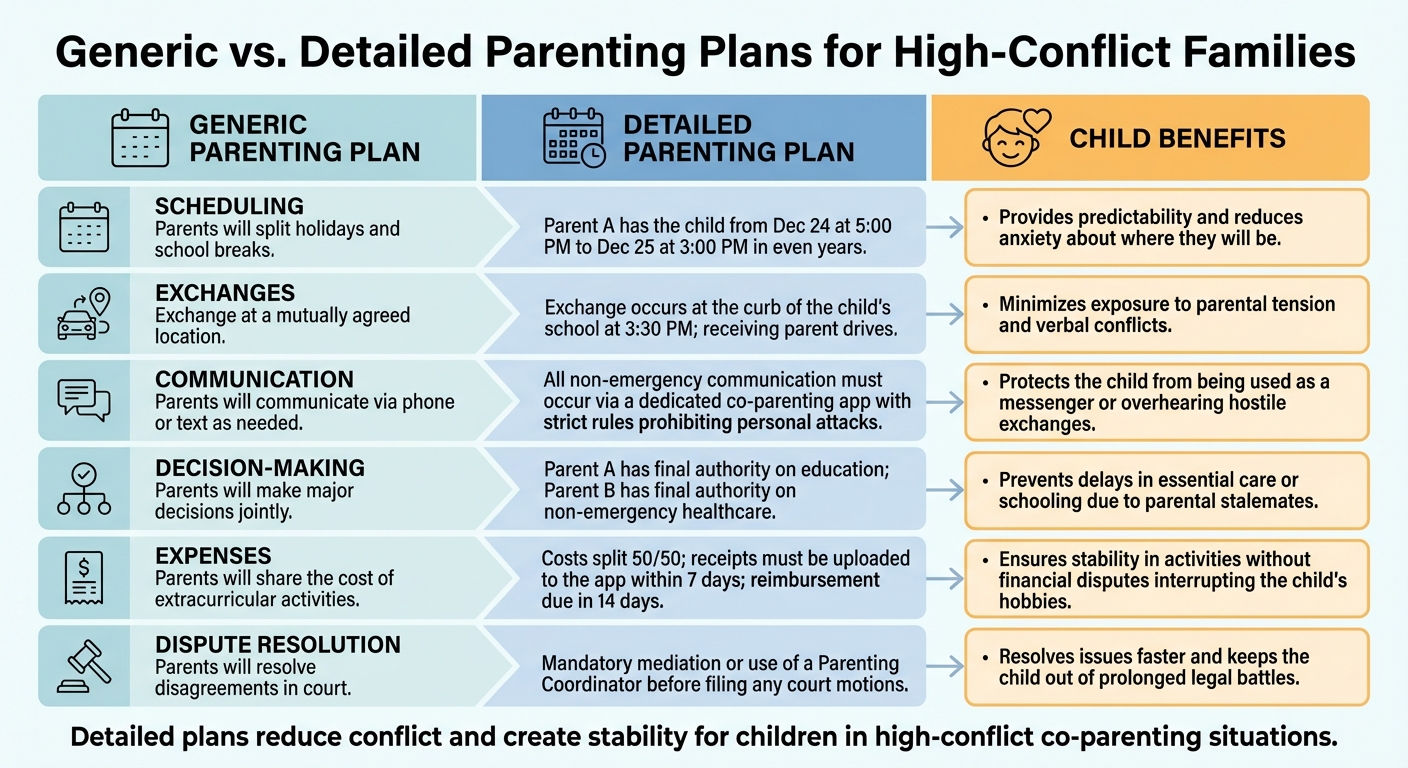
Generic vs Detailed Parenting Plans: High-Conflict Co-Parenting Comparison
In high-conflict co-parenting situations, the difference between a generic plan and a detailed one goes beyond words on paper - it can shape your child’s day-to-day life. Generic plans often use broad, undefined terms, leaving room for disagreements. On the other hand, detailed plans spell out exact times, locations, and responsibilities, eliminating ambiguity and reducing opportunities for conflict.
Take this example: a generic plan might say "exchange after school", leaving parents to interpret the details. A detailed plan would specify, "Exchange occurs at the curb of the child's school at 3:30 PM; receiving parent drives." This level of clarity not only prevents arguments but also spares your child from witnessing tense moments.
The table below illustrates how detailed parenting plans address common issues in high-conflict situations, offering stability and predictability for your child.
| Aspect | Generic Approach | Detailed Approach (High-Conflict) | Child Benefits |
|---|---|---|---|
| Scheduling | "Parents will split holidays and school breaks." | "Parent A has the child from Dec 24 at 5:00 PM to Dec 25 at 3:00 PM in even years." | Provides predictability and reduces anxiety about where they will be. |
| Exchanges | "Exchange at a mutually agreed location." | "Exchange occurs at the curb of the child's school at 3:30 PM; receiving parent drives." | Minimizes exposure to parental tension and verbal conflicts. |
| Communication | "Parents will communicate via phone or text as needed." | "All non-emergency communication must occur via a dedicated co-parenting app with strict rules prohibiting personal attacks." | Protects the child from being used as a messenger or overhearing hostile exchanges. |
| Decision-Making | "Parents will make major decisions jointly." | "Parent A has final authority on education; Parent B has final authority on non-emergency healthcare." | Prevents delays in essential care or schooling due to parental stalemates. |
| Expenses | "Parents will share the cost of extracurricular activities." | "Costs split 50/50; receipts must be uploaded to the app within 7 days; reimbursement due in 14 days." | Ensures stability in activities without financial disputes interrupting the child's hobbies. |
| Dispute Resolution | "Parents will resolve disagreements in court." | "Mandatory mediation or use of a Parenting Coordinator before filing any court motions." | Resolves issues faster and keeps the child out of prolonged legal battles. |
When co-parenting involves conflict, precision matters. A detailed plan reduces misunderstandings, minimizes arguments, and shields your child from unnecessary stress. By closing loopholes and setting clear expectations, these plans create a more stable environment for your child, where they can focus on being a kid rather than worrying about adult disputes.
Conclusion
Co-parenting in a high-conflict situation demands clear rules, firm boundaries, and a commitment to prioritizing your child above all else. The strategies shared here are effective because they eliminate uncertainty, establish accountability, and help protect your child from being caught in adult disagreements. Treating co-parenting as a professional partnership reduces the chances for conflict to escalate.
Your child is observing how you handle tough situations, set limits, and manage challenging relationships. By staying composed, keeping thorough records, and focusing on their routines rather than disputes, you're teaching them valuable coping skills they can carry into the future. Even when direct collaboration feels out of reach, managing your stress and practicing healthy relationship habits can guide your choices. As noted in The Family Court Workbook:
"The goal isn't to cooperate - it's to reduce conflict".
Using these strategies, you can shift from constant conflict to a more constructive approach to co-parenting. Tools like Coflo can make this process easier by streamlining custody planning. Instead of endless debates over schedules, Coflo uses AI-driven recommendations to suggest plans that match your priorities - whether it's maintaining stability, equal time, or school consistency. These recommendations are backed by insights from developmental psychology and come with clear benefits, potential considerations, and step-by-step guidance, turning custody planning into a calm, informed process.
With structured plans and helpful tools, every decision you make can support your child's well-being. They deserve a stable, predictable environment free from unnecessary conflict. By adopting these strategies and using the right resources, you can create a space where they can truly thrive, even amidst co-parenting challenges.