Co-Parenting in Blended Families: Tips
Co-parenting in blended families comes with unique challenges - defining roles, managing schedules, and balancing emotions. Here's how to make it work:
- Create Child-Focused Schedules: Tools like Coflo help customize age-specific custody schedules based on your child’s developmental needs.
- Communicate Respectfully: Keep discussions focused on the child, use "I" statements, and leverage shared digital tools for clarity.
- Maintain Consistency: Align routines like bedtimes and homework rules across households to provide stability.
- Define Stepparent Roles: Let biological parents handle discipline initially while stepparents build trust.
- Present a United Front: Agree on major decisions privately to avoid conflicts in front of children.
- Avoid Negativity: Never criticize the other parent in front of kids to prevent loyalty conflicts.
- Build Trust Gradually: Let stepchildren set the pace for bonding without forcing relationships.
- Keep Both Parents Involved: Active participation from both biological parents strengthens emotional security. Research also shows that stable joint custody can benefit cognitive development.
- Stay Flexible: Life happens - be open to adjusting schedules while prioritizing the child’s stability.
- Work as a Team: All caregivers should collaborate with the shared goal of the child’s well-being.
- Prioritize Kids’ Needs: Always ask, “How does this benefit the child?” when making decisions.
Blended families take time - about four years on average - to find their rhythm. Patience, teamwork, and a child-first approach can create a stable, supportive environment for everyone.
1. Use Coflo to Create Child-Focused Custody Schedules
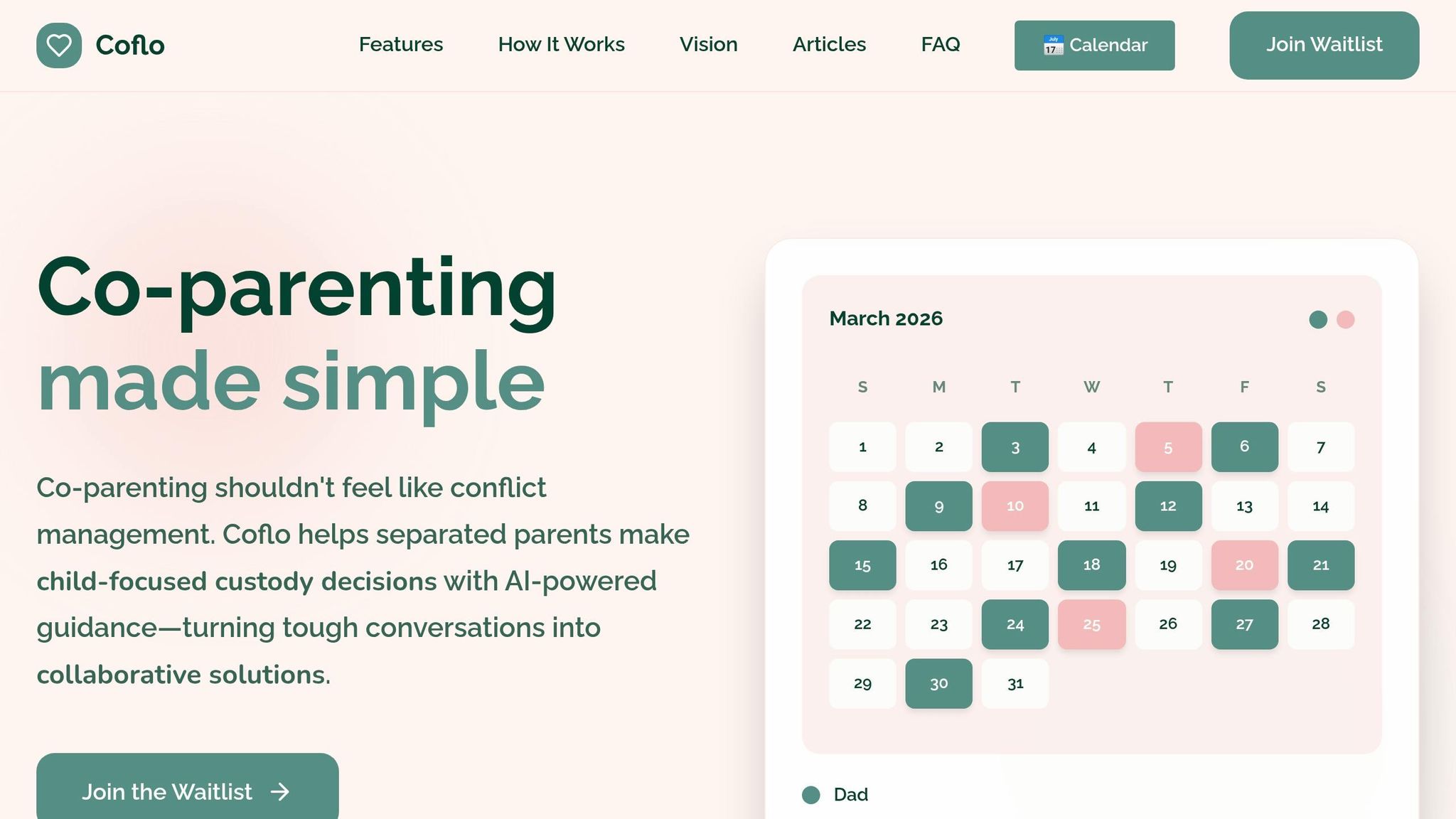
Navigating custody schedules in blended families can be tough. Traditional approaches often involve drawn-out negotiations and subjective decisions, which don’t always align with a child's developmental needs. That’s where a precise, data-driven tool like Coflo comes in.
Coflo takes into account factors like work schedules, travel distances, school routines, extracurricular activities, and even your child’s age to create customized, research-based custody recommendations. You can tweak priority sliders to focus on things like stability, equal parenting time, school consistency, or flexibility, resulting in a schedule tailored to your family’s needs. This kind of structured decision-making supports a child-centered approach that’s key to successful co-parenting in blended families.
What makes Coflo stand out is its ability to provide age-specific recommendations. For instance, toddlers thrive on frequent interactions with both parents to build secure attachments, while teens often need longer, more flexible time blocks to balance their busy social lives [6, 11]. Each suggestion comes with a clear explanation, so you can see how it aligns with your child’s developmental stage.
To get started, input your family’s priorities - such as work commitments, travel demands, or your child’s unique needs. Coflo then delivers AI-generated schedules that you and your co-parent can review together. The neutral, well-reasoned suggestions can help resolve disputes over tricky logistics like travel times or age-appropriate holiday custody plans. This streamlined process keeps the focus where it belongs: on your child’s wellbeing.
sbb-itb-a09457a
2. Communicate Openly and Respectfully
Once you’ve created a child-specific schedule, the next step is ensuring clear and respectful communication to make it work smoothly.
Think of co-parenting as a professional partnership. With blended families juggling multiple households, structured communication becomes essential. As Lindsay Cameron, a co-parenting coach, explains:
"You can only control you, you can only control how you show up. And if you would want something communicated with you, communicate it with your co-parent."
Focus your conversations strictly on your child's needs - like school schedules, medical updates, or upcoming activities - and steer clear of personal grievances.
When discussing sensitive topics, use "I" statements to express your feelings without assigning blame. For instance, instead of saying, "You never tell me what's going on", try, "I feel overwhelmed when plans aren't discussed in advance." Cameron also advises pausing before responding:
"Don't write what you want to say in this moment and press send because you won't be happy with yourself later that you did that."
Take a moment to calm down and craft a thoughtful response instead of reacting emotionally.
Technology can also help simplify communication and reduce tension. Shared digital calendars like Google Calendar or co-parenting apps can keep everyone on the same page by tracking schedules, expenses, and messages. These tools also create a clear record of communication, which can minimize misunderstandings.
For more complex discussions - like logistics or finances - periodic "business meetings" in a neutral setting (such as a coffee shop) can help. Keeping these meetings child-free allows both parents to focus and address issues calmly.
Active listening is another key skill. Reflect back what the other parent says to ensure you’ve understood correctly. And don’t forget to acknowledge small wins - something as simple as saying "thank you" when your co-parent handles a task well can build trust and help you work together more effectively.
Respectful and consistent communication is the foundation of any successful co-parenting arrangement in blended families.
3. Keep Routines and Rules Consistent Across Homes
Consistency in routines and rules can bring a sense of stability to a blended family’s dynamic. Children tend to thrive when they know what to expect, and in blended families, maintaining similar routines across households makes transitions easier. When things like bedtimes, homework expectations, and screen time rules are aligned, kids feel more secure because they can anticipate what comes next.
Aurisha Smolarski, LMFT, explains it well:
"A child needs boundaries that are clear and firm, yet loving and respectful, to feel safe and secure in their environment. You can think of this as a safety net they can carry with them between their two homes."
That doesn’t mean both households need to mirror each other exactly. Instead, aim to align on the basics, like discipline methods, chore responsibilities, and daily routines. For example, agreeing on a 9:30 PM bedtime - when one home leans toward 9:00 PM and the other prefers 10:00 PM - can reduce confusion and make transitions smoother for everyone involved. These consistent routines complement custody schedules, giving kids a steady foundation no matter where they are.
If rules differ between homes, acknowledge your child’s feelings. You might say, “I understand it’s confusing that rules are different at your dad’s house.” This kind of validation helps them process their emotions without feeling stuck in the middle. And while you can’t control the rules in the other household, stay consistent in your own home and avoid criticizing the other parent’s approach in front of the kids.
To support this consistency, shared digital tools can be a game-changer. They help keep everyone on the same page, making transitions between households smoother and reducing potential misunderstandings.
4. Set Clear Roles and Boundaries for Stepparents
Clearly defining roles for stepparents can help avoid confusion and reduce potential conflicts. Statistics show that 20% of U.S. households include at least one stepparent. When stepparents attempt to take on a full parenting role too quickly, it often leads to resistance from children and feelings of being undermined by the other biological parent.
In the early stages, discipline should remain the responsibility of the biological parent. Stepparents are often more effective as mentors or supportive figures rather than stepping into a parental role. Dr. JoAnne Pedro-Carroll, a Clinical Psychologist, emphasizes this dynamic:
"A healthy boundary and role for a stepparent is to support the children's primary parent in having healthy limits."
Before blending households, it’s vital for couples to discuss and assign responsibilities. This includes tasks like discipline, household chores, school drop-offs, and daily routines. Reviewing custody agreements is also critical, as these may outline specific rules about who can pick up children or attend parent-teacher meetings. For example, when enforcing rules, stepparents should reinforce the biological parent’s authority by referring to their decisions (e.g., "Your dad said games are only for after homework").
Letting children decide what they want to call their stepparent and setting their own boundaries for physical affection can make the relationship feel more natural. Pushing for a parental bond often backfires. Additionally, stepparents should steer clear of offering unsolicited advice during conversations between the biological parents. As Jenna Korf, a Certified Stepfamily Foundation Coach, explains:
"The ex didn't agree to co-parent with you and will likely feel ganged up on if you give unsolicited advice."
It can take stepfamilies about three years to feel fully integrated, and older children may need even more time to accept a stepparent's role. By maintaining patience and respecting boundaries, families can allow relationships to develop naturally, creating a smoother adjustment for everyone involved.
5. Present a United Front on Major Decisions
When it comes to education, healthcare, and discipline, all adults in a blended family need to work together and speak with one voice. Research shows that children in co-parenting situations thrive when adults make decisions cooperatively. In fact, kids raised by cooperative co-parents tend to show fewer behavioral issues compared to those in high-conflict environments. The goal is to provide consistency, not conflict.
Have private discussions first. Before announcing decisions - whether about curfews, school rules, or medical care - parents and stepparents should agree in private. Jessica Patterson, a Licensed Professional Counselor, emphasizes this point:
"If an agreement needs to be reached, they discuss it privately, away from the kids".
This approach helps avoid situations where children, especially those aged 10 to 14, try to play one adult against another or undermine a stepparent's authority.
Although stepparents play an important role in offering input and support, biological parents usually have the final say on major disciplinary decisions. The stepparent’s job is to publicly support those decisions, even if their personal approach might differ. A united front doesn’t mean everyone parents in the exact same way - it means all adults back each other up and enforce the same overarching rules.
To stay organized, consider using co-parenting apps to manage schedules for school events, medical appointments, and extracurricular activities. Treat co-parenting like a professional partnership: communication should be respectful, clear, and focused on the child’s best interests. Dr. Kathryn Jones, a Pediatric Psychologist at Cleveland Clinic, advises:
"Focusing on one problem at a time and collaboratively brainstorming solutions makes management simpler".
By combining clear communication with technology, blended families can create a unified strategy that benefits everyone.
Transitions take time, and blended families need space to adjust. However, presenting a united front on major decisions provides the consistency kids need to feel secure during these changes.
6. Never Speak Negatively About Other Parents
Children see both parents as key parts of who they are. So, when you criticize the other parent - whether it's your ex or a stepparent - your child may interpret it as criticism of themselves. Co-parenting expert Christina McGhee puts it this way:
"When kids hear something negative about a parent - even if it's true - they tend to take it in as something bad or undesirable about themselves."
This kind of negativity can lead to lasting emotional challenges.
Speaking poorly about the other parent can create "loyalty binds", where a child feels pressured to pick sides. This can stir up guilt, confusion, and even emotional distress. Research shows that constant criticism can increase a child’s anxiety, depression, and stress levels. In a survey of over 500 co-parents, mental health experts found that kids exposed to parental negativity were more likely to struggle with low self-esteem and even regress in their behavior.
Sometimes, badmouthing isn’t as obvious as direct insults. It can show up in subtle ways - like sighing when the other parent is mentioned, complaining about financial arrangements in front of the kids, or brushing off their positive experiences in the other household. Even small comments can send a message that one parent is "better" than the other, which can shake a child’s sense of stability. Maintaining consistent routines across both homes can help counteract this instability.
To avoid these harmful effects, make it a point to express frustrations in private - talk to a therapist, a trusted friend, or a support group, but never vent where your children can hear. Use neutral or respectful terms like "Mom" or "Dad" instead of "my ex." If you’re dealing with specific issues, document them for legal purposes rather than reacting in front of your child. As family law attorney Kelly Parks aptly states:
"If you are spending more time playing gotcha games than you are parenting, you're doing it wrong."
Your child’s relationship with the other parent is separate from your personal feelings. By showing respect - even when it’s tough - you help your child feel secure and whole. This approach not only protects their emotional health but also reinforces the importance of keeping co-parenting focused on what truly matters: your child’s wellbeing.
7. Let Stepchildren Build Trust at Their Own Pace
When it comes to blended families, building trust with stepchildren is just as important as establishing routines and custody schedules. But here's the thing: you can't rush it. Trust isn't automatic - it has to be earned, and that takes time. Research highlights that it can take 3 to 5 years for stepparents and stepchildren to form strong bonds, and in some cases, it may take 7 to 12 years for a blended family to feel emotionally stable. The key? Patience and a steady, gradual approach.
Dr. Charles Fay, President of the Love and Logic Institute, shares an insightful analogy:
"Some kids are like dogs. If you pet them, they lick you. But other kids are like cats. If you run up to them, they run away. But when you sit quietly, they eventually come over and rub all over you."
This comparison is a great reminder to take things slow. Many stepchildren are like the "cats" in Dr. Fay's example - they need space and time to feel comfortable. Start by being a supportive, non-intrusive presence rather than trying to step into a parental role right away.
One way to ease into the relationship is by engaging in low-pressure activities. Think about grabbing ice cream, taking a walk, or playing a casual game - anything that encourages conversation without the intensity of direct eye contact. Instead of asking questions that feel like chores ("Did you finish your homework?"), go for open-ended, nurturing ones like, "What did you think of that movie?". In the beginning, let the biological parent handle discipline to avoid creating unnecessary friction or resentment.
Physical boundaries are another area where patience is key. Let the child decide when they're ready for gestures like hugs or high-fives. It’s also important to acknowledge their feelings. Say things like, "It makes sense this feels weird", or "Change is hard", to validate their emotions. Many children in blended families wrestle with loyalty conflicts, feeling that liking a stepparent might betray their other biological parent. Recognize this struggle and don't take it personally.
As Casaspsi.com puts it, "Trust isn't built in big speeches. It's built in ordinary Tuesdays", and "Slow is smooth. Smooth is fast. Trust grows slowly. Push too hard and you'll stall everything." Celebrate small wins - a shared laugh, a thoughtful question, or even a simple request for help. These little moments are the building blocks of trust, and over time, they can form the foundation for a strong, lasting bond in your blended family.
8. Keep Both Biological Parents Actively Involved
It's crucial for both biological parents to stay actively involved in their child's life. Kids naturally want to feel loved by - and be able to love - both parents. When this connection is nurtured, children are less likely to feel torn or pressured to choose sides, which can otherwise lead to resentment. Active engagement from both parents provides the emotional support and stability children need, especially during periods of change. Achieving this requires clear communication and well-coordinated schedules.
Studies indicate that children raised in cooperative co-parenting arrangements experience fewer behavioral issues and often have stronger relationships with their fathers compared to those in conflict-heavy co-parenting situations. The message is clear: consistent involvement from both parents isn't just helpful - it plays a critical role in a child's overall well-being. This approach also aligns with the child-centered custody strategies discussed earlier.
Direct communication between co-parents is essential. Avoid relying on intermediaries, as this can lead to misunderstandings. As HelpGuide emphasizes:
"The key to successful co-parenting is to separate the personal relationship with your ex from the co-parenting relationship".
Think of co-parenting as a partnership where the "business" at hand is your child's happiness and future. Tools like co-parenting apps and shared calendars can make things easier by streamlining the coordination of school events, medical appointments, and visitation schedules, reducing unnecessary back-and-forth.
Biological parents should take the lead on discipline and major decisions, while stepparents play a supportive role. This is particularly important for children aged 6 to 18, who may struggle to accept authority from a stepparent. When biological parents maintain authority, it creates clear boundaries and reduces potential conflicts within the household.
Preserving traditions and routines that involve both biological parents can also help. Whether it's a weekly phone call, alternating holidays, or continuing a cherished family tradition, these consistent touchpoints reassure children that their lives remain stable despite changes. As the Divorce Recovery Center points out:
"Their child wants to be loved by and allowed to love both parents. Disparaging the other parent will only trigger resentment toward you".
9. Stay Flexible with Schedules and Arrangements
Life rarely sticks to a script, and strict schedules can sometimes add unnecessary tension for everyone involved. Things like work emergencies, school functions, or sudden illnesses can pop up and force last-minute adjustments. The trick is to allow some flexibility in your co-parenting plan while keeping your child's sense of stability at the forefront of every decision.
When schedules shift, children might feel anxious or even rejected. To help ease these feelings, experts suggest notifying the other parent of any changes at least 24 hours in advance - unless it’s a genuine emergency - and documenting these changes through text or email to avoid confusion or disputes.
Including clear terms in your parenting plan can also help maintain consistency. For example, consider adding a "Right of First Refusal" clause. This allows the other parent to step in and care for the child if the scheduled parent has a conflict, ensuring that time with a parent takes precedence over third-party care.
Shared digital tools and AI can make managing schedules easier. Apps or shared calendars can help both parents stay on the same page and make adjustments with less stress. If disagreements arise and persist after three attempts to resolve them, seeking guidance from a mediator or parenting coordinator can be a practical next step.
As Divorce.com Staff wisely puts it:
"It's not the divorce that hurts kids but the conflict between their parents".
For older children, keeping them informed about schedule changes can show respect for their routines and help them feel more secure.
10. Work as a Team Across All Households
Blended families thrive when all adults - whether they’re biological parents, stepparents, or other caregivers - operate as a cohesive team. Think of it like managing a project where everyone shares the same objective: the child’s well-being. Attorney Andrew Bonderud emphasizes this approach, stating, "Blended families work best when all parents, stepparents, and caregivers function as a team. Approach parenting challenges together rather than in opposition".
To create this sense of unity, clear communication and consistent routines are essential, but defining roles is equally important. Typically, biological parents take the lead on major decisions and discipline, while stepparents offer support without stepping into the role of the other biological parent. This balance helps reduce tension and ensures children feel secure, knowing exactly who is responsible for setting boundaries.
Consistency across households also plays a big role in minimizing stress and confusion for children. Shared digital tools, like family calendars or apps, can help everyone stay on the same page when it comes to schedules, appointments, and other important details. Open communication reinforces this teamwork, ensuring everyone feels included and informed.
Regular check-ins among caregivers can strengthen this collaborative dynamic. Brief meetings - preferably without the children present - are a good opportunity to discuss any concerns or upcoming decisions. If disagreements arise, addressing them privately and using "I" statements can help express feelings in a constructive way without escalating conflict.
The advantages of this unified approach are clear. Studies show that around 40% of children in the United States live in co-parenting situations, and those raised in cooperative environments tend to experience fewer behavioral issues and maintain stronger relationships with both parents. When all households work together, the child’s well-being naturally becomes the top priority.
11. Always Put Children's Needs First
When making decisions, always ask yourself: "How will this affect the child?" This mindset helps create an environment where children feel secure and supported, free from the weight of adult conflicts. Whether it's about custody schedules, household rules, or weekend plans, the child's wellbeing should always take priority.
Children's needs vary by age. For example, infants need frequent contact with both parents to form secure bonds. School-age children thrive with predictable routines and consistent expectations, like regular homework schedules. Teenagers, on the other hand, require more flexibility and a say in their own schedules. What works for a 7-year-old might feel overly restrictive to a 15-year-old seeking more independence. Children aged 10 to 14 often face the greatest challenges adjusting to stepfamilies and may resist a new adult taking on a disciplinarian role.
It's also crucial to shield children from feeling pressured to choose sides. Their core needs - security, love, and clear guidance - must remain at the heart of every decision. If a choice doesn't support these needs, it’s time to reconsider.
Here are a few practical ways to put children first:
- Keep duplicate essentials, like toothbrushes, pajamas, and favorite snacks, at both homes to make transitions smoother.
- Ensure consistency in key areas such as discipline, bedtime routines, and screen time rules across households. This helps reduce confusion for the child.
- Handle disagreements about parenting privately. Avoid arguing in front of children, and use "I" statements to discuss concerns without assigning blame.
"Your marriage may be over, but your family is not; acting in your kids' best interest is your most important priority." - HelpGuide
Blending families successfully takes time - on average, about four years to function optimally. Rushing the process can cause setbacks. Let children set the pace when it comes to bonding with stepparents, and emphasize that a blended family is an addition to their circle of support, not a replacement for their original family. A child-first approach not only strengthens the family but also ensures the happiness and stability of everyone involved.
Biological Parent vs. Stepparent Responsibilities
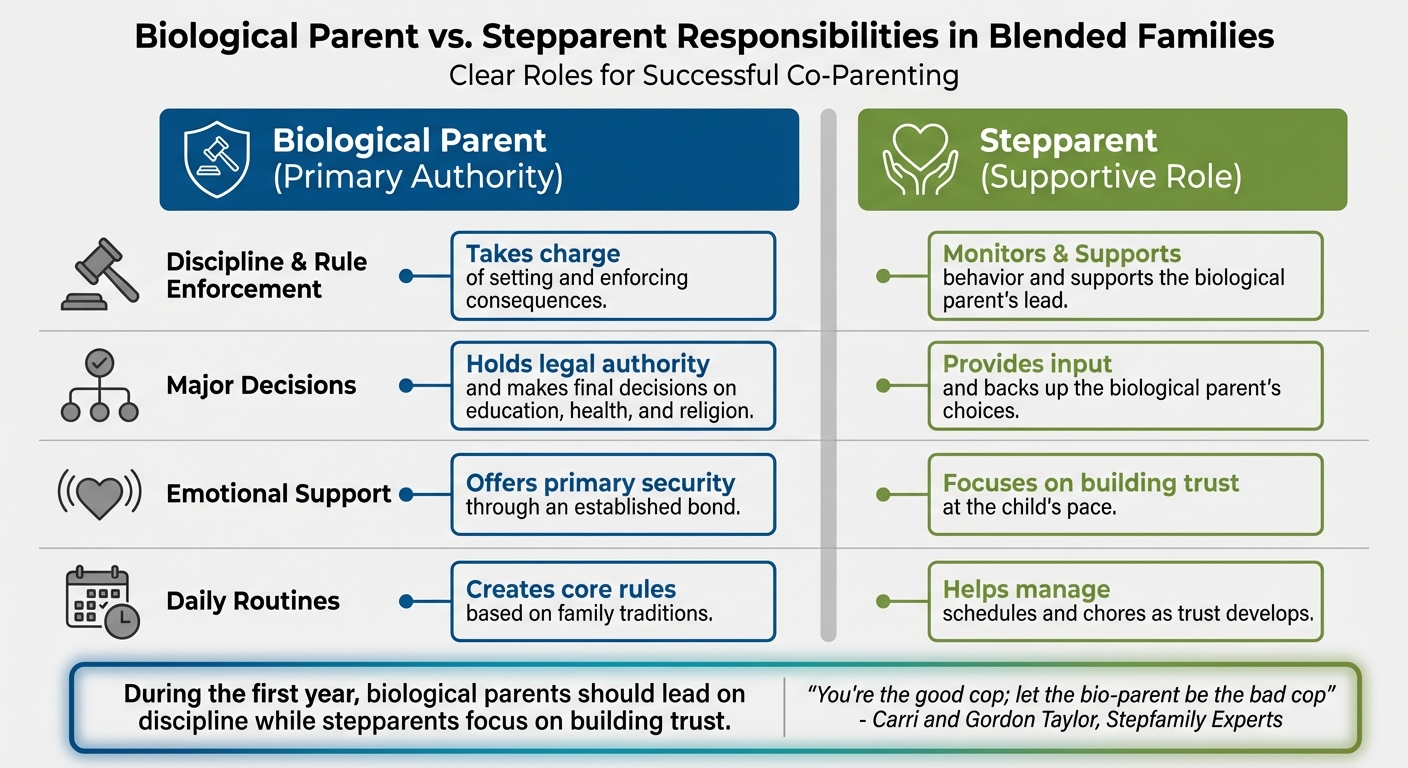
Biological Parent vs Stepparent Roles in Blended Families
It's essential to establish clear roles early on in blended families. During the first year, biological parents should take the lead on discipline and major decisions, allowing stepparents time to build trust before stepping into more authoritative roles.
Stepparents are most effective when they act as supportive figures, focusing on building positive relationships with the children while leaving rule enforcement to the biological parent. Think of the stepparent's role as that of an encouraging mentor. As stepfamily experts Carri and Gordon Taylor explain:
"You're the good cop; let the bio-parent be the bad cop. If there's a behavior for which your stepchild needs a consequence, let your spouse deal with it and support their decision."
This approach positions the stepparent as more of a caring mentor or trusted relative - like an aunt or uncle - rather than a primary disciplinarian. Such a division of responsibilities can ease household dynamics and help maintain a child-centered co-parenting environment.
Here’s a breakdown of responsibilities to help clarify these roles:
| Responsibility Area | Biological Parent Role | Stepparent Role |
|---|---|---|
| Discipline & Rule Enforcement | Takes charge of setting and enforcing consequences | Monitors behavior and supports the biological parent’s lead |
| Major Decisions | Holds legal authority and makes final decisions on education, health, and religion | Provides input and backs up the biological parent’s choices |
| Emotional Support | Offers primary emotional security through an established bond | Focuses on building trust at the child’s pace |
| Daily Routines | Creates core household rules based on family traditions | Helps manage schedules and chores as trust develops |
This structured approach helps ensure that both biological parents and stepparents work together effectively, creating a stable and nurturing environment for the children.
Conclusion
Co-parenting in blended families can be challenging, but it’s entirely possible when the focus stays on what truly matters: your children's stability and emotional well-being. Studies suggest it takes about four years for blended families to find their rhythm, so patience and persistence are key.
The cornerstone of successful co-parenting is open, respectful communication and a strong sense of teamwork between households. When biological parents and stepparents collaborate instead of competing, children feel more secure and supported.
Consistency is another crucial factor. When routines are aligned, and roles are clearly defined - where biological parents take the lead on discipline and stepparents offer reinforcement - it reduces confusion and helps avoid loyalty conflicts or power struggles.
Respect among all parental figures is non-negotiable. A single moment of disrespect can unravel months of effort and leave lasting emotional scars. Instead, focus on nurturing individual relationships, staying flexible with schedules, and allowing connections to grow naturally over time.
Ultimately, the success of a blended family lies in prioritizing the children’s needs every single day. With dedication, clear boundaries, and a cooperative mindset, you can create a stable, loving environment where all children feel valued and thrive.