
Custody Transition Checklist for Parents
Custody transitions can be challenging, but with preparation and clear communication, they can become smoother for both parents and children. Here's a quick guide to help you navigate these moments effectively:
- Preparation: Review custody agreements, pack essentials early, and confirm plans with your co-parent.
- Communication: Keep conversations neutral, focused on logistics, and use tools like co-parenting apps for clarity.
- During the Exchange: Arrive early, ensure all items are packed, and keep the handoff brief and positive.
- Emotional Support: Speak positively about both homes, maintain consistent routines, and watch for signs of distress in your child.
- Follow-Up: Check in with your child, update your co-parent on any issues, and refine your process for future transitions.
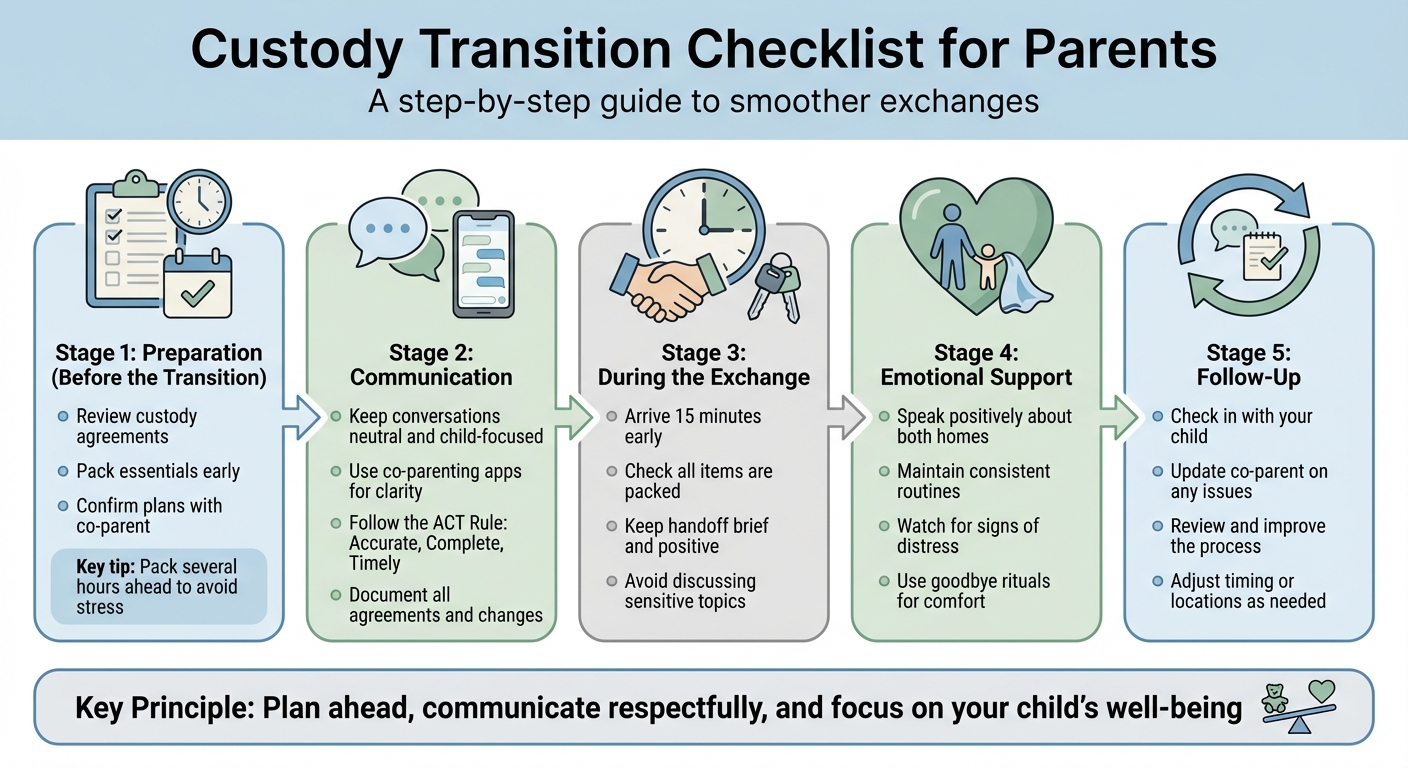
5-Stage Custody Transition Checklist for Co-Parents
Before the Transition: Preparation Steps
Review Your Custody Agreement and Schedule
Start by double-checking all the details of your custody agreement. Confirm the time, location, and transportation responsibilities for the exchange. It's important to understand the distinction between physical custody (where the child lives) and legal custody (who makes decisions for the child) to ensure you're clear on your role.
Pay close attention to clauses about holidays or special events, as these often take precedence over regular schedules. Also, look for any "first right of refusal" provisions, which may require you to offer parenting time to the other parent before arranging for a babysitter. To avoid surprises, compare your custody schedule with your child's school calendar for early dismissals or holidays that might alter pickup times.
"The less you leave to the imagination, the less you have to potentially come back to court about." - Tracy Krall, Professional Liaison and former Family Law Attorney
Once the schedule is set, turn your attention to preparing your child's belongings for the transition.
Pack Your Child's Essentials
Make a checklist of items your child will need, such as medications, school supplies, uniforms, homework, electronics, and any necessary permission slips. Don’t overlook comfort items like a favorite stuffed animal or blanket - these can help your child feel more at ease in either home.
To avoid last-minute stress, aim to pack several hours ahead of time. Keeping duplicate essentials - like clothing, toiletries, and toys - at both homes can also make transitions smoother and less stressful for your child.
"Having certain items at each house is meant to reduce the burden on the child of feeling like they are constantly packing and having to plan for what they will need and where." - Danielle Kestnbaum, Lawyer and MSW
With everything packed, the next step is ensuring seamless communication with your co-parent.
Confirm Plans with Your Co-Parent
Touch base with your co-parent to confirm the timing and location of the exchange. Using digital tools to reduce conflict and shared calendars can help ensure everyone is on the same page and make it easier to track extracurricular activities or special events.
If unexpected issues arise - like a school delay or illness - let your co-parent know immediately instead of waiting until the last minute. Avoid discussing schedule changes or sensitive topics during the exchange itself, especially in front of your child. Save those conversations for a separate time to keep things as stress-free as possible.
sbb-itb-a09457a
Communication Guidelines
After sorting out all the logistics, clear and focused communication becomes the backbone of a smooth custody transition.
Keep Communication Neutral and Focused
It's crucial to maintain a professional, child-centered tone in all your interactions. This not only reduces stress for your child but also keeps discussions productive. A helpful tip? Follow the ACT Rule: make your communication Accurate, Complete, and Timely [[11]](https://www.afccnet.org/Portals/0/PDF/AzAFCC Coparenting Communication Guide-web.pdf?ver=D1R0qJ7bLEZbl0Wv0QLiiw%3d%3d).
Stick to topics like schedules, logistics, and your child's needs. Avoid language that assigns blame, such as "You always" or "You never."
"Write the communication as if someone such as a judge or other decision-maker will read it."
- Arizona Chapter of the Association of Family and Conciliation Courts [[11]](https://www.afccnet.org/Portals/0/PDF/AzAFCC Coparenting Communication Guide-web.pdf?ver=D1R0qJ7bLEZbl0Wv0QLiiw%3d%3d)
For better organization and transparency, consider using a secure co-parenting app like Coflo. These tools provide a verified record of messages and shared calendars. If you're using email, stay on topic - limit each message to one subject (e.g., "Emma's Soccer Schedule") for easier reference later. Setting boundaries, such as agreeing to respond to non-emergency messages within 24 hours, can also help establish clear expectations [[11]](https://www.afccnet.org/Portals/0/PDF/AzAFCC Coparenting Communication Guide-web.pdf?ver=D1R0qJ7bLEZbl0Wv0QLiiw%3d%3d).
Talk to Your Child About the Transition
Prepare your child ahead of time by using age-specific custody schedules to show which days they'll be at each home. This can be especially helpful for younger children who may not yet understand dates or time.
When discussing the transition, keep the tone positive. Highlight the exciting aspects of spending time with the other parent, and use language that reinforces the idea of having two homes, creating a sense of security and belonging in both places. Avoid putting your child in the middle by asking them to relay messages or inquiring about the other parent's personal life.
These thoughtful conversations can help your child adjust and lay the groundwork for smoother transitions.
Keep Records of Agreements and Changes
Written records are invaluable for ensuring accountability and resolving any disputes. If one parent consistently fails to follow the agreed schedule, these records can serve as evidence in court. Keep in mind, however, that agreements only become legally binding once approved by a judge and included in a court order.
Document everything - whether it's a quick email about a schedule change or a detailed log about your child's care. A "Child News Report", which could be a notebook or digital log that travels between homes, is a great way to share non-urgent information like feeding routines, medications, moods, or developmental milestones [[11]](https://www.afccnet.org/Portals/0/PDF/AzAFCC Coparenting Communication Guide-web.pdf?ver=D1R0qJ7bLEZbl0Wv0QLiiw%3d%3d). This practice ensures both parents stay informed and your child's needs are met consistently.
"Always provide the other parent information that you expect that parent to give to you."
- Arizona Chapter of the Association of Family and Conciliation Courts [[11]](https://www.afccnet.org/Portals/0/PDF/AzAFCC Coparenting Communication Guide-web.pdf?ver=D1R0qJ7bLEZbl0Wv0QLiiw%3d%3d)
During the Exchange: Logistics Steps
The physical handoff is the moment where all your planning and preparation come together. A well-organized exchange can set a positive tone for your child's visit, so keeping things calm and efficient is key.
Arrive 15 Minutes Early
Getting there 15 minutes early gives you time to settle in and handle any last-minute surprises, like traffic delays or forgotten items. If something unavoidable makes you late, let your co-parent know immediately to avoid unnecessary stress. Use those extra minutes to double-check your child's belongings and ensure everything is in place.
Check That All Items Are Present
Before your co-parent leaves, confirm that all essential items are packed. This includes medications, schoolwork, sports gear, and comfort items like a favorite toy or blanket. Using the same bag for every exchange - whether a backpack or duffel - can make this step simpler. A quick "Got everything?" check during the handoff can prevent issues later on. Taking this small step ensures the transition flows smoothly into the next phase.
Keep the Exchange Brief and Positive
Keep the focus on your child during the handoff. Avoid discussing sensitive topics like finances or schedule changes. If your co-parent brings up a difficult subject, calmly suggest revisiting it later by saying, "Let's address that after today's exchange - our priority is our child's well-being" [Claery & Hammond, LLP].
Make the moment about your child. Give them a quick hug, remind them how much you care, and wish them a great time. As Sarah Nicole Landry, creator of The Birds Papaya, wisely shares:
"I don't know what the rest of their day looks like, that's out of my control, but what I can control is what it looks like in the morning".
Supporting Your Child Emotionally
Your child's emotional well-being during custody transitions deserves thoughtful attention and care. Once the logistical aspects are sorted, the next step is ensuring they feel emotionally secure.
Speak Positively About Both Homes
Let your child know it's okay - and even good - to enjoy time with both parents. Rosalind Sedacca, CDC, Founder of the Child-Centered Divorce Network, emphasizes this:
"Give your children permission to enjoy themselves and their time with Dad or Mom. Tell them you have much to do and will appreciate some 'alone' time."
Kids often feel guilty about leaving one parent behind. Reassuring them that you're okay with the arrangement can ease their worries and help them fully enjoy their time in the other home. A short, consistent goodbye ritual can also work wonders. Whether it's a special hug, a cheerful "goodbye wiggle dance", or a unique phrase, these small gestures help regulate their emotions and create a sense of normalcy.
Keep Routines Consistent Between Homes
Consistency is key to helping your child feel secure. Try to align routines such as bedtimes, meal schedules, and homework expectations between both households. This predictability reduces confusion and reinforces stability. Additionally, scheduling regular video calls or phone chats with the parent who isn't present at the time can remind your child that both parents are actively involved in their life.
Watch for Signs of Emotional Distress
Keep an eye out for signs of emotional struggle, like ongoing anxiety, sadness, irritability, or withdrawal. Younger children might show regressive behaviors, such as increased clinginess or unexpected accidents. Older kids might lose interest in activities they once loved or see a drop in academic performance. Ariana Hoet, PhD, from Kids Mental Health Foundation, notes:
"Research shows that most children are resilient and cope well following divorce."
However, if these behaviors persist for several months or start interfering with daily life, it might be time to consider professional therapy. Regularly reminding your child that the custody arrangement is not their fault can also provide comfort. As SkillsYouNeed explains:
"Simply reassuring children regularly that the divorce is not their fault, and that both parents love them deeply, can be powerfully healing."
After the Transition: Follow-Up Steps
Once the exchange is done, it's important to focus on how things went and address any lingering concerns. Taking a moment to reflect and check in ensures smoother transitions in the future and helps everyone adjust better.
Ask Your Child How They're Feeling
Take time to ask your child how they feel, but keep it low-pressure. Use open-ended questions about their day and emotions, steering clear of probing into the other parent's details. According to Mayo Clinic, there are specific signs to watch for:
"If you see changes in schoolwork, friendships, behavior or mood, your child may be struggling to manage the change."
Also, keep an eye out for shifts in sleep patterns, eating habits, or bathroom routines. While some nervousness during transitions is normal, persistent behaviors like clinging, crying, or whining might indicate that your child is feeling overwhelmed. Another red flag is if your child seems overly worried about your well-being, asking questions like, "Were you lonely while I was gone?" This could suggest "parentification", where they feel responsible for your emotions instead of focusing on their own adjustment.
Update Your Co-Parent on Any Issues
Good communication with your co-parent remains essential. Share any concerns you notice, such as behavioral changes or specific feedback from your child. Keep these conversations private and respectful. To avoid confusion, document updates or agreed changes using tools like a shared calendar or co-parenting app.
Review and Improve the Process
Take a moment to evaluate what worked well and what didn’t. Were there items that kept getting forgotten? Did the timing of the exchange cause unnecessary stress, like if your child was tired or hungry? Tracy Krall, Professional Liaison and former Family Law Attorney at OurFamilyWizard, highlights the importance of being specific:
"The most common mistake she sees is vagueness... The less you leave to the imagination, the less you have to potentially come back to court about."
If certain issues keep cropping up, adjust your checklist or consider different exchange locations, such as a park or school pick-up zone, to make things easier. You can also use tools like Coflo's implementation roadmaps to fine-tune custody schedules. These resources offer step-by-step guidance to help you adjust timing, locations, or routines as your child’s needs change over time.
Conclusion
Navigating custody transitions effectively requires thoughtful preparation, open communication, and heartfelt emotional support. To set the stage for success, review custody agreements thoroughly, pack necessities in advance, and keep handoffs brief to create a predictable and secure environment. With approximately 42% of customers using online divorce services having minor children, structured parenting plans are a necessity for countless families.
Three key principles can make all the difference: plan ahead, communicate respectfully, and focus on your child's well-being. Having essential items in both homes, maintaining consistent routines, and fostering positive conversations can help your child feel secure and supported. As Philip M. Stahl Ph.D, ABPP (Forensic) wisely advises:
"If you create a comprehensive parenting plan, you can save considerable aggravation later."
These strategies form the backbone of effective custody planning. If you're unsure about creating a comprehensive custody plan, Coflo can help with personalized recommendations. Their tools, based on developmental psychology, allow you to prioritize stability, equal time, and school consistency, factors shown to improve cognitive development in children, all while providing a clear roadmap for implementation. By following these steps, you can lay the groundwork for a custody plan that truly prioritizes your child's needs.