
Ultimate Guide to Co-Parenting Rules Across Homes
When parents separate, creating consistent rules between two households is key to giving children stability. Differences in rules - like screen time limits or bedtimes - can confuse kids and lead to behavioral issues. This guide helps co-parents align on critical areas like discipline, routines, and communication to reduce conflict and support their child’s well-being.
Key Takeaways:
- Consistency matters: Align on core rules (e.g., screen time, bedtimes) to help kids feel secure.
- Focus on big-picture issues: Safety, academics, and discipline should be addressed together.
- Communication is critical: Use respectful, clear messaging and tools like shared calendars.
- Legal agreements: A written parenting plan and implementation checklist ensures clarity and prevents disputes.
- Use tools like Coflo: Platforms can help streamline communication and custody planning.
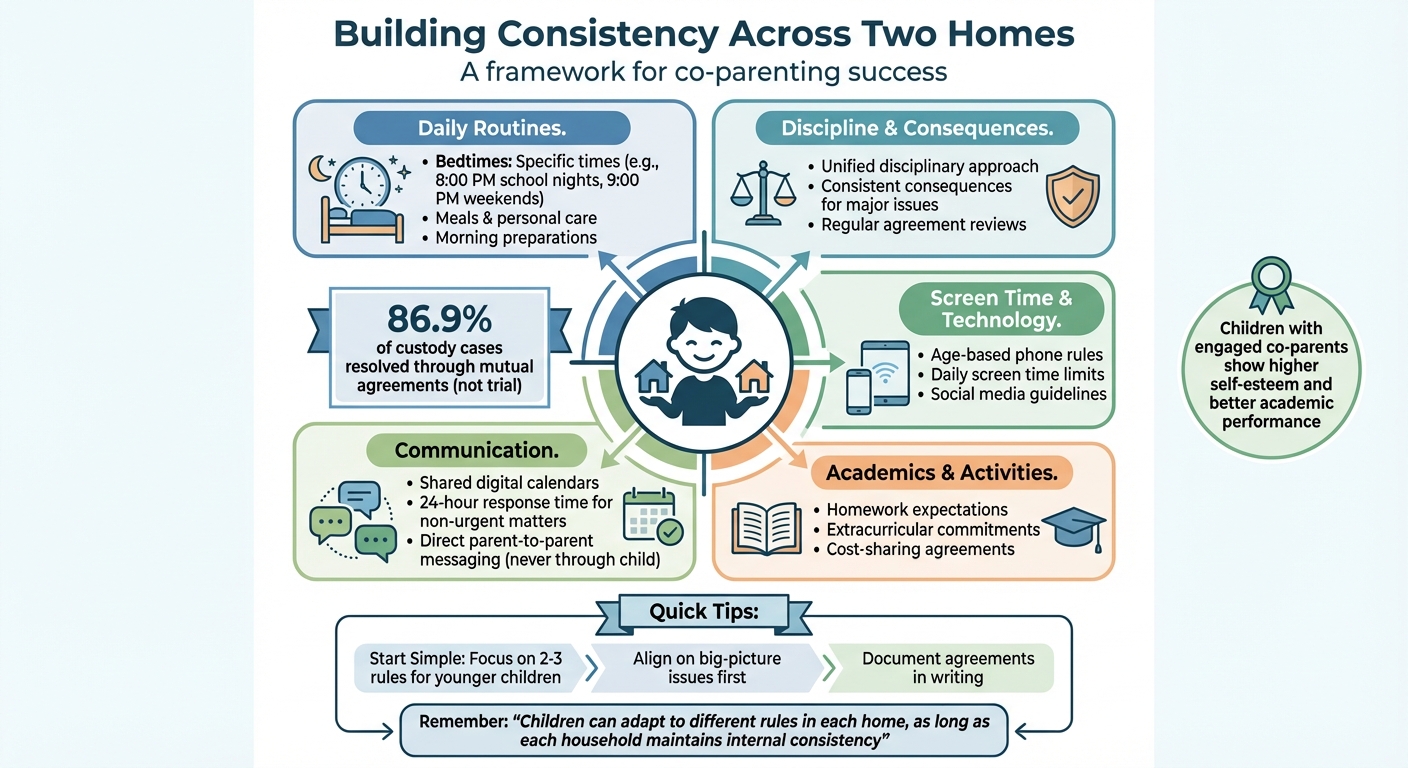
Essential Co-Parenting Rules Framework: 5 Key Areas for Consistency Across Homes
Creating Consistent Rules Between Two Homes
Why Children Need Consistency
Clear and predictable rules provide children with a sense of security, even when they’re moving between two households. When expectations are steady, children feel less stressed and tend to behave better.
"A child needs boundaries that are clear and firm, yet loving and respectful, to feel safe and secure in their environment. You can think of this as a safety net they can carry with them between their two homes." - Aurisha Smolarski, LMFT
Without this kind of stability, children may struggle to understand what’s expected of them. Consistent rules also reduce the likelihood of children trying to manipulate situations by playing one parent against the other. For younger children, like infants and toddlers, consistency becomes even more crucial. Studies suggest that babies should interact with the noncustodial parent at least every two days to maintain their bond and sense of security. This kind of predictability not only fosters emotional stability and supports cognitive development while helping children build confidence and learn how to set boundaries in their own relationships later in life.
Agreeing on Core Rules Together
Once the importance of consistent boundaries is clear, the next step is agreeing on shared, non-negotiable rules. Focus on the key areas where alignment is most critical, such as discipline methods, bedtimes, homework routines, screen time limits, and approaches to handling behavioral issues. For younger kids, like toddlers and preschoolers, it’s best to keep it simple - stick to just two or three rules they can easily remember.
"Rules work best when there is consistency, predictability, and follow-through." - CDC
To make these expectations clear, consider drafting a written agreement. This document can outline the essential rules for both homes and should be posted where everyone can see it. Regular check-ins between co-parents can help ensure that everyone stays on the same page. A helpful addition to this agreement might be a table listing each rule alongside its specific consequence, so children know that breaking a rule will have the same outcome regardless of which parent they’re with.
Balancing Structure with Individual Parenting Styles
It’s important to remember that absolute consistency between two households isn’t realistic - or even necessary. What matters more is consistency within each home. Children are capable of adjusting to different rules as long as each household has its own clear and steady expectations.
"Children are able to learn from consistency within a particular household or with a particular parent, even if rules are different elsewhere." - Melanie A. Fernandez, PhD, ABPP
Focus on aligning the big-picture issues, like safety, academic expectations, and handling major behavioral challenges, rather than trying to match every small detail such as bedtime routines or meal choices. If your child mentions that the other parent has different rules, you can simply say, "Our rules are different here", without criticizing the other parent. When setting consequences, design ones that can be enforced during your time with the child, rather than relying on the other parent to follow through. It’s also essential to avoid undermining your co-parent’s authority, even if you disagree with their approach. Children benefit from respecting both parents, even when the rules differ. These strategies help create a balanced foundation for managing routines and discipline across two homes.
sbb-itb-a09457a
Main Areas Where Rules Should Align
Daily Routines: Sleep, Meals, and Personal Care
Consistency in daily routines between homes plays a big role in giving children a sense of stability. For example, irregular bedtimes can disrupt sleep and make school nights more challenging. Instead of vague guidelines, set specific times like "8:00 PM on school nights and 9:00 PM on weekends" to provide clear expectations for kids.
A shared digital calendar can be a lifesaver for keeping track of important details like medical appointments and daily schedules. When it comes to school routines, agreeing on homework expectations, pickup times, and morning preparations can help create a smoother, more predictable structure for everyone.
Discipline and Consequences
While smaller house rules might differ, it's crucial to align on how major disciplinary actions are handled to avoid sending mixed messages to children. For instance, if one parent uses physical discipline and the other does not, it can create confusion and tension. Finding common ground on discipline ensures children aren’t caught in the middle of conflicting approaches.
"Consistency between the rules and consequences in your home and those in your co-parent's home avoids confusion for your children."
- Meriwether & Tharp, LLC
To avoid misunderstandings, agree on a unified strategy for discipline and revisit these agreements regularly to keep them up to date. Focus on collaboration rather than blame, and always ensure disciplinary practices stay within legal boundaries to prevent any actions that could be deemed abusive.
Screen Time, Homework, and Activities
Aligning expectations around screen time, academic responsibilities, and extracurricular activities is another key area for creating consistency. For example, setting clear age-based rules for when kids can get their first phone, use social media, or how much screen time is allowed daily can help maintain structure. Decisions about education, extracurricular activities, lessons, and camps should also be made together to ensure a fair balance of time and financial responsibilities.
"A parenting plan is always something that people agree to, whereas ultimately if they can't come to an agreement, the court is going to issue a parenting order - a custody and parenting schedule that would go into an order that will then be forced upon the parents."
- Richard E. Garriott, Family Law Attorney
Staying involved in your child’s academics, even during the other parent’s time, can also make a big difference. For instance, using video calls to help with homework keeps you engaged. Additionally, agreeing on how to split costs for extracurricular activities and making an effort to attend events like sports games, recitals, or parent-teacher conferences shows mutual support and strengthens the co-parenting relationship.
Communication Between Co-Parents
How to Communicate Effectively with Your Co-Parent
Approach co-parenting conversations like a professional exchange, focusing strictly on your child's needs. Keep the discussion centered on schedules, health, and overall well-being, steering clear of past relationship issues or personal disagreements.
"Treat your communication as if it were a professional relationship. Before sending any message, ask yourself: Does it provide all the necessary information? Is the tone respectful?"
- Atty Bruggemann, Esq.
Written communication, such as emails or co-parenting apps, helps maintain a clear record and can reduce disputes. Follow the "ACT" Principle: ensure your messages are Accurate, Complete, and Timely. If emotions are running high, take a pause before responding. For non-urgent matters, aim to reply within 24 hours to keep things on track without unnecessary stress.
Setting boundaries is also key. Agree on specific times for non-urgent communication and limit the number of daily messages to avoid overwhelm. Active listening plays a big role too - summarizing the other parent's points can help prevent misunderstandings. For more complex topics, like changes to rules or extracurricular schedules, scheduling a dedicated time to talk is often more productive than addressing them on the fly.
These strategies create a solid foundation for organized communication, benefiting both parents and children.
Managing Schedules and Transitions
A detailed, written schedule with clear pickup and drop-off times, as well as designated exchange locations, reduces confusion and gives children a sense of security. Shared digital calendars and AI-generated custody schedules are excellent tools for updating arrangements, school events, or appointments. This is especially important when coordinating age-appropriate holiday custody plans to ensure celebrations remain stress-free. Notify the other parent of any changes as early as possible, reserving last-minute adjustments for emergencies.
To ease transitions, keep essential items like clothes or school supplies in both homes. This eliminates the need for frantic last-minute packing. During handoffs, maintain a positive attitude about your child's time with the other parent and remain courteous to minimize tension. A "Child News Report" - whether a shared notebook or a digital log - can keep both parents informed on important matters like medical updates, school progress, and behavior.
Consistent scheduling not only keeps things running smoothly but also reinforces a stable parenting approach across households.
Helping Children Understand the Rules
Clear communication between co-parents helps ensure consistency when explaining rules to children. A unified approach provides reassurance and stability. Use the same language when discussing rules in both homes, and avoid contradicting the other parent in front of your child. Children often mirror their parents' attitudes, so demonstrating mutual respect - even during disagreements - is essential.
"The kids need to see that even though mom and dad aren't married anymore, they're still a parenting team. This reassures them that there is stability amid the tough changes."
- Bryan Driscoll, Divorce Content Specialist & Lawyer
Never use your child as a go-between for messages. Communicate directly with your co-parent and allow your child to share their experiences freely, without feeling caught in the middle. Studies show that cooperative co-parenting is linked to higher self-esteem, better mental health, and improved academic outcomes for children.
Legal Aspects of Co-Parenting Rules
Adding Rules to Your Parenting Agreement
A written parenting plan turns informal co-parenting arrangements into legally enforceable commitments. Often referred to as a custody agreement or parenting time arrangement, this document lays out key details like living arrangements, decision-making responsibilities, and daily schedules. To make it enforceable, you’ll need to have a judge sign off and issue a court order.
One critical component of the plan is defining legal custody, which determines who has the authority to make major decisions about your child’s education, healthcare, and religious upbringing. Interestingly, about 86.9% of custody cases are resolved through mutual agreements rather than going to trial. This underscores the importance of crafting a thorough plan from the start. Be as specific as possible - include exact days, times, and locations for parenting schedules to reduce any chance of confusion.
"A detailed, well-written agreement is the best tool to prevent future conflict. A judge must approve the plan to make it a legally enforceable court order." - Justia
Consider including a dispute resolution clause that requires mediation before escalating to legal action. Another helpful addition is a "right of first refusal" clause, which ensures the other parent gets the chance to care for the child before outside childcare is arranged. To ensure compliance with state laws, have an attorney review the agreement.
When disputes arise, having a legally sound parenting agreement provides a clear path forward.
Resolving Disagreements About Rules
Even with a solid parenting plan, disagreements can happen. When they do, there are legal steps to address them. Mediation is often the first step, where a neutral third party helps both parents reach a resolution. In fact, many courts require mediation before allowing a case to move forward, and it’s usually a more cost-effective option than litigation.
"Most parenting plans build in a provision that, in the case that they can't agree, they should try to resolve it by an alternative dispute resolution method." - Dana L. Parks, Family Law Attorney
If mediation doesn’t resolve the issue, there are other options. Collaborative law involves lawyers working together to find a solution, but keep in mind that these attorneys cannot represent you in court if the process fails. Another route is arbitration, where a private arbitrator makes a binding decision. While faster, this option does come with additional costs. As a last resort, you can pursue court litigation, where a judge will decide based on what they believe serves the child’s best interests. This process typically involves a hearing or trial. Throughout any legal proceedings, keep detailed records to support your case if enforcement becomes necessary.
How Coflo Helps Implement Consistent Co-Parenting Rules
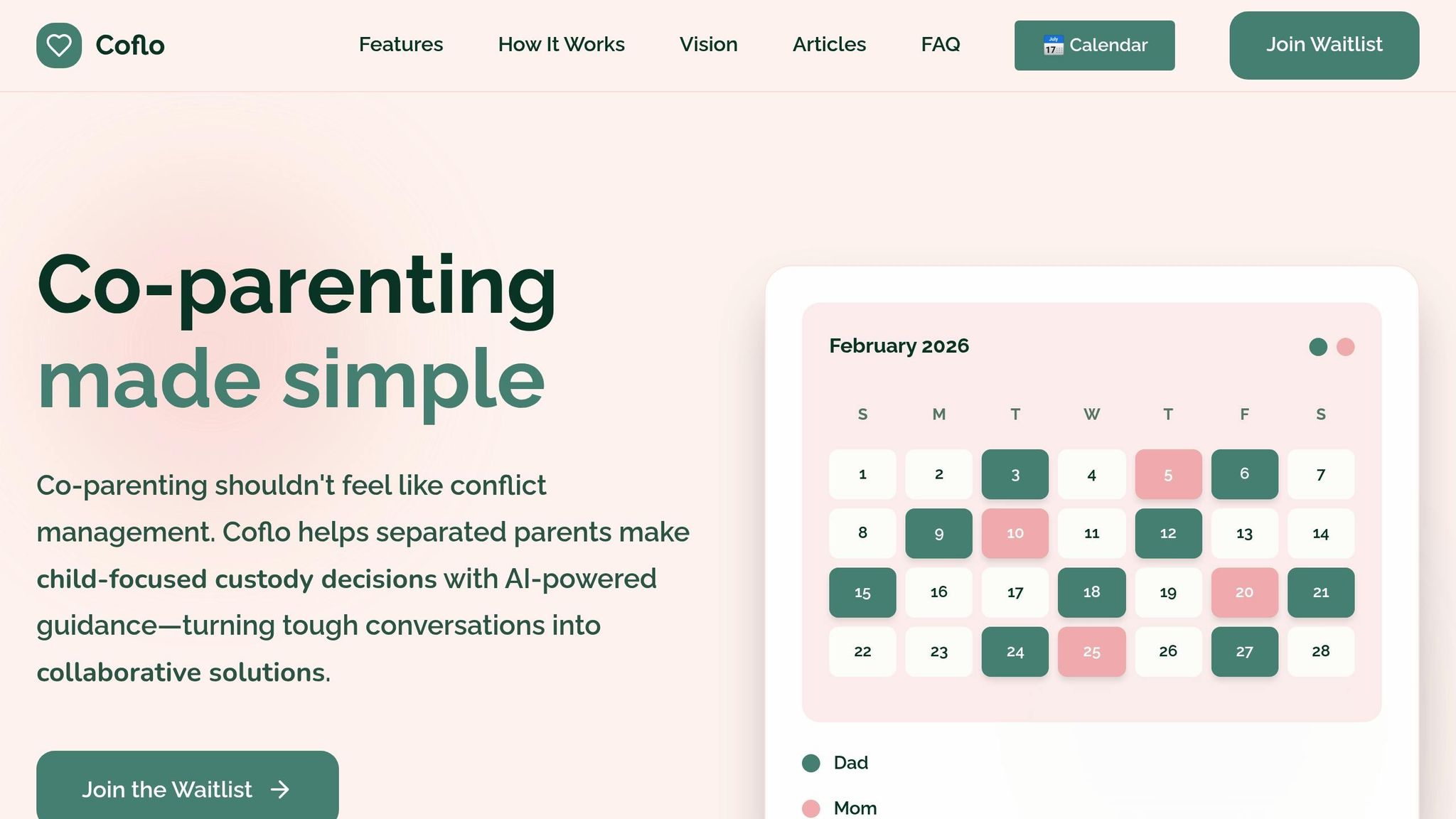
With clear legal frameworks and open communication as a foundation, digital tools like Coflo empower co-parents to create and maintain consistent rules.
Coflo's Support for Consistency Across Homes
Establishing consistent rules between two households can be tough, especially when emotions or miscommunication get in the way. Coflo steps in with AI-powered custody recommendations that help parents align on schedules and guidelines tailored to their family’s needs. The platform also incorporates developmental psychology insights, ensuring that rules - like bedtimes, screen time, or discipline - are age-appropriate for your child.
"Understand how your child's developmental stage should influence custody decisions, from infancy through the teenage years." - Coflo Team
For example, if you’re co-parenting a toddler, Coflo might suggest shorter, more frequent visits to support attachment security. On the other hand, teenagers may benefit from more flexible arrangements to accommodate their social lives and growing independence. By grounding these recommendations in research, Coflo helps parents move beyond vague agreements to establish clear, enforceable rules that minimize confusion for everyone.
Tools That Help Co-Parents Work Together
Coflo offers interactive priority sliders that allow co-parents to visualize and align on key factors like equal time, school stability, and minimizing transitions. As you adjust these priorities, the platform recalculates and ranks custody schedule options based on your family’s specific circumstances. Each option comes with clear benefits, potential challenges, and a step-by-step roadmap for implementation. Detailed success indicators explain not only what to do but also why it works, giving you confidence in your decisions.
Beyond scheduling, Coflo functions as a centralized communication hub, reducing conflicts and eliminating the "he-said, she-said" dynamic. These tools help co-parents collaborate effectively, ensuring that decisions keep the child’s best interests front and center.
Making Child-Focused Decisions with Research-Backed Guidance
A consistent and cooperative co-parenting environment has been shown to improve children’s self-esteem and academic performance. In contrast, high-conflict or inconsistent parenting can lead to anxiety, depression, and behavioral challenges in adolescents. Coflo builds on these findings, turning research into actionable guidance tailored to each child’s developmental stage.
"If you're co-parenting, you're really trying to figure out a way to continue to be a team for your child, even if you're not in a relationship anymore." - Kathryn Jones, PhD, Pediatric Psychologist, Cleveland Clinic
Conclusion
Co-parenting isn’t about getting everything perfect - it’s about creating a sense of stability and security for your child in both homes. By agreeing on key rules like bedtime routines, homework expectations, discipline approaches, and screen time limits, you provide the consistency kids need to feel safe and grow. Studies even suggest that children with engaged parents tend to have higher self-esteem, perform better in school, and enjoy stronger mental health.
Think of co-parenting as a business partnership centered on your child’s well-being. As Bryan Driscoll, Divorce Content Specialist & Lawyer, explains:
"Effective communication doesn't mean you have to be best friends with your ex. But you will need to put personal differences aside and focus on the task at hand: parenting your children".
This involves keeping discussions short and focused on your child, documenting agreements in a thorough parenting plan, and avoiding the temptation to use your child as a go-between.
Start by identifying your top three non-negotiable rules and sitting down with your co-parent to align on them. Tools like Coflo can help you turn these priorities into practical custody schedules grounded in developmental psychology. Taking these steps now sets the stage for a steady and supportive environment.