
Checklist: Building a Flexible Custody Roadmap
Creating a custody roadmap is about ensuring stability for your child while reducing conflict between co-parents. Here's the key takeaway: a clear, detailed plan helps both parents manage responsibilities, adapt to changes, and prioritize the child's needs without constant legal intervention.
Key Steps to Build Your Custody Plan:
- Understand Your Family's Needs: Consider your child's age, routines, and preferences while aligning with both parents' work schedules and logistics.
- Choose a Schedule: Options like 50/50 weekly splits, 2-2-3 rotations, or long-distance plans can fit your situation.
- Plan for Holidays and Events: Divide major holidays, birthdays, and vacations in advance to avoid disputes.
- Set Communication Rules: Use written communication for clarity and define decision-making responsibilities.
- Review Regularly: Adjust the plan annually or as your child grows, ensuring it stays relevant.
Pro Tip: Tools like Coflo can simplify the process, offering tailored custody schedules and insights based on your family's priorities.
This roadmap isn't just paperwork - it's a way to create consistency and reduce stress for your child, no matter the circumstances.
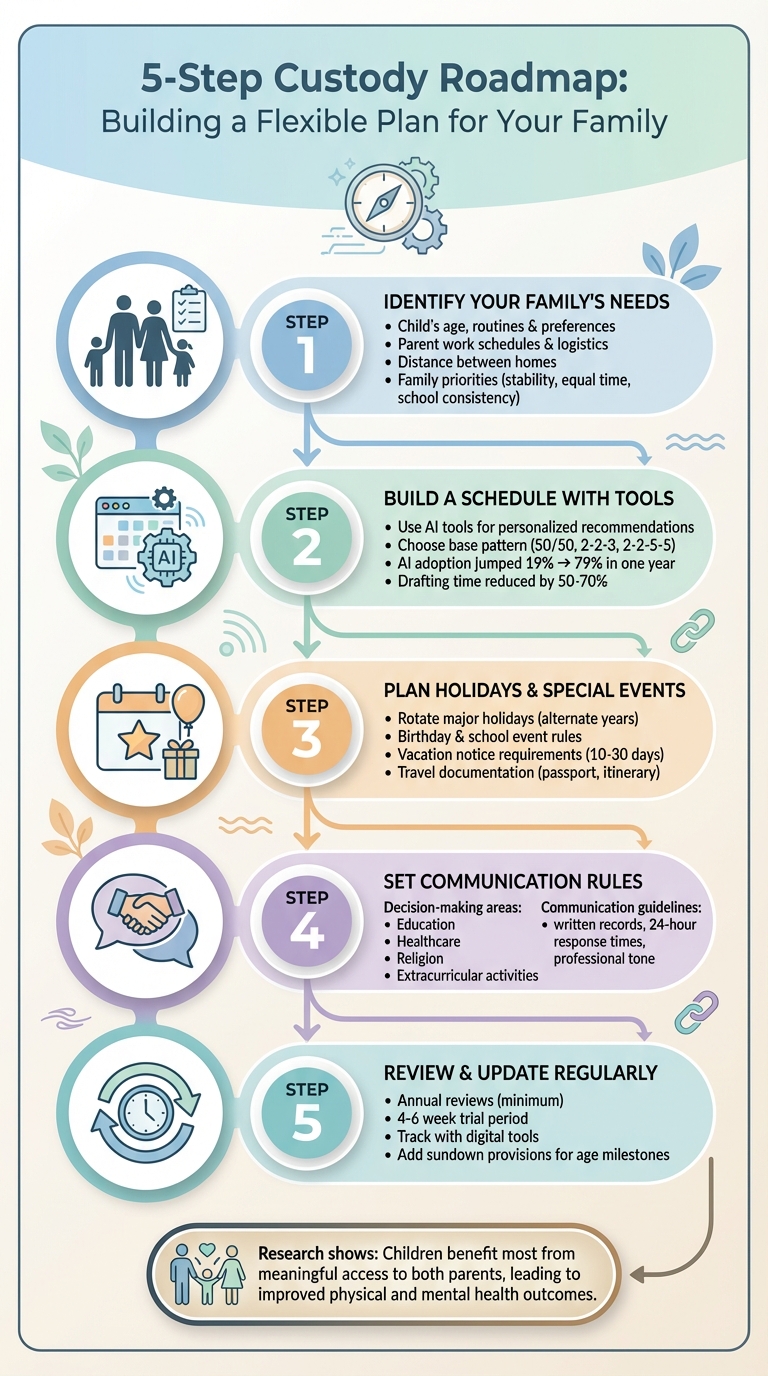
5-Step Custody Roadmap Planning Process
Step 1: Identify Your Family's Needs and Priorities
Creating a custody plan starts with understanding your family's unique circumstances. This means taking into account schedules, needs, and values that reflect your reality - not someone else’s.
Review Child-Specific Factors
Consider your child’s age and developmental stage when designing your plan. For instance, while an 8:00 p.m. bedtime might suit a younger child, a teenager will have entirely different routines and needs. As children grow older, they often want to have a say in decisions that impact their lives. It’s important to listen to their preferences without putting them in a position where they feel forced to choose sides.
If your child has physical or mental disabilities, think about how well they can manage moving between homes. Make sure both residences are equipped with any necessary medical or assistive devices. Additionally, factor in the role of siblings and extended family, as they can provide vital emotional support.
"Having certain items at each house is meant to reduce the burden on the child of feeling like they are constantly packing and having to plan for what they will need and where." - Danielle Kestnbaum, Lawyer and MSW
Plan for milestones like getting a cellphone, navigating social media, driving privileges, and curfews. Tracy Krall, a former family law attorney, suggests using sundown provisions - rules that expire once a child reaches a certain age. For example, Halloween custody arrangements might no longer apply once the child turns 12.
Finally, ensure that the parents’ schedules and logistical considerations align with the child’s specific needs.
Review Parent Schedules and Logistics
Co-parenting logistics are key. Review both parents’ work hours and commitments alongside school schedules to determine a realistic division of parenting time, whether it’s 50/50, 60/40, or another arrangement.
The distance between homes also matters. If you’re managing a long-distance arrangement, outline travel details such as methods (plane, train, or bus), who will cover the costs, and the required notice period - often 30 days. Amanda Love, Principal at the Love Law Firm, recommends a school-based exchange approach:
"I encourage school-based trade when the child transitions from school to the co-parent's home. That way, you drop off the child and pick them up, and there's no need to meet up or have guesswork about timing."
Decide on transportation responsibilities, neutral exchange locations (like parks or restaurants, especially for high-conflict situations), and what happens if a parent cannot provide transport. Additionally, establish backup childcare plans and decide whether the other parent should have the right of first refusal before hiring a sitter.
List Your Family Priorities
After reviewing schedules and logistics, identify what’s most important to your family. These priorities will shape your custody plan. Some families may prioritize stability and routine, while others focus on equal parenting time, consistency with school, minimizing transitions, or maintaining shared decision-making authority. Cultural and religious values may also play a role.
Rank these priorities honestly. For example, some families may value meaningful interactions over strictly equal time splits. Others might prioritize reducing conflict to shield children from the negative effects of high-tension environments. Research shows that children exposed to high-conflict separations can face risks similar to those who experience direct physical or emotional abuse.
"The key is to shift into a business partner relationship built on courtesy, just as you do with professional colleagues. You can work out the details if you have a goal-oriented relationship." - Annette Katchaluba, MSW, RSW, Director of By Peaceful Waters
These priorities will serve as the foundation for your decisions moving forward. Tools like Coflo (https://blog.coflo.app) can help by allowing you to adjust sliders for factors like stability, equal time, and school consistency, offering customized custody schedule recommendations tailored to your family’s needs.
Step 2: Build a Schedule with Tools and Expert Guidance
Once you've outlined your family's priorities, the next step is to create a custody schedule that reflects those needs in a practical, workable way. This involves choosing a pattern that fits your situation, tailoring the details, and leaving room for adjustments as circumstances change.
Use AI Tools to Personalize Your Plan
With your priorities in place, AI tools can step in to help craft a schedule tailored to your unique family dynamics. These tools consider factors like work shifts, school schedules, travel distances, and more to generate custody schedules that fit your specific needs. They also adapt schedules to your child's developmental stage, ensuring the plan evolves as your child grows. By inputting detailed information about your circumstances, you’ll receive ranked recommendations designed to match your family's reality.
For instance, Coflo (https://blog.coflo.app) provides personalized custody schedule suggestions ranked by how well they meet your needs. These recommendations come with insights from developmental psychology tailored to your child’s age, along with benefits, considerations, and steps for implementation. It’s a way to access professional-level guidance without the hefty cost of hiring an attorney or mediator.
AI’s role in custody planning is growing rapidly - adoption among legal professionals has jumped from 19% to 79% in just one year. These tools serve as a checklist, helping parents avoid common oversights like holiday schedules, right-of-first-refusal clauses, and communication protocols. Plus, they can cut down the time it takes to draft a parenting plan by 50% to 70%, giving you more time to focus on your child’s well-being.
Choose a Base Schedule Pattern
The next step is selecting a base schedule pattern that aligns with your family’s needs while honoring the priorities you identified earlier. Amanda Love, Principal at the Love Law Firm, suggests:
"In my practice, we have been leaning toward recommending a 50/50 schedule with one week on and one week off for each co-parent".
This arrangement is often ideal for older children and parents who want equal time with fewer transitions.
Other popular patterns include the 2-2-3 rotation (2 days with Parent A, 2 days with Parent B, followed by 3 days with Parent A), which is great for younger children needing frequent contact with both parents. The 2-2-5-5 rotation offers a consistent weekly routine that works well for school-age children and structured activities. For long-distance arrangements, the "every weekend" pattern - where the child stays with one parent during the week and the other on weekends - may be more practical.
Once you’ve settled on a pattern, fine-tune the details. Decide on exchange locations (school-based transitions can reduce conflict), specific handoff times, transportation responsibilities, and backup childcare plans. Keep in mind that joint custody works best when parents live in the same community or neighborhood, so proximity is a key factor in finalizing your plan.
Plan for Flexibility
No custody arrangement can account for every twist and turn life throws at you. That’s why it’s crucial to include provisions for flexibility. For example, a right of first refusal clause ensures that if one parent can’t care for the child during their scheduled time, the other parent gets the opportunity to step in before a babysitter is hired.
You’ll also want to address makeup parenting time for situations like vacations, work trips, or illnesses that disrupt the schedule. Clearly define how missed time will be made up and how late exchanges will be handled. Consider adding sundown provisions, which automatically phase out specific rules - like Halloween custody arrangements - once your child reaches a certain age, such as 12.
Regular reviews are another key element. Plan to reassess your custody schedule annually or every two years to ensure it continues to meet your child’s evolving needs. In high-conflict situations, you might require a neutral mediator to resolve disputes before escalating to legal action. Including these flexibility measures in your plan helps you adapt to life’s changes without constantly returning to court.
Step 3: Plan for Holidays, Vacations, and Special Events
Once your customized schedule is in place, it's time to tackle the specifics for holidays, vacations, and other important events. These moments, while special, can sometimes become sources of conflict if not clearly outlined in advance. By planning ahead and setting clear rules, you can help avoid unnecessary disputes.
Rotate Major Holidays
Start by listing key dates - think Thanksgiving, Christmas, religious holidays, school breaks, and long weekends. Then decide how to divide them. A common solution is alternating holidays each year. For instance, one parent might have Thanksgiving in even years, while the other gets it in odd years. To make things even smoother, clearly define time splits for the day - for example, one parent from 9 a.m. to 3 p.m., and the other from 3 p.m. to 9 p.m..
In families with different religious practices, assigning specific holidays to each parent can work well. For example, one parent may always celebrate Hanukkah while the other gets Christmas.
Steve Epstein, a Board-Certified Family Law Specialist from Raleigh, NC, underscores the importance of early planning:
"We always include holiday provisions in our custody orders so that co-parents know, well in advance, what their holiday schedule will be".
It’s also crucial to include exact pick-up and drop-off times - like 6 p.m. the evening before or 9 a.m. on the holiday itself - to eliminate confusion. Make it clear that holiday schedules override the regular weekly plan, and watch for situations where alternating holidays could unintentionally give one parent extended time, such as three weekends in a row.
Don’t forget to address personal events like birthdays and school performances as part of your overall plan.
Plan for Birthdays and Other Celebrations
Events like birthdays, school plays, and family reunions deserve special attention in your custody arrangements. Decide upfront whether both parents will attend these events together - what family law professionals often call "parent dual attendance" rules. For older children, consider asking for their input on how they’d like to celebrate holidays and birthdays. If sharing the actual day is difficult, you might establish a "second celebration" tradition, where one parent celebrates on a different day, like the following weekend.
Family Law Attorney and Guardian ad Litem Erin Wilson suggests:
"If your child is old enough, definitely get their input on how they want to spend the holidays".
Set Vacation and Travel Rules
Establishing clear vacation and travel rules can help avoid last-minute disagreements. Decide how far in advance one parent must notify the other about travel plans - 10 or 30 days’ notice is common.
Danielle Kestnbaum, a Lawyer and MSW, advises:
"Have the conversations about out-of-state or international travel and how much notice the other parent will need. Do they need ten days? Thirty days?".
Define what counts as "travel" requiring notification - this could include crossing state lines, traveling beyond a certain distance, or international trips. Address practical details, such as who holds the child’s passport and how it will be exchanged when needed. The traveling parent should also share key itinerary information, like flight numbers, hotel addresses, and emergency contacts.
For older kids, set guidelines for when they can travel alone, such as flying as an unaccompanied minor. Lastly, decide who will cover travel expenses to avoid surprises later.
sbb-itb-a09457a
Step 4: Set Communication and Decision-Making Rules
Co-parenting works best when both parents establish clear rules for communication and decision-making. Without these boundaries, even small disagreements can snowball into bigger issues that may affect your child's well-being.
Divide Decision-Making Responsibilities
Start by distinguishing between legal custody (which involves major decisions) and physical custody (focused on day-to-day care). Decision-making generally falls into four main categories:
- Education: Choices about schools, tutoring, or academic plans.
- Healthcare: Decisions regarding doctors, treatments, and vaccinations.
- Religion: Participation in faith-based activities or practices.
- Extracurricular Activities: Sports, hobbies, associated costs, and time commitments.
Assign these responsibilities based on each parent's strengths. For instance, one parent might handle all education-related decisions, while healthcare choices are shared. If you share legal custody and can't reach an agreement, consider giving one parent the role of "tie-breaker" to avoid deadlocks.
Tracy Krall from OurFamilyWizard emphasizes why clarity matters:
"If it's spelled out in the parenting agreement, there's nothing to argue about. On the other hand, any gray area can be taken advantage of by either party, which inevitably negatively affects the child."
Once responsibilities are divided, set clear rules for how and when decisions are communicated.
Create Communication Guidelines
Communication rules are just as important as custody schedules. They help reduce conflict and keep the focus on your child's needs. Written communication - such as emails, texts, or apps specifically designed for co-parenting - can create a reliable record, especially if tensions run high.
Set boundaries around how you communicate. For example:
- Establish response times (e.g., 24 hours for non-urgent matters, immediate calls for emergencies).
- Define what qualifies as an emergency.
- Agree on a primary communication method.
Keep your messages professional and practical, focusing on topics like school schedules, medical updates, or activity logistics. Avoid personal topics or revisiting past conflicts. A good rule of thumb: pause before responding to avoid miscommunication or escalating tensions. Using "I" statements (e.g., "I feel concerned when...") instead of "you" statements can also help keep conversations constructive.
One key tip: don’t involve your child in delivering messages between households. This can place unnecessary emotional strain on them.
As Atty Bruggemann, Esq., from ParentCo., advises:
"Treat your communication as if it were a professional relationship."
Plan Support Logistics
Iron out the practical details for daily transitions. This includes setting specific drop-off and pickup locations, assigning transportation duties, and arranging backup childcare. School-based exchanges can be a helpful option, as they eliminate face-to-face interactions and simplify timing.
For extracurricular activities, define the scope clearly - whether it's local leagues or travel teams - and decide how to split costs for equipment, registration, and travel. If backup childcare is needed, agree on who is authorized to step in, such as a relative or nanny. You might also use a "right of first refusal", which gives the other parent the option to care for the child before hiring outside help.
Consistency between households is key to making transitions easier for your child. Align routines like bedtimes, screen time, nutrition, and discipline. Decide whether items like clothes, toys, or homework should stay at one home or travel back and forth. Clear agreements on these details can make co-parenting smoother for everyone involved.
Step 5: Review and Update the Custody Roadmap
A custody plan isn’t something you set and forget. Kids grow, routines shift, and what works today might be completely out of sync next year. Regular reviews ensure your plan evolves alongside your child’s needs and continues to serve their best interests.
By revisiting and refining your schedule and plans, you can keep your custody roadmap effective and relevant over time.
Add Provisions for Schedule Changes
Your parenting plan should include clear guidelines for updates. Plan for formal reviews at least once a year - or more often if you’re parenting teenagers, who often experience rapid changes in their social and academic lives. You might also tie reviews to key milestones, like starting middle school or getting a driver’s license.
Consider adding automatic updates, such as sundown provisions. For example, you could establish that bedtime rules will change when your child turns 13, or that Halloween trick-or-treating arrangements will end after age 12. These built-in adjustments can help avoid unnecessary conflicts later on.
Tracy Krall from OurFamilyWizard emphasizes the importance of clarity, even when co-parenting relationships seem smooth:
"Parents might be getting along at the moment they are crafting the parenting plan, so they leave it loose, but things might change, the temperature of the relationship might change... The less you leave to the imagination, the less you have to potentially come back to court about."
Including a mutual consent clause for informal schedule tweaks can also reduce friction. Additionally, make sure your plan includes steps for handling non-compliance, such as mediation, parenting coordination, or other dispute resolution methods.
Test the Custody Plan
Once you’ve outlined how updates will work, it’s time to put your plan to the test.
Before finalizing your custody roadmap, try it out with a four- to six-week trial period. This trial run helps you see how well the plan works in practice. You’ll get a sense of whether exchanges run smoothly, if transportation arrangements are realistic, and whether communication methods are effective. Keep a co-parenting journal during this time to document successes, challenges, and any recurring issues, like missed pickups or discrepancies in parenting time. This record can be invaluable if you need to make adjustments or address non-compliance later.
Track Success with Tools
After testing your plan, consider using digital tools to track its effectiveness.
Platforms like Coflo can provide data-driven insights into how well your custody arrangement is working. These tools can calculate parenting time percentages, track shared expenses, and maintain a clear communication log. By regularly reviewing this data, you can spot patterns - like recurring transition issues or timing conflicts - and use that information to fine-tune your custody plan.
Regular tracking and scheduled reviews ensure your roadmap stays aligned with your child’s changing needs, making co-parenting smoother for everyone involved.
Conclusion
Creating a custody roadmap that prioritizes your child's well-being while remaining adaptable to life's changes is essential for successful co-parenting. By following key steps - such as identifying your family's specific needs, utilizing evidence-based tools, planning for important events, establishing clear communication guidelines, and regularly reviewing your approach - you can build a strategy that supports your child’s best interests.
Effective co-parenting means recognizing the other parent as "the child's other parent" and working together to minimize conflict. A well-thought-out custody plan ensures consistent and supportive arrangements, shielding your child from unnecessary stress.
Research consistently shows that children benefit from arrangements that provide meaningful access to both parents, leading to improved physical and mental health outcomes. What truly matters isn’t the custody label but the strength of the parent-child relationship and the stability provided across both homes.
Tools like Coflo can make custody planning more manageable and precise. Instead of draining resources on legal fees or feeling overwhelmed by tough decisions, you can use features like priority sliders to tailor schedules to your family’s needs. These tools also offer age-specific insights and detailed implementation plans, helping you understand not just what schedule works best, but also why it’s effective and how to make it a success.