
How to Balance Stability and Flexibility in Custody Plans
Balancing stability and flexibility in custody plans is key to ensuring children feel secure while parents can adjust to life’s changes. Stability provides children with consistent routines and care, supporting their emotional well-being and development. Flexibility allows parents to accommodate unexpected events like work or social commitments without conflict.
Key takeaways:
- Stability ensures predictable routines, benefiting children’s emotional health and academic success.
- Flexibility helps parents manage life’s unpredictability while maintaining cooperation.
- Common custody schedules include 4-3, alternating weeks, and 60/40 splits, tailored to family needs.
- Tools like shared calendars and flexibility clauses improve communication and reduce disputes.
- Regular reviews of custody plans ensure they evolve with children’s changing needs.
The best custody arrangements prioritize clear communication, minimize conflict, and adapt as children grow. Using tools like Coflo can simplify decision-making by generating tailored, research-backed schedules.
What Stability and Flexibility Mean in Custody Plans
When it comes to custody arrangements, stability means creating a reliable and predictable environment where children can feel secure. This involves maintaining consistent routines, having clear exchange times, and ensuring children always know where they will be on any given day. A structured routine helps reduce stress and supports a child’s ability to learn and grow. Richard H. Cole, Partner at Cole, Sorrentino, Hurley, Hewner & Gambino, P.C., emphasizes this point:
"Children thrive in stable and predictable environments, and a parenting plan can help create that sense of stability".
On the other hand, flexibility is about a parent’s ability to adapt when life doesn’t go as planned. This could mean accommodating changes for work trips, birthday parties, or new extracurricular activities. It’s important to note that flexibility doesn’t mean throwing structure out the window. Instead, it’s about having agreed-upon rules to make reasonable adjustments without needing to involve the court.
Why Children Need Stability
Children benefit immensely from consistent routines, which provide a sense of security that directly influences their emotional well-being and academic success. Studies show that kids in shared custody arrangements with stable schedules tend to have better self-esteem, fewer emotional challenges, and stronger academic performance compared to those in sole custody. A predictable environment also supports brain development, particularly in the prefrontal cortex, which governs impulse control and emotional regulation.
There’s even a biological angle: stability helps increase oxytocin levels (the “bonding hormone”) and lowers cortisol (the stress hormone). For younger children, stability is especially critical. They may struggle to maintain a relationship with a parent who isn’t physically present for extended periods, as they lack the cognitive ability to hold that connection in their mind. Experts recommend that young children avoid being away from either parent for longer than their age in years. A stable schedule also ensures children can build strong relationships with both parents without feeling torn between them.
Why Parents Need Flexibility
While children thrive on predictability, parents often need the ability to adapt to life’s unpredictability. Work obligations, family emergencies, and the evolving needs of growing children can all require adjustments to the custody schedule. A plan that works for a toddler may no longer suit a teenager juggling sports practices and social commitments. Invictus Law highlights the importance of this flexibility:
"Flexibility is key when dealing with non-emergency changes. Both parents should be willing to make reasonable adjustments to accommodate each other's schedules. This helps maintain a cooperative relationship and ensures that the child's needs are always prioritized".
Flexibility also plays a role in protecting parents in legal situations. Fawell & Fawell warns that:
"too many refusals over minor requests can make you look hostile and unwilling to work with your ex in your children's best interests. This can be very problematic in court if your ex decides to challenge the current custody plan".
Balancing stability for children with the flexibility parents need is essential for making custody arrangements work smoothly for everyone involved.
sbb-itb-a09457a
Assessing Your Family's Specific Needs
Creating a custody plan that aligns with your family's unique situation is key to providing both stability and adaptability. To achieve this, it's crucial to understand the specific factors that influence your circumstances. Every family is different, and the goal is to craft a plan that not only works logistically but also supports your child's overall well-being.
Factors to Consider
Start by considering age-appropriate holiday custody plans and developmental needs. Younger children often thrive on consistent routines, while teenagers may benefit from more flexible arrangements that accommodate their growing independence and social lives .
Geographic proximity is another important element. If you're thinking about a schedule with frequent transitions - like a 2-2-3 rotation - both parents should ideally live within a short distance (10–15 miles) to make exchanges easier and maintain your child's ties to their community .
Logistics like work schedules also play a big role. For instance, if one parent works nights or weekends, you might trade weekday time for weekend time to ensure quality interactions. Don't forget to factor in school and childcare hours when planning parenting time .
Your child's temperament is equally important. Some kids adapt well to moving between homes, while others may struggle with frequent transitions, especially if the two households have significantly different rules or routines. Studies show that about 90% of parents manage to reach custody agreements through mediation or direct negotiation, highlighting the importance of cooperation.
Use these insights to create a comprehensive checklist that will guide your custody plan.
Creating Priority Checklists
Building a priority checklist can help streamline the decision-making process. Both parents should contribute to this list, focusing on what truly matters for your child’s daily life. Include practical details like the distance between homes, the availability of extended family for support, and how to manage transitions between households.
It's also important to clearly define responsibilities. Decide who will handle tasks such as driving your child to extracurricular activities, attending school events, or managing healthcare and religious decisions . Geographic factors are especially critical if you're aiming for equal time-sharing, as joint custody works best when both parents live in the same community or neighborhood.
Organize your checklist into four main categories:
- Environmental factors: Proximity of homes, work schedules, childcare options.
- Child-related factors: Age, temperament, school and activity commitments.
- Parent-related factors: Caregiving history, availability, and mental health.
- Co-parenting factors: Communication, conflict resolution, and willingness to cooperate .
Keep in mind that priorities will change as your child grows. According to Justice Canada, custody arrangements should be flexible and reviewed periodically to reflect your child’s developmental milestones and increasing independence. What works for a toddler may need rethinking as they transition into their teenage years. Including a plan for regular reassessment in your checklist ensures that your custody arrangement remains effective and responsive to your child's evolving needs.
Common Custody Schedule Options
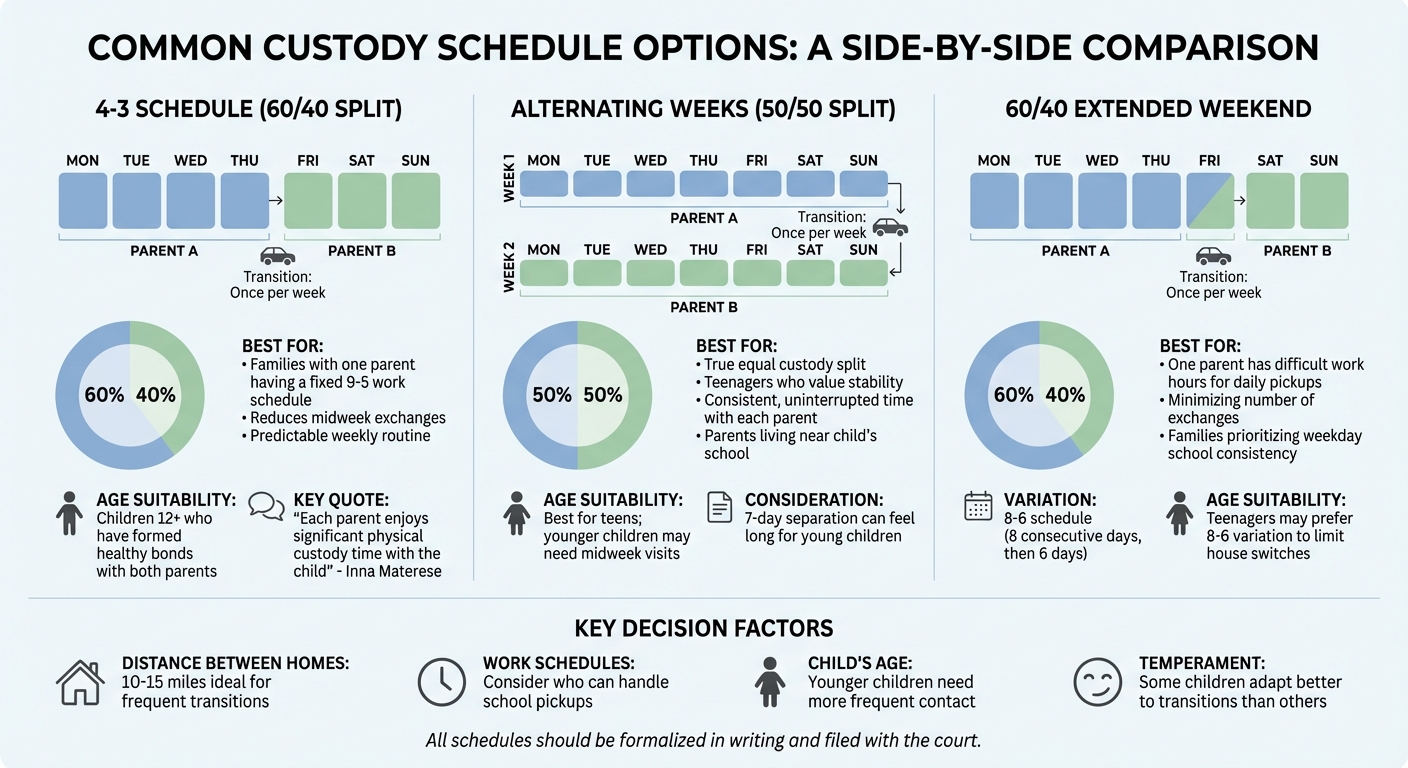
Common Custody Schedules Comparison: 4-3, Alternating Weeks, and 60/40 Plans
Using your family's priorities as a guide, explore these common custody schedules designed to balance stability and flexibility. You can also use AI-generated custody schedules to help minimize friction during the planning process. The right schedule should account for your child's age, the distance between homes and school, and your work commitments.
4-3 Schedule
The 4-3 schedule divides custody on a 60/40 basis, with one parent having four days and the other three. A common arrangement might have one parent caring for the child from Monday morning through Friday afternoon (four overnights), while the other parent takes over for a long weekend from Friday afternoon to Monday morning (three overnights).
This setup creates predictable weekly transitions, making it easier to plan around. Over the course of a year, the parent with the four-day stretch typically has more overnight stays.
"A 60/40 schedule is one where each parent enjoys significant physical custody time with the child, but the co-parents don't have the exact same parenting time."
– Inna Materese, Founder and Managing Attorney, Materese Family Law
The 4-3 schedule often works well when one parent has a fixed 9-to-5 job, as it reduces the need for midweek exchanges.
If you're looking for a schedule that alternates longer blocks of time, consider the following option.
Alternating Weeks Schedule
The alternating weeks schedule offers a true 50/50 custody split, with children spending an entire week with one parent before switching to the other. This arrangement provides consistent, uninterrupted time for both parents and limits exchanges to just once per week. Teenagers, in particular, may appreciate the stability of staying in one home for longer periods.
However, the seven-day separation can feel lengthy for younger children. To address this, some families add a midweek visit or overnight stay to bridge the gap. For younger kids, using a visual calendar can help ease any anxiety about the schedule.
This plan works best when both parents live near the child's school and maintain similar routines and household rules. Its simplicity - only one exchange per week - can also be helpful for parents navigating high-conflict situations.
For those needing even more flexibility, the 60/40 schedule offers additional options.
60/40 Schedule
This schedule expands on the 4-3 model, offering variations to fit families with specific work or school needs. One option, the "Every Extended Weekend" schedule, assigns weekday responsibilities to one parent while the other enjoys extended weekends. Another variation, the 8-6 schedule, alternates eight consecutive days with one parent and six with the other.
"The 4-3 plan will work well for children above 12 who have already formed healthy bonds with both co-parents. Teenagers may even prefer the 8-6 schedule, limiting the time they need to switch houses."
– Elle Barr, Guardian ad Litem
These variations are ideal when one parent's work hours make daily school pickups difficult or when reducing the number of exchanges is a priority. Be sure to consider school or daycare schedules when deciding on custody splits. Additionally, the parent with 60% of overnights is often designated as the custodial parent, which can influence child support calculations under state laws.
Building Flexibility into Stable Custody Plans
Once you've chosen a custody schedule, it's important to weave in some flexibility that still prioritizes your child's sense of security. Stability doesn't have to mean being rigid - it’s about creating consistent routines while allowing room for life's unpredictability. To make this work, formalizing flexibility with clear guidelines and communication practices is key.
Flexibility Clauses and Communication Rules
Your custody agreement should include written flexibility clauses that allow for occasional adjustments without needing to involve the court. These clauses should define what qualifies as a reasonable change and outline how much notice is required. For instance, non-emergency changes might need at least 48 hours' notice.
When discussing schedule changes, keep the conversation strictly between the parents - never use your child as a messenger. Aim for a professional tone in these discussions: focus on what’s best for your child, stick to the facts, and avoid making personal remarks.
Another helpful addition to your agreement is a Right of First Refusal clause. This ensures that if one parent can’t fulfill their scheduled time, they must first offer the other parent additional time with the child before seeking outside childcare.
Shared Calendars and Adjustment Triggers
To complement these clauses, consider using technology to stay organized. A shared digital calendar can be a game-changer, keeping all custody exchanges, school activities, sports practices, and medical appointments in one easily accessible place. This reduces confusion and helps maintain your child's routine with minimal disruption.
It’s also smart to define adjustment triggers - specific events like a job relocation, shift changes, or developmental milestones - that automatically prompt a review of the custody plan. By setting these triggers in advance, you create a clear and predictable way to adapt as your family’s circumstances evolve.
| Tool/Strategy | Purpose | Impact on Stability |
|---|---|---|
| Shared Calendars | Centralizes all custody, school, and activity schedules | Minimizes confusion and ensures smooth transitions |
| Schedule Change Request Forms | Formalizes requests and keeps a record | Reduces misunderstandings and provides clear documentation |
| Right of First Refusal | Ensures the other parent gets priority for extra time | Increases parenting time while maintaining consistency |
| Adjustment Triggers | Establishes conditions for updating the custody plan | Creates a clear path for adapting to family changes |
In cases where a parent might miss their scheduled time due to work or an emergency, virtual parenting time can help maintain the connection without disrupting the established routine.
"No one schedule fits all, and there are always situations that do not quite fit into a 'regular' routine."
– Lisa Standish, Family Law Attorney
Using Coflo for Custody Planning

Navigating the balance between stability and flexibility in custody arrangements can feel overwhelming, but technology can make the process much simpler. Enter Coflo (https://blog.coflo.app), an AI-powered app designed specifically for co-parenting. Coflo takes the guesswork out of custody planning by creating personalized, research-based schedules tailored to your family's unique needs. It’s a time-saver that can help you avoid hours of research and hefty attorney fees, while staying focused on your child’s wellbeing.
How Coflo Simplifies Custody Decisions
Coflo uses an intuitive system of priority sliders, allowing you to adjust factors like stability, equal parenting time, school consistency, flexibility, and minimizing transitions. The app evaluates more than 10 proven custody patterns, ranking them based on your family’s specific priorities and circumstances.
For instance, if your primary focus is stability and school consistency for a 7-year-old, Coflo might suggest a 5-2-2-5 schedule instead of alternating weeks. On the other hand, if your work involves frequent travel and flexibility becomes a priority, it could recommend a 60/40 arrangement with built-in clauses for adjustments.
This data-driven process helps eliminate decision paralysis. By factoring in your child’s age, your work commitments, and even the distance between homes, Coflo delivers tailored recommendations. As you adjust priorities, the app recalculates in real time, allowing you to explore different scenarios and clearly see how each choice affects your family. This approach ensures that both stability and flexibility - key elements in custody planning - are thoughtfully addressed.
Age-Specific Developmental Guidance
Coflo doesn’t stop at schedules; it also incorporates insights from developmental psychology to ensure age-appropriate recommendations. For toddlers and preschoolers (ages 3–5), the app often suggests schedules like 2-2-3, which promote secure attachments through consistent routines and meaningful interactions. Family law attorney Lisa Zeiderman underscores this approach:
"For very young children, we often start with a 2-2-3 schedule... young children and babies need a consistent routine. They also should interact with both parents meaningfully to form secure, healthy attachments."
For elementary-aged children (6–12), Coflo typically recommends schedules such as 5-2-2-5 or 3-4-4-3, which balance logistical ease with regular contact between parents. When it comes to teenagers, the app often leans toward alternating weeks, respecting their growing need for independence and minimizing disruptions to their social lives. Studies indicate that children in dual-residence arrangements tend to enjoy better health and lower risk factors - provided there’s low conflict and strong cooperation between parents. By aligning custody schedules with your child’s developmental stage, Coflo ensures a plan that adapts to their evolving needs.
Implementation Guides for Each Schedule
Coflo doesn’t just suggest a plan and leave you to figure out the rest. Each recommended schedule comes with a detailed implementation guide. These guides outline the benefits, key considerations, success indicators, and a practical 5-step roadmap to help you transition smoothly. This level of support transforms custody planning into a collaborative process, keeping the focus on your child’s needs while reducing potential conflict. With Coflo, planning becomes less about stress and more about creating a positive, structured environment for your child.
Implementing and Monitoring Your Custody Plan
5-Step Implementation Process
Start by documenting your parenting plan (or using AI tools for custody planning), ensuring both parents sign it, and then file it with the court. This step makes it an official court order, which is enforceable by law. Keep in mind that filing fees may vary depending on your location.
Once the plan is finalized, make sure everyone involved understands it clearly. A great way to do this is by creating a visual schedule - try using a color-coded calendar for easy reference. If the situation calls for it, consider introducing the plan gradually to allow for smoother adjustments during the early stages.
For the first three months, keep a close eye on how well the plan is working. Look for signs of stress or disruptions to routines, as these can indicate areas that may need tweaking. Teresa Mareschal, a Regional Specialist at the University of Missouri Extension, highlights the importance of tailoring the plan to the strengths of both parents:
"The parenting plan should be based on both parents' strengths in meeting the child's needs".
If conflicts arise, address them quickly through neutral mediation. Studies show that mediation can significantly reduce the likelihood of returning to court - only 10% of mediated couples end up back in court after two years, compared to 26% of those who bypass mediation. To keep the plan relevant, schedule annual reviews and make adjustments as necessary. Any changes must also be documented, signed by both parents, and filed with the court to ensure they remain legally binding.
Evaluating and Adjusting Over Time
Once your plan is in place, ongoing evaluation is essential to ensure it continues to meet your child's needs. As children grow, their routines, priorities, and challenges evolve. For example, a custody schedule that works for a 13-year-old may no longer suit a 17-year-old with a busier academic and social calendar. Regular check-ins help keep the plan aligned with your child's development.
Focus on three main areas when reevaluating: how your child is adapting to the routine, the quality of communication between co-parents, and whether both parents are supporting (not obstructing) each other's relationship with the child. For teenagers, consider whether the plan allows for their growing independence and extracurricular commitments. Experts suggest that setting clear boundaries for teens can help them transition safely into adulthood.
When fine-tuning your plan, always prioritize your child's well-being. Think about their emotional connections with both parents, their ties to school and community, and the stability they need to thrive. Even minor adjustments - like changing exchange times to avoid traffic or shifting weekends to fit a sports schedule - can make a big difference in how smoothly the plan works. The goal is to keep improving the arrangement over time, rather than expecting it to be flawless from the start.
Conclusion
Crafting a custody plan that balances stability with flexibility isn’t about finding a one-size-fits-all solution - it’s about prioritizing your child’s well-being. Studies reveal that the quality of interactions holds more weight than the exact number of hours spent together. What truly matters is consistent, positive involvement in your child’s daily life.
The most effective custody plans tend to have three key traits: open communication between co-parents, the ability to adapt as children grow, and efforts to shield children from conflict. Julia Fernandez Moreno, a family lawyer and divorce coach, highlights this point perfectly:
"Minimising conflict between you and the other parent is the most important thing for your children's recovery and future wellbeing, as conflict damages children".
For parents navigating this process, tools like Coflo simplify decision-making by offering personalized, data-driven custody schedules. By adjusting sliders for factors like stability, equal time, and school routines, Coflo delivers tailored recommendations, complete with developmental guidance and a clear plan for implementation - all at a fraction of the cost of traditional legal services.
As you finalize your custody plan, remember that it should grow with your child. The needs of a preschooler differ greatly from those of a teenager juggling extracurriculars and social activities. Schedule regular reviews, stay flexible with minor adjustments, and focus on creating an environment where your child can thrive with both parents actively and positively involved.
The ultimate aim is to foster collaboration, maintain clear communication, and commit wholeheartedly to meeting your child’s needs as they evolve.