
Why Routine Matters in Co-Parenting
When parents separate, maintaining consistent routines across both households is critical for a child's emotional stability and development. Predictable schedules help children feel secure, reduce anxiety, and support healthy behaviors. Key elements of successful co-parenting routines include:
- Clear visitation schedules tailored to age-specific needs with set pickup and drop-off times.
- Consistent daily habits like bedtimes, meals, and screen time rules.
- Aligned approaches to discipline and shared values across both homes.
Research shows that children in stable routines experience fewer behavioral issues, better mental health, and improved school performance. On the other hand, inconsistent schedules can lead to stress, confusion, and emotional challenges.
To create effective routines, co-parents should communicate openly, agree on shared priorities, and use tools like shared calendars or apps to stay organized. A written custody plan ensures clarity and helps adjust routines as children grow.
Consistency isn’t about making both homes identical - it’s about providing children with a reliable framework that fosters security and trust.
How Routine Supports Children's Emotional and Behavioral Health
Routines play a crucial role in shaping children's emotional and behavioral responses. When kids know what to expect, they feel a sense of control over their environment, which helps ease anxiety and stress - especially during transitions between two households.
Reducing Anxiety and Stress
A predictable routine gives children a clear sense of what their day will look like, creating a feeling of stability even during uncertain times. Dr. Raisa Ray from The Kids Mental Health Foundation puts it this way:
"Routines help us know what to expect from a situation, which helps us feel in control and can decrease feelings of anxiety."
Research backs this up. A study involving 717 parents of third-graders found that consistent family routines were linked to fewer internalizing problems, such as anxiety, by strengthening family relationships. This sense of predictability becomes even more valuable during transitions between parents' homes, which might otherwise cause stress and uncertainty.
Improving Self-Regulation
Routines do more than reduce anxiety - they also help children develop self-regulation. Structured daily activities teach kids to follow steps and adhere to rules, which naturally builds their ability to manage emotions and behaviors.
One study of 403 mothers found that higher-quality coparenting led to more consistent routines, which in turn boosted children's social-emotional skills. In these cases, children showed better emotional control, empathy, and positive social behaviors.
The impact of routines is striking. Around 75% of parents establish consistent daily routines to create a sense of security and help kids adjust to their surroundings. Children in households with steady routines experience fewer attention issues and behavioral problems compared to those in homes where routines are inconsistent. Even small, everyday activities can make a difference - regular involvement in tasks like cooking or setting the table has been shown to lower conduct issues and overall psychosocial challenges in teens.
The Centers for Disease Control and Prevention (CDC) highlights three key elements that make routines effective:
"Structure is created by consistency, predictability, and follow-through. Kids feel safe and secure because they know what to expect."
When co-parents align in how they respond to behaviors, children learn boundaries without constantly pushing limits. This consistency across households helps kids develop "scripts" for expected behaviors, which strengthens their executive functioning skills.
Age-Specific Needs for Routine
As children grow, their needs around routines change. For younger kids, routines provide a sense of security, while for older children, they help foster independence.
Toddlers and preschoolers depend on routines to feel safe and secure. Repetitive activities like bedtime rituals or shared meals help them manage separation anxiety during transitions between co-parents. At this stage, routines answer basic questions like, "Will my needs be met?" and "Am I safe?"
Older children and teens, on the other hand, benefit from routines as a framework for developing independence and confidence. Regular schedules for homework, chores, and family meals help them build responsibility while reducing power struggles with parents. Giving older kids input in creating their schedules also fosters a sense of autonomy while maintaining structure.
Research involving 349 preschoolers revealed that consistent routines played a key role in mediating the link between maternal marital satisfaction and a child's readiness for school, including academic and social indicators. This shows that routines not only support emotional well-being but also set the stage for future success.
For co-parents, the challenge is to adapt routines to fit a child's developmental stage while ensuring consistency across both homes. Younger children may benefit from visual schedules with pictures, while older kids might prefer written lists that encourage them to take ownership of their responsibilities.
Why Consistency Across Homes Matters
When children move between homes, having aligned core rules is essential. Each home will naturally have its unique rhythm and personality, but it's crucial to agree on key expectations - like bedtime, homework, screen time, and discipline. This doesn’t mean both homes need to mirror each other; it simply ensures kids receive consistent messages about priorities and values.
Aligning Rules Without Being Identical
While every household has its quirks, aligning on shared values is what really makes a difference. For example, agreeing on an 8:30 p.m. bedtime or setting limits on screen time helps children understand that rest and academics are important, no matter where they are.
Research supports this idea, showing that consistent routines play a vital role in preparing kids for school. When parents focus on syncing up in high-impact areas - like bedtime, study habits, screen use, discipline, and even diet - they create a sense of predictability. This predictability doesn’t erase each home’s individuality but instead provides a stable foundation for children to thrive. As Edward Kruk, Ph.D., Professor Emeritus of Social Work at the University of British Columbia, explains:
"The parents will cooperatively share the parenting of the children... This includes respect for one another's parenting style and authority; that is, parents agree to say or do nothing that will harm the relationship of the other parent with their children."
Preventing Confusion and Conflict
When rules vary drastically between homes, children can end up feeling lost. For instance, if one parent allows unlimited video games while the other enforces strict limits, kids may struggle to understand what’s acceptable. This isn’t about kids being defiant - it’s about genuine confusion over expectations.
Beyond behavior, conflicting rules can create emotional strain. Children may feel torn between parents, leading to loyalty struggles that can damage relationships. A 10-year-old boy in a University of Missouri study described this challenge:
"I don't like being the messenger between parents... it just goes back and forth for a while until I quit doing that. I just didn't want to do that anymore."
Unified messages from parents, on the other hand, have a clear impact. MU Extension research points out:
"When children hear the same message from both parents, they are more likely to listen and cooperate."
By aligning expectations, parents allow kids to focus on what truly matters - school, friendships, and hobbies - rather than being caught in the middle of disagreements.
Research on Aligned Parenting Approaches
Studies consistently highlight the benefits of aligned parenting. Research shows that children in homes with consistent and cooperative routines experience fewer behavioral and emotional challenges. They also tend to perform better academically and have improved mental health. On the flip side, disruptions in routine often lead to increased behavioral issues.
Ultimately, creating consistency across homes doesn’t just make daily life smoother - it helps set the stage for a child’s long-term well-being and success.
How Custody Schedule Consistency Affects Behavior
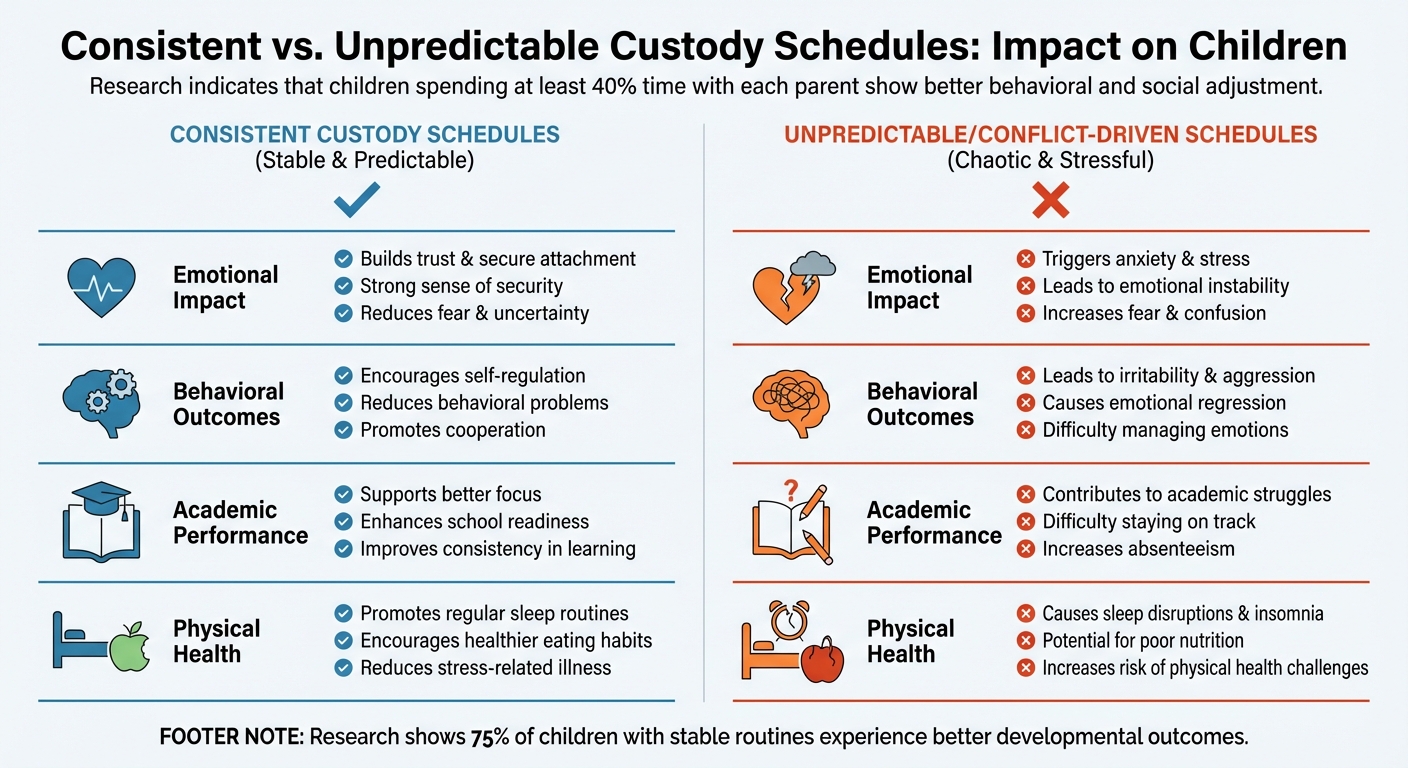
Consistent vs Unpredictable Custody Schedules: Impact on Children
A predictable custody schedule plays a vital role in shaping children’s behavior, complementing the benefits of routine. When children know exactly what to expect week after week, they can channel their energy into growth, learning, and forming healthy relationships. Stability in custody arrangements isn’t just a logistical convenience - it’s a cornerstone of their emotional and behavioral well-being.
Short- and Long-Term Behavioral Effects
Unpredictable custody schedules can throw a wrench into a child’s sense of stability. Sudden or irregular transitions often disrupt sleep, increase irritability, and make it harder for kids to stick to learned behaviors. This uncertainty can lead to what researchers call "negative arousal", a state that makes managing emotions and actions much harder.
Over time, these disruptions can snowball. A study of 2,353 children revealed that about 75% maintained stable routines during their preschool years, and these children showed better outcomes overall. On the flip side, kids whose routines became less consistent over time experienced more attention problems, acting-out behaviors, and social withdrawal. For older kids and teenagers, frequent changes in family structure have been linked to higher rates of delinquency and substance use. These findings highlight how crucial a steady custody schedule can be for a child’s development.
Benefits of Predictable Custody Patterns
Consistent custody schedules do more than just keep the peace - they actively support healthy development. Research shows that children in stable routines experience fewer behavioral and emotional challenges. For example, those in "stable-high" routine groups are less likely to face attention issues or externalizing problems compared to kids with inconsistent schedules. Dr. Diane Bales, an expert in human development at the University of Georgia, explains:
"The developing brain thrives on repetition. When a baby experiences the same things over and over, the pathways of connections in her brain become stronger and more complex."
This stability also translates into measurable benefits in school. Predictable routines are closely tied to improved readiness for school, helping boost early math, language, and literacy skills. Additionally, research shows that children who spend at least 40% of their time with each parent tend to exhibit better behavioral and social adjustment.
Comparison: Consistent vs. Unpredictable Schedules
The differences between consistent and unpredictable custody schedules are striking. Here’s a closer look:
| Feature | Consistent Custody Schedule | Unpredictable/Conflict-Driven Schedule |
|---|---|---|
| Emotional Impact | Builds trust, secure attachment, and a strong sense of security | Triggers anxiety, stress, and emotional instability |
| Behavioral Outcomes | Encourages self-regulation and reduces behavioral problems | Leads to irritability, emotional regression, and difficulty managing emotions |
| Academic Performance | Supports better focus and school readiness | Contributes to academic struggles and difficulty staying on track |
| Physical Health | Promotes regular sleep and healthier eating habits | Causes sleep disruptions and potential health challenges |
When children can rely on a stable schedule, they’re free to focus on what truly matters - learning, playing, and building meaningful relationships. A predictable routine isn’t just about managing time; it’s about giving kids the secure foundation they need to thrive.
sbb-itb-a09457a
How to Create and Maintain Routine in Co-Parenting
Establishing consistent routines across two households requires more than just good intentions - it calls for a clear, written agreement that both parents can stick to. Turning vague ideas into a concrete plan is the key to building stability.
Building a Shared Routine Plan
Start by having each parent outline what a typical week looks like from their perspective. This "time survey" approach helps pinpoint where your routines already align and where adjustments are needed. Your plan should cover essential aspects like overnight stays, caretaker schedules (including meals, homework, and bedtime), recreational time, and decision-making responsibilities for areas like education, health, and religion.
Be specific. Include exact pickup and drop-off times, as well as exchange locations, to avoid misunderstandings. Standardizing daily anchor routines - like bedtimes, wake-up times, meal schedules, and hygiene habits (e.g., baths and brushing teeth) - can provide children with a sense of stability, even when they move between homes.
Once you’ve drafted your plan, test it over a trial period of 6–12 months. Children’s needs change, so your routines may need to evolve too. Putting everything in writing ensures everyone knows what to expect and offers a point of reference if disagreements arise.
As Edward Kruk, Ph.D., Professor Emeritus of Social Work at the University of British Columbia, explains:
"The parents will cooperatively share the parenting of the children, with co-parenting defined as having two core elements: shared responsibility for important decision-making as well as the daily routine parenting of the children".
Once your plan is in place, maintaining it requires effective communication between co-parents.
Communicating Effectively for Consistency
A well-thought-out plan can only succeed with clear communication. Stick to direct methods like text, email, or phone calls to avoid putting children in the middle as messengers, which can cause unnecessary emotional stress. Keep conversations focused on child-related matters and limit them to pre-agreed times.
Schedule regular check-ins - whether weekly or monthly - to review your child’s progress and make any necessary adjustments to the routine. A shared digital calendar can be a lifesaver for tracking school events, medical appointments, and extracurricular activities, ensuring both parents stay informed in real time. Research shows that effective communication supports consistent routines, which in turn can lead to better school readiness.
Handovers should always be positive and courteous to minimize stress for everyone involved. While sticking to the schedule provides predictability, be flexible when genuine emergencies or special opportunities arise. As noted by the Centers for Disease Control and Prevention:
"Structure is created by consistency, predictability, and follow-through. Routines teach children what to expect throughout the day".
For additional support, digital tools can help streamline communication and routine management.
Using Coflo to Support Routine

Coflo, an AI-powered tool, can make routine planning easier and more effective. Instead of starting from scratch or getting stuck in debates, you can use Coflo’s priority sliders to adjust factors like stability, equal time, and school consistency. The platform then generates personalized custody schedule recommendations that fit your family’s specific needs.
Coflo also provides age-specific insights for children at different stages - whether they’re 3–5, 6–9, or 10–12 years old - along with a step-by-step guide to help you navigate transitions smoothly. This makes it a valuable resource for keeping your co-parenting routine adaptable and research-informed.
Conclusion
Establishing consistent routines and predictable custody schedules is crucial for supporting your child's emotional well-being and overall development. When children have a clear sense of what to expect, they tend to feel more secure, regulate their emotions more effectively, and exhibit fewer behavioral challenges. Research even shows that consistent routines play a direct role in preparing children for school - boosting both academic skills and social-emotional development.
To maintain this stability, cooperative parenting is vital. Edward Kruk, Ph.D., Professor Emeritus of Social Work at the University of British Columbia, highlights the importance of shared responsibilities in co-parenting:
"The parents will cooperatively share the parenting of the children, with co-parenting defined as having two core elements: shared responsibility for important decision-making as well as the daily routine parenting of the children".
Aligning on shared expectations is essential to making this approach work effectively.
Creating effective routines starts with clear communication, a well-defined plan, and a willingness to adapt. Written agreements help ensure that both parents are on the same page and offer a reference point for resolving any uncertainties. It's a good idea to test your plan for 6–12 months and make adjustments as your child's needs change over time. This includes creating age-appropriate holiday custody plans that evolve with your child.
Platforms like Coflo simplify custody planning, offering tools that turn complicated decisions into child-centered solutions. Coflo provides custody schedule recommendations based on research, insights tailored to your child’s developmental stage, and step-by-step guidance for implementation. This collaborative approach ensures that your child’s well-being remains the top priority.
With thoughtful planning, effective tools, and a commitment to cooperation, you can create a stable, nurturing environment that allows your child to thrive in both homes.