
5 Ways Technology Improves Co-Parenting
Co-parenting can be challenging, especially when communication breaks down or emotions run high. Technology offers solutions to common issues like poor communication, scheduling conflicts, and financial disputes. Here's how:
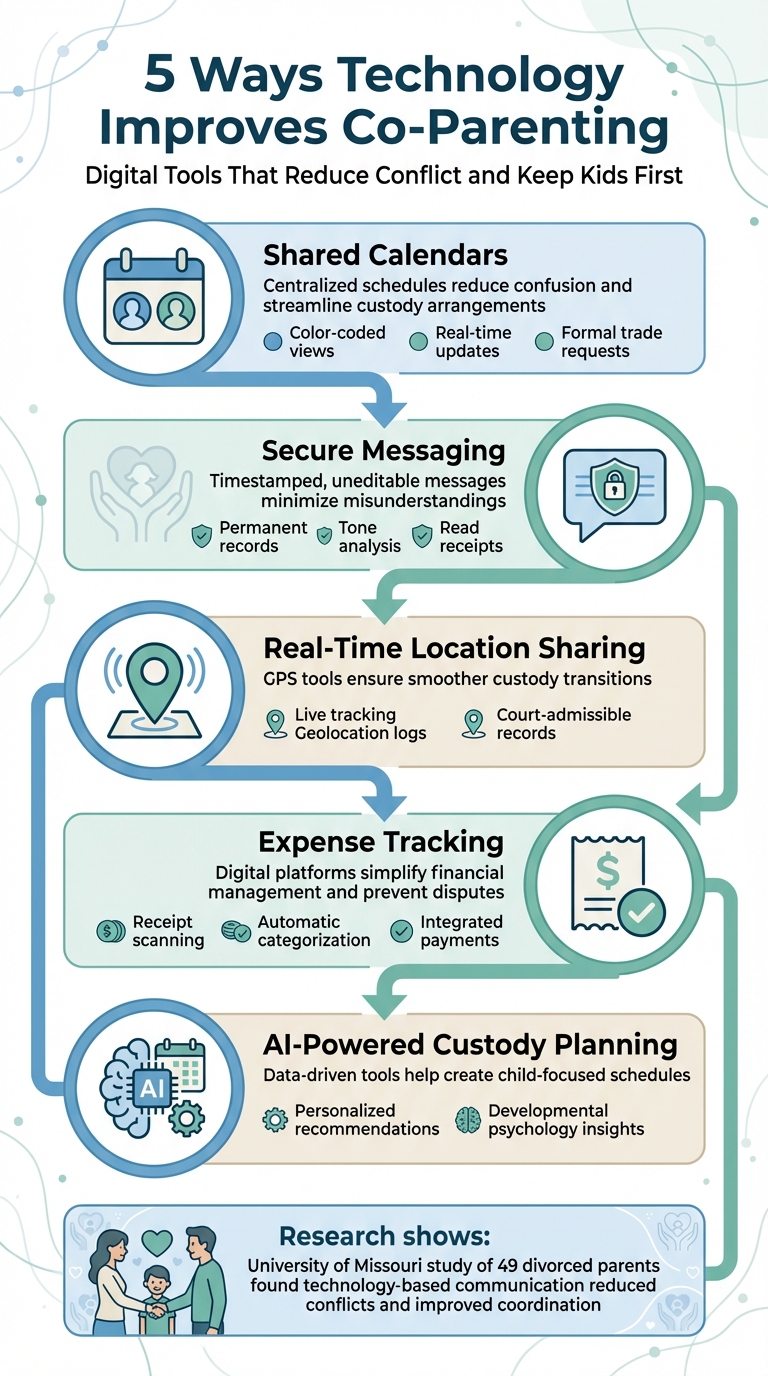
- Shared Calendars: Centralized schedules reduce confusion and streamline custody arrangements.
- Secure Messaging: Timestamped, uneditable messages minimize misunderstandings.
- Location Sharing: GPS tools ensure smoother custody transitions.
- Expense Tracking: Digital platforms simplify financial management and prevent disputes.
- AI-Powered Custody Planning: Data-driven tools help create child-focused schedules.
These tools help parents stay organized, reduce conflict, and keep the focus on their child's well-being. By replacing emotional exchanges with structured communication, technology makes co-parenting less stressful and more efficient.
5 Ways Technology Improves Co-Parenting Communication and Organization
How Technology Helps Co-Parents
Digital tools bring much-needed structure to co-parenting by replacing scattered texts and tense phone calls with a centralized platform. These tools keep everything - schedules, medical records, school updates, and expenses - in one place, making communication more organized and less stressful. This setup encourages clearer interactions and reduces misunderstandings.
Features like timestamps, read receipts, and uneditable message logs further boost accountability. They eliminate "he said/she said" arguments and provide court-admissible evidence when necessary. Research from the University of Missouri, which involved 49 divorced parents, found that email communication helped reduce conflicts and streamline shared responsibilities. Some apps even include AI tools like ToneMeter, which can flag inflammatory language before a message is sent, helping to keep conversations civil.
Technology also creates a buffer for emotional exchanges, protecting both parents and children. Attorney Shelly M. Ingram highlights this benefit:
"By providing a platform to structure (and limit) communication, a parent can take the time they need to craft a thoughtful response that focuses on their child, rather than on the conflict with their co-parent".
Apps that handle logistics directly spare children from being messengers between parents. Shared, real-time calendars make it easy to update schedules, track doctor appointments, and coordinate extracurricular activities - all without the need for direct interaction.
By shifting communication from reactive to intentional, technology helps create a healthier co-parenting dynamic. As co-parenting coach Teresa (Harlow) Luse puts it:
"Technology won't solve every issue, but the right app can give you a framework for healthier communication, better coordination, and clearer documentation".
1. Shared Calendar and Scheduling Apps
Ease of Scheduling and Coordination
Shared calendar apps simplify co-parenting by providing a centralized hub for custody schedules, school events, and medical appointments. Instead of digging through endless texts or emails, both parents can access the same up-to-date information in real time. Many apps use color-coded calendars - like blue for one parent and green for the other - making it easy to see responsibilities at a glance.
When plans change, these apps handle adjustments with formal trade requests, avoiding the need for stressful phone calls. One parent proposes a switch, the other approves or declines, and the app timestamps everything for clarity. This feature eliminates disputes over what was agreed upon and when. Some apps even track time allocations, ensuring transparency for child support considerations.
By streamlining these processes, shared calendars set the stage for more efficient and less stressful communication.
Facilitation of Effective Communication
These tools go beyond scheduling - they also promote clear, low-conflict communication. Real-time updates help prevent double-bookings and keep both parents informed about important events without the need for constant calls or texts.
"In instances where one parent doesn't want to talk to the other or they choose to relay messages through the children... co-parenting apps can act as a mediator allowing for fewer miscommunications." - Saba Harouni Lurie, LMFT and Founder of Take Root Therapy
Additionally, many apps securely store vital information, so both parents can access it whenever needed. Some platforms even offer view-only access for older children, helping them feel more involved and reassured by knowing their schedules in advance.
Safety and Transparency During Transitions
Features like GPS check-ins add an extra layer of accountability. With a simple tap, parents can provide geotagged, timestamped proof of their arrival, which can be helpful if punctuality is ever questioned.
Shared calendars also allow for handoff notes, where parents can specify key details like who’s driving, pickup locations, or items the child needs (such as sports equipment, medication, or homework). This level of detail reduces last-minute confusion and keeps transitions smooth, ensuring the child feels supported and prepared.
2. Secure Messaging and Communication Tools
Facilitation of Effective Communication
Secure messaging platforms offer a dedicated space for communication, keeping interactions professional and focused on parenting matters rather than personal disputes. Unlike standard texting or social media, these tools provide permanent, timestamped records that cannot be altered or deleted, helping to avoid "he said/she said" misunderstandings.
One of the standout benefits is the opportunity for parents to take their time when responding. This can be especially helpful during tense moments. Family law attorney Shelly M. Ingram highlights this advantage:
"By providing a platform to structure (and limit) communication, a parent can take the time they need to craft a thoughtful response that focuses on their child, rather than on the conflict with their co-parent".
Many of these platforms now include tone analysis features, which act as a built-in filter for communication. For instance, these tools can flag aggressive or confrontational language and suggest edits before the message is sent. Additionally, some apps categorize messages by topics like medical needs, school updates, or extracurricular activities, ensuring that logistical planning stays organized and free from unrelated personal conflicts.
These features create a solid foundation for accountability, which is explored further in the next section.
Safety and Transparency During Transitions
Features such as read receipts and view tracking provide clarity on when messages are opened, reducing disputes over whether critical information was received. This is especially useful for handling last-minute schedule changes or sharing essential details about pick-ups and drop-offs.
In high-conflict situations, many platforms allow third-party access for professionals like attorneys, mediators, or therapists. This enables them to monitor communication without requiring additional court involvement. Judges are increasingly recommending or mandating the use of these tools because they offer objective, court-admissible records. Research from the University of Missouri, which studied 49 divorced parents, found that using technology like email helped reduce tension and improve the management of separate households.
3. Real-Time Location Sharing and Safety Features
Safety and Transparency During Transitions
Real-time location sharing adds a practical layer of reliability to co-parenting exchanges, complementing secure messaging and scheduling tools. With GPS tracking, custody transitions become smoother and safer, removing much of the uncertainty. For example, if one parent is running late, the other can simply check their location on a map instead of sending potentially stressful texts or making calls that could distract someone while driving. Anne Parris, Managing Partner at Midlife Boulevard, highlights this convenience:
"It has a great messaging system, and the kids and I can see each other's location on a map through GPS. If they are running late, I don't have to worry".
This real-time visibility not only reduces immediate anxiety but also serves as a foundation for accountability. Location logs generated by some apps can provide court-admissible records to confirm custody compliance. Elise Buie, Founder of Elise Buie Family Law, underscores the legal importance of these logs:
"Fayr... provides a geolocation log, which offers a court a verifiable way to log your presence at any given time. This means that you and your co-parent can keep each other accountable".
For parents navigating high-conflict or abusive situations, safety features become even more critical. The National Network to End Domestic Violence advises using apps with scheduled check-ins instead of constant tracking. Their Safety Net Project explains:
"An app feature that prompts a user to upload a location at a scheduled time presents more safety options than an app that requires location to be constantly on".
This approach ensures accountability during scheduled exchanges while minimizing risks like stalking. Parents in these situations should also take extra precautions, such as enabling multi-factor authentication for their accounts and stripping metadata from photos before sharing them, as metadata can inadvertently reveal location details.
sbb-itb-a09457a
4. Expense Tracking and Financial Management Platforms
Reduction of Financial Disputes
Expense tracking platforms bring much-needed clarity to co-parenting by centralizing financial records in one place.
Money matters can quickly become a source of tension, especially when receipts go missing or payment details are unclear. With financial management platforms, parents can rely on a single, shared digital ledger where every expense is logged and stored. Whether it’s medical bills, school supplies, or extracurricular fees, both parents can upload receipts instantly using their smartphone cameras. This eliminates the need to hunt for paper receipts and reduces the likelihood of disagreements.
These tools go beyond tracking expenses - they integrate seamlessly with scheduling and messaging systems to create a comprehensive co-parenting solution. Instead of informal texts, parents can send structured reimbursement requests through the app. These requests can be approved, declined, or paid directly within the platform, cutting down on the emotional strain that often accompanies financial discussions. As Kenny Levine, LCSW and Co-Parenting Therapist, puts it:
"This transparency in financial matters can reduce stress and help avoid disputes over money, which is often a significant source of tension in co-parenting relationships."
Many of these apps also include integrated payment systems, automatically recording every transaction. This ensures there’s an unchangeable, timestamped record accessible to both parents. Real-time notifications prevent surprise expenses from piling up, and some platforms even generate court-admissible reports to demonstrate compliance with child support orders.
For added convenience, expenses can be categorized instantly (e.g., "Medical", "School Supplies", "Extracurricular") and exported as summaries for legal or mediation purposes. Mobile scanning features allow receipts to be attached at the time of purchase, avoiding disputes over lost documentation. With free versions available and premium features offered at reasonable costs, these platforms are far more affordable than resolving financial conflicts through legal channels.
5. Coflo: AI-Powered Custody Planning and Decision Support
Child-Focused, Research-Backed Decision-Making
When it comes to co-parenting, managing daily logistics like shared calendars and secure messaging is only part of the equation. The bigger challenge often lies in creating a custody schedule that works for everyone - especially the child. This is where AI steps in to make custody planning less overwhelming and more effective.
Coflo uses artificial intelligence to tailor custody schedules based on your family’s specific needs and priorities. Instead of relying on generic templates or guesswork, parents can adjust sliders to set preferences for factors like stability, equal time, and school consistency. The platform then analyzes these inputs and provides ranked custody schedules supported by insights from developmental psychology.
Each suggested schedule comes with a breakdown of its benefits, potential challenges, and a detailed implementation plan. For younger children, recommendations focus on routines and attachment security and cognitive development, while for older kids, they prioritize independence and consistency with social and school activities. By relying on objective data rather than emotions or memory, Coflo serves as a neutral guide, helping parents make informed decisions. It even takes into account school calendars and extracurricular commitments to ensure stability and flag potential communication gaps - all while keeping the child’s well-being front and center.
This AI-driven approach offers professional-grade guidance at a fraction of the cost of attorneys or mediators. By combining developmental psychology with advanced technology, Coflo adds a powerful tool to the co-parenting toolkit, simplifying custody planning and keeping the focus where it belongs: on the child’s best interests.
Conclusion
Co-parenting doesn't have to be a constant source of stress or conflict. The five tools discussed - shared calendars, secure messaging, location sharing, expense tracking, and AI-powered custody planning - offer a practical way to streamline communication, reduce emotional friction, and keep the focus where it belongs: your child's well-being.
Research backs this up. A University of Missouri study involving 49 divorced parents found that using technology like email helped defuse tense conversations. It gave parents the chance to respond thoughtfully rather than reacting on impulse. By consolidating communication, schedules, and financial matters, these tools also prevent children from being placed in the middle as messengers - a situation that can heighten their stress and anxiety.
Experts agree that these platforms provide structure, improve accountability, and reduce misunderstandings, fostering a more balanced and child-centered co-parenting dynamic. Features like timestamped messages and shared schedules promote transparency, making it easier to avoid disputes.
Today's co-parents have access to digital tools that previous generations could only dream of. Whether you're organizing day-to-day logistics with a shared calendar or making complex custody decisions with the help of AI, these technologies offer a way to prioritize your child's stability and happiness. With the right mix of these tools, co-parenting can shift from being a daunting task to a cooperative effort focused on raising healthy, thriving children.