Stability vs. Flexibility in Custody Schedules
When creating a custody schedule, the main question is whether to focus on stability or flexibility. Stability provides a predictable routine, which is especially helpful for younger children and families with high conflict. Flexibility, on the other hand, allows adjustments for work, travel, or a child’s changing needs - better suited for cooperative parents or teenagers with busy schedules.
Key points to consider:
- Stability: Offers emotional security, supports school and social routines, and minimizes co-parent conflicts.
- Flexibility: Handles life’s unpredictability, encourages co-parent cooperation, and meets older children’s or teens' dynamic needs.
- Challenges: Stability can feel rigid for parents with irregular schedules, while flexibility may lead to conflicts or disrupt routines.
The best custody plan balances your child’s age, needs, and family circumstances. Younger children thrive on consistency, while teens benefit from more freedom. Regularly revisiting the plan ensures it stays relevant. Tools like Coflo can help customize schedules, making the process smoother for everyone involved.
Benefits of Stability-Focused Custody Schedules
Emotional Security for Children
Divorce can shake a child's sense of stability, but a consistent custody schedule can serve as a comforting anchor. Knowing exactly where they'll be each night helps ease worries about their living situation and future, offering a sense of security during an uncertain time.
"A consistent routine helps children feel more secure during the challenging time following their parents' separation." - Johnson, Johnson, & Nolan
Regular schedules also promote secure attachment, allowing children to focus on their daily lives rather than the stress of transitions. According to attachment theory, when kids experience predictable and responsive interactions with both parents, they gain better self-regulation skills and confidence to explore their world.
For families where co-parent communication is strained, a structured schedule can reduce the need for frequent interaction, shielding children from potential conflicts and minimizing their exposure to parental tension.
This sense of stability not only supports emotional well-being but also sets the stage for success in school and social settings.
Support for Academic and Social Development
Predictable transitions - especially those timed at the end of the school day - help children stay on top of homework and remain active in extracurricular activities.
"School-age children want to belong to peer groups and have a strong drive toward competition and mastery of intellectual/cognitive, physical and social challenges... schedule consistency [allows] children to make plans with peers and see their activities through on a consistent basis." - M. Kline Pruett, Ph.D. and N. Najman, Encyclopedia on Early Childhood Development
Whether it's soccer practice or piano lessons, a regular schedule ensures kids can attend their activities, build skills, and maintain friendships. Studies indicate that children who spend at least 40% of their time with each parent in a dependable arrangement tend to show better behavioral and social outcomes.
Clear routines also make co-parenting smoother, reducing the stress of daily logistics.
Smoother Co-Parenting Dynamics
For co-parents who struggle to communicate effectively, a stability-focused schedule with fewer exchanges can be a game-changer. Clear and predictable expectations help avoid misunderstandings about pickups and drop-offs.
"A parenting plan arrangement... should foster a decreased level of conflict, provide sufficient structure so that both parents are clear about the routines and expectations in each home." - Michael Saini, Ph.D., Professor and Chair in Law and Social Work at the University of Toronto
When the schedule is consistent, both parents can plan their work and personal lives with confidence, reducing the stress that often fuels conflict. Fewer transitions also mean fewer opportunities for tense interactions, creating a calmer environment for everyone involved.
sbb-itb-a09457a
Challenges of Stability-Focused Custody Schedules
Limited Flexibility for Parents
A consistent routine has its perks, but strict custody schedules can become a real headache when life throws curveballs. Parents with unpredictable jobs - like healthcare workers, firefighters, or IT specialists - often find it tough to stick to rigid arrangements. Emergencies, like a family member’s surgery or an out-of-town crisis, can make these schedules nearly impossible to follow.
Courts don’t make changes lightly, either. To modify a custody order, you usually need a "material change in circumstances", and most judges don’t see short-term work changes or brief personal issues as enough reason to alter the plan.
"A minor or temporary shift, such as a brief fluctuation in work hours, may not be substantial enough to support a modification unless it demonstrably affects the existing parenting plan." - Justia
This rigidity can spark tension between co-parents, especially if one insists on sticking to the schedule during the other’s genuine emergency. And it’s not just the parents who feel the pressure - kids can get caught in the middle too. For example, a child might miss a special event, like a father-daughter dance, simply because it doesn’t fall on the "right" parent’s night.
The challenges don’t stop at short-term crises; long-term changes can be even harder to navigate.
Difficulty Adapting to Life Changes
Major life shifts, like a parent relocating for work, can throw a wrench into even the most stable custody plans. Typically, the moving parent must give 30 to 60 days' notice, but courts can block the move if it disrupts the current routine - even if the relocation is financially necessary for the family.
As kids grow, their needs evolve too. A schedule that worked perfectly for a toddler might feel stifling to a teenager who wants to attend weekend sports tournaments or hang out with friends.
"Adolescents want flexibility to adjust the schedule to meet their needs rather than their parents adjusting it for their own." - Justice Canada
Without room for reasonable adjustments, these rigid schedules can create even more conflict. Whether it’s a home renovation, a last-minute work trip, or a child’s changing extracurricular activities, life’s unpredictability doesn’t always fit neatly into a set custody plan.
Benefits of Flexibility-Focused Custody Schedules
Flexibility-focused custody schedules are designed to adapt to life's inevitable changes, offering a more dynamic approach compared to rigid, stability-centered plans.
Adjusting to Life's Changes
Life doesn’t always follow a set routine, and flexible custody arrangements reflect that reality. These plans often use annual day counts instead of fixed weekly cycles, making it easier for parents to navigate unexpected work travel, shift changes, or personal emergencies. For instance, a flexible 60/40 split or a 4-3 rotation can align with differing work schedules, such as a teacher working weekdays and a healthcare worker covering weekends.
This approach can also help lower childcare expenses when one parent's work demands shift unexpectedly. In a 60/40 schedule, one parent might have 219 overnights while the other has 146 - a difference of 73 nights per year.
"Parents whose work obligations prohibit them from being able to facilitate school or childcare transportation... may benefit from having slightly less physical custody during the week." - Inna Materese, Founder and Managing Attorney, Materese Family Law
By accommodating logistical challenges, these schedules encourage smoother co-parenting dynamics.
Encouraging Cooperative Co-Parenting
Flexibility isn’t just practical - it also promotes cooperation between co-parents. When one parent is open to adjusting the schedule, the other is more likely to respond in kind. Having a clear, flexible plan in place removes the discomfort of asking for changes due to family emergencies, home projects, or other unforeseen events.
"If you're willing to be flexible, your co-parent will likely be more inclined to return the favor." - Lancaster and St. Louis, PLLC
These arrangements also ensure children spend time with an available parent instead of relying on third-party childcare. In situations where conflict is higher, using neutral exchange points like schools or daycare centers can minimize direct interactions while maintaining consistent quality time with each parent.
Meeting the Needs of Teens and Older Children
As children grow, their schedules and priorities shift. Studies show that teens value the ability to adjust custody plans to fit their activities, such as sports, music, or social events, rather than adhering to their parents' schedules.
"In general, however, adolescents want flexibility to adjust the schedule to meet their needs rather than their parents adjusting it for their own." - Justice Canada
Flexible custody setups allow teens to attend school dances, compete in weekend tournaments, or manage heavy homework loads without being restricted by a rigid plan. Many older kids even begin negotiating time directly with each parent, fostering a sense of independence and responsibility. This approach helps them feel more at home in both households, rather than feeling like they’re constantly in transit.
Challenges of Flexibility-Focused Custody Schedules
While flexibility in custody arrangements might sound ideal, it often comes with challenges that can affect both parents and children.
Potential for Increased Conflict
Flexible custody schedules demand ongoing coordination, which can quickly become a breeding ground for disputes. Without a clear, fixed plan, one parent might exploit the arrangement by arbitrarily denying the other's requests, creating a power imbalance and eroding trust. This dynamic is even more problematic for parents with high levels of conflict, as the frequent communication needed to manage such schedules often escalates tensions.
The conflicts aren’t limited to major decisions - they often boil down to everyday logistics. Issues like forgotten clothing, disagreements over transportation, or last-minute changes can spark arguments that strain co-parenting relationships. These disputes also disrupt the stable environment children need to thrive.
"The issue with having parenting time contingent upon the agreement of the parties is that the potential exists for one party to control the parenting time of the other by arbitrarily deciding to deny requests." - Melissa Pearce, Family Law Attorney
Disruption to Child Routines
The logistical challenges of flexible schedules often spill over into the child’s daily life, disrupting essential routines. For younger children, consistency is critical for their emotional and developmental well-being. Unpredictable schedules can interfere with school attendance, meal times, and bedtimes, leaving children confused and anxious. For those under five, this lack of consistency can even hinder the formation of secure attachments.
"Frequent changes in parenting time schedules can disrupt young children's sense of stability and result in emotional issues." - Melissa Pearce, Attorney
Older children aren't immune to these disruptions either. Sudden changes can throw off homework, extracurricular activities, and social plans. On top of that, moving between homes with differing rules and expectations adds another layer of stress. To avoid turning flexibility into chaos, parents should establish a minimum notice period - usually 24 to 48 hours - for any schedule changes. This approach helps maintain some level of predictability for everyone involved.
Stability vs. Flexibility Comparison Table
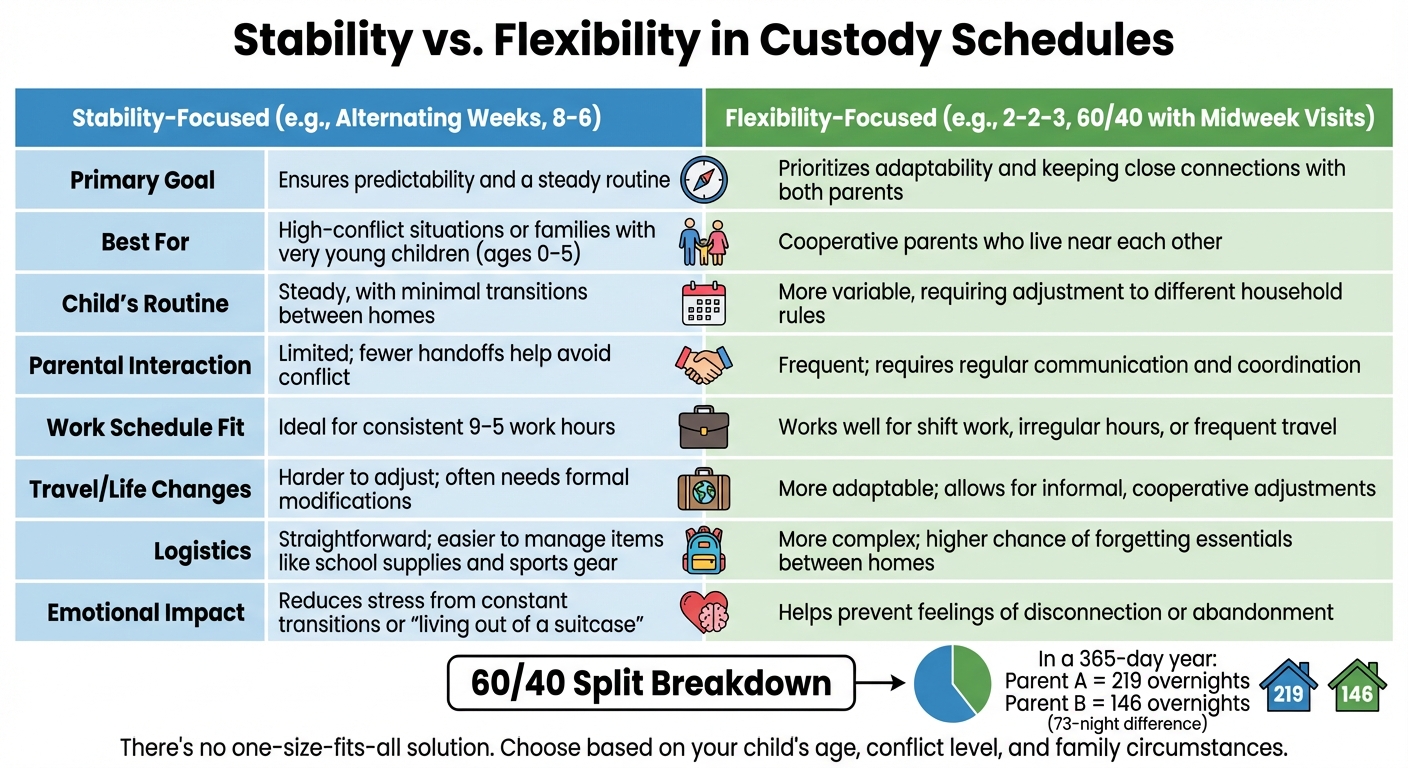
Stability vs Flexibility in Custody Schedules: Complete Comparison Guide
Here’s a look at how stability-focused and flexibility-focused custody schedules compare across important co-parenting factors:
| Factor | Stability-Focused (e.g., Alternating Weeks, 8-6) | Flexibility-Focused (e.g., 2-2-3, 60/40 with Midweek Visits) |
|---|---|---|
| Primary Goal | Ensures predictability and a steady routine | Prioritizes adaptability and keeping close connections with both parents |
| Best For | High-conflict situations or families with very young children (ages 0–5) | Cooperative parents who live near each other |
| Child's Routine | Steady, with minimal transitions between homes | More variable, requiring adjustment to different household rules |
| Parental Interaction | Limited; fewer handoffs help avoid conflict | Frequent; requires regular communication and coordination |
| Work Schedule Fit | Ideal for consistent 9–5 work hours | Works well for shift work, irregular hours, or frequent travel |
| Travel/Life Changes | Harder to adjust; often needs formal modifications | More adaptable; allows for informal, cooperative adjustments |
| Logistics | Straightforward; easier to manage items like school supplies and sports gear | More complex; higher chance of forgetting essentials between homes |
| Emotional Impact | Reduces stress from constant transitions or "living out of a suitcase" | Helps prevent feelings of disconnection or abandonment |
For perspective, in a 365-day year, a 60/40 split means one parent has 219 overnights, while the other has 146 - a difference of 73 nights. This gap can significantly influence daily routines, depending on your child’s age, the level of conflict, and how well both parents coordinate.
"While a split week can be desired by parents for many reasons, a child-centric focus upon what is best for the kids is critical." - Brendan Hammer, Mediator and Consultant
There’s no one-size-fits-all solution. Stability works best for families dealing with conflict or for younger children who thrive on consistency. Flexibility, on the other hand, is better suited for cooperative parents and older kids with busier, more dynamic schedules. Up next, we’ll explore how these approaches align with joint custody and cognitive development across different ages.
Child Age and Developmental Considerations
A child's stage of development plays a crucial role in determining whether a stable or more adaptable custody arrangement will best meet their needs. As the New York Family Law Group explains, "what works for a 2-year-old can harm a 12-year-old, and what a teenager needs would overwhelm a preschooler". Custody plans should align with the child’s developmental stage, and the following sections outline how these needs evolve from early childhood through adolescence.
Custody for Young Children (Ages 0-5)
For young children, predictable routines and frequent contact with both parents are essential. During this stage of rapid brain development, consistent caregiving is critical for fostering secure attachment. Studies indicate that children under three experience heightened biological stress when separated from a parent for more than 24 hours.
At this age, frequent but shorter visits work better than long separations. For example, 2-3 hour visits several times a week are often more effective than extended, less frequent stays. By age four, children with overnight arrangements often show improved behavioral adjustment and closer relationships with their fathers.
Consistency across both households is key. Similar bedtime routines, meal schedules, and familiar comfort items help create a sense of security. As the Encyclopedia on Early Childhood Development highlights, "When children are young, their ability to regularize their sleeping and eating, and become trusting that their needs will be met, are to be emphasized". Parenting plans for this age should be revisited regularly to adapt as the child grows and their ability to handle change improves.
Custody for School-Aged Children (Ages 6-12)
School-aged children are better equipped to handle longer separations and benefit from custody schedules that balance academic stability with quality time with both parents. Arrangements like week-on-week-off or 2-2-5-5 rotations often work well, as children in this age group can maintain connections despite longer gaps.
For these children, the focus shifts to supporting homework routines, extracurricular activities, and friendships. Using schools or daycare as neutral exchange points can help reduce conflict and simplify transitions. While predictability remains important, school-aged children are capable of understanding and adapting to structured custody schedules. By ages 12–14, children’s preferences often carry more legal weight in custody decisions. At this stage, the added academic and social demands make it increasingly important to consider their input when planning schedules.
Custody for Teens (Ages 13+)
Teenagers require a high degree of flexibility and autonomy in their custody arrangements. Their lives are often packed with social commitments, part-time jobs, sports, and academic responsibilities, making rigid schedules less practical. Guardian ad Litem Elle Barr notes, "Teenagers may even prefer the 8-6 schedule, limiting the time they need to switch houses".
For teens, a primary home base with fluid movement between households is often the most effective setup. While week-on-week-off schedules can provide structure, it’s important to allow adjustments based on their changing commitments. Reviewing the custody plan every three to six months ensures it stays aligned with their evolving needs.
Including teens in custody decisions is crucial. As they grow more independent, a collaborative approach that blends structure with flexibility is essential to support their development and busy lives.
Parental Work Schedules and Practical Implementation
Work schedules often don’t align with the standard custody arrangements many are familiar with. Parents working in fields like healthcare, law enforcement, or manufacturing frequently deal with rotating shifts or irregular hours, making traditional alternating-weekend plans impractical. To accommodate this, custody arrangements must be customized to fit the realities of each parent's work calendar.
Accommodating Shift Work or Irregular Hours
For parents juggling 12-hour shifts or rotating schedules, custody plans based on actual work hours can be a game-changer. Instead of sticking to fixed days, parenting time is aligned with the parent’s availability. For instance, a nurse working three consecutive 12-hour shifts might have custody during their four days off, while the other parent takes over on workdays.
"The key to successful custody arrangements for shift workers is flexibility paired with clear communication protocols." - The Mitten Law Firm
Adding a First Right of Refusal clause can further simplify things. This ensures that if one parent is called in for work or has an overnight shift, the other parent gets the first opportunity to care for the child instead of relying on babysitters. This clause can even be tailored to kick in only for shifts longer than a set duration, like four to eight hours.
Block scheduling is another useful approach for families dealing with predictable but non-traditional work patterns. For example, an 8-6 or 3-4-4-3 schedule can align with rotating shifts, reducing transitions while giving each parent quality time during their days off. However, these schedules require parents to live close to each other and maintain open communication, often through shared digital tools like co-parenting apps. For those with extended hours or frequent travel, careful planning becomes even more critical.
Balancing Work, Travel, and Parenting Responsibilities
Parents with demanding travel schedules - like pilots, consultants, or sales professionals - face unique challenges. Courts may favor a parent with a more predictable schedule, so it’s essential to show proactive planning. This might include detailed childcare arrangements, family support, or daycare enrollment to ensure consistent care.
For frequent travelers, custody plans that focus on flexibility and are built months in advance tend to work best. These plans adapt to travel schedules instead of clashing with them. The rise of remote work has also introduced creative solutions, like “workations,” where a parent temporarily works from the co-parent’s city to spend extended time with their child without taking leave. When physical presence isn’t possible, virtual visitation - via video calls for bedtime stories or homework help - helps maintain the parent-child connection.
To minimize conflict, including notice requirements in the parenting plan can help. For instance, a clause requiring 48 hours’ notice for schedule changes due to work ensures predictability and builds trust. Regularly reviewing the plan - perhaps every six months for parents with high-mobility careers - ensures the arrangement continues to meet the child’s needs as circumstances evolve.
Using Coflo for Personalized Stability vs. Flexibility Recommendations
Coflo bridges the gap between rigid schedules and flexible arrangements, aligning custody plans with your child's developmental needs and your family's unique circumstances. Choosing between stability and flexibility doesn't have to feel like an impossible choice. With AI-powered tools, Coflo helps parents strike the perfect balance for their situation, cutting out the guesswork and easing potential conflicts. Here's how the platform tackles the challenges of personalized custody planning.
How Coflo's Priority Sliders Work
Coflo offers adjustable priority sliders for key factors like stability, flexibility, equal parenting time, school consistency, and minimizing transitions. As you tweak these sliders, the system recalculates custody schedule recommendations in real time, tailored to your family's specific needs. For instance, if your five-year-old thrives on routine and stability, the system might suggest a 2-2-3 rotation, ensuring regular contact with both parents while maintaining a predictable structure. On the other hand, if you're co-parenting a teenager with a packed schedule of sports and social commitments, the focus shifts toward alternating weeks to support their growing independence. This feature puts you in control, offering expert guidance without the high cost of legal professionals or mediators.
Age-Specific Insights and Implementation Roadmaps
Coflo doesn't just generate schedules - it provides developmental insights to ensure the recommendations align with your child's needs. For example, toddlers may experience heightened stress from separations lasting more than 48 hours, so the system suggests schedules that keep both parents actively involved. For school-aged children, a 5-2-2-5 schedule might be ideal, balancing academic consistency with meaningful time at both homes. Beyond the recommendations, Coflo offers step-by-step roadmaps for implementation, addressing common challenges like managing schoolwork and transporting sports gear between homes.
Collaborative and Conflict-Reducing Features
Coflo turns custody planning into a collaborative, data-driven process. By providing objective recommendations based on shared priorities, it reduces the emotional strain often associated with custody discussions.
"It is important to carve out a plan that could work best for their family circumstances, their child's ages and stages of development, the relationship of the child with both parents, [and] the practicalities and realities of each parent's circumstances." - Professor Michael Saini
This practical, child-focused approach helps co-parents stay on the same page, prioritizing their child's well-being above all else. These personalized tools and insights create a strong foundation for selecting the right custody arrangement.
Conclusion: Choosing the Right Custody Schedule for Your Family
There’s no one-size-fits-all custody schedule. Finding the right balance between stability and flexibility means considering your child's age, temperament, and developmental needs - not aiming for a perfect percentage split. For example, younger children thrive on consistency, while teenagers often benefit from more adaptable arrangements. As divorce attorney Melissa Cohen explains, "Co-parents try not to prioritize achieving a certain percentage of parenting time. Instead, co-parents could consider organizing a schedule based on the child's best interest". This approach can profoundly impact your child’s daily life and well-being.
Focus on the quality of daily interactions - like morning routines, homework help, and bedtime rituals - rather than trying to evenly divide overnight stays. In situations with high conflict, a more structured schedule with fewer exchanges can help protect your child by reducing opportunities for parental disputes.
Keep in mind that children’s needs change over time. What works for a five-year-old may not suit a teenager. Regularly reviewing your parenting plan - every six to twelve months - ensures it adapts to your family’s evolving circumstances [5,8]. Ultimately, the goal is to create a schedule that supports your child’s growth and changing needs.
To make this process easier, Coflo offers personalized recommendations tailored to your family’s situation. By adjusting settings for factors like stability, school routines, and flexibility, you can generate age-appropriate schedules that prioritize your child’s well-being. This transforms custody planning into a collaborative, child-centered experience.