
Research on Attachment and Overnight Stays
When parents separate, deciding where a child sleeps overnight is a tough challenge, especially for infants and toddlers. Studies show that frequent overnights with a non-primary caregiver can increase attachment insecurity in infants, with 43% of infants experiencing weekly overnights showing insecure attachment, compared to 16% with fewer overnights. However, by preschool age, most children adapt well to shared custody arrangements if conflict is minimized and routines are consistent.
Key takeaways:
- Infants (0-12 months): Minimize overnights; prioritize short, frequent daytime visits with the non-residential parent.
- Toddlers (1-3 years): Limit consecutive nights away from either parent to 1-2 days.
- Preschoolers (3-5 years): Equal parenting time can work if parents communicate well and reduce conflict.
Consistency, emotional responsiveness, and low parental conflict are more important than the number of overnights. Tailoring age-specific custody schedules to a child's developmental stage helps maintain secure attachments and emotional stability.
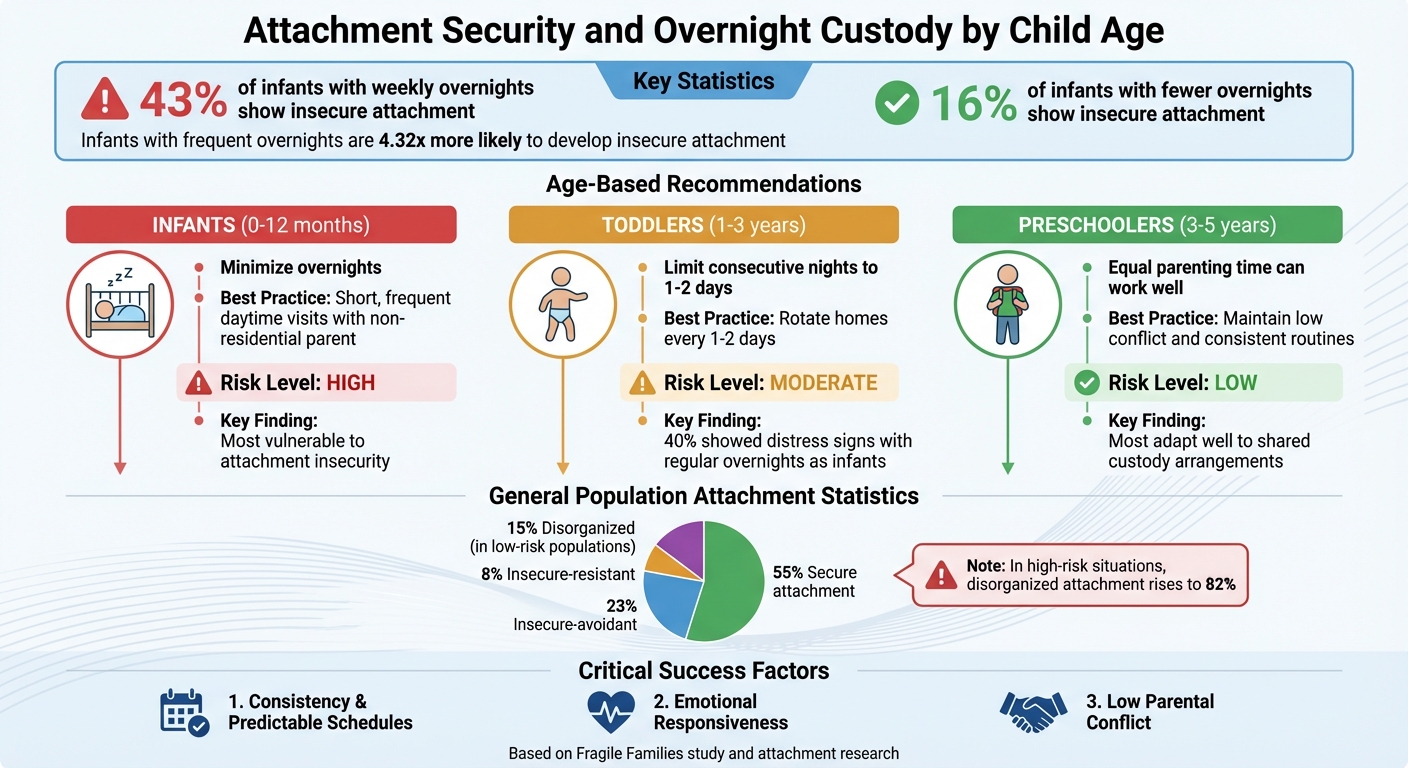
Attachment Security and Overnight Custody by Child Age: Research-Based Guidelines
What the Research Shows About Overnight Custody and Attachment
Recent studies have shed light on how overnight custody impacts children, breaking the effects down into age-appropriate custody plans. The Fragile Families study, which followed children from mostly low-income families across 20 U.S. cities, revealed that 6.9% of infants (birth to age 1) and 5.3% of toddlers (ages 1 to 3) spent at least one overnight per week with a nonresident parent. Let’s dive into how these overnight stays affect infants and toddlers differently.
Infants appear to face the greatest challenges. Research has shown that infants who experience frequent overnights (one or more per week) are 4.32 times more likely to develop insecure attachment compared to those with fewer overnight separations. Tornello et al. found that early attachment insecurity at age 3 could lead to adjustment difficulties at ages 3 and 5.
Attachment Security in Infants vs. Toddlers
The way children respond to overnight separations evolves as they grow. For infants under one year old, frequent overnight stays are closely tied to insecure attachment patterns. Judith Solomon and Carol George discovered that infants in separated or divorced families with regular overnight visits were significantly more likely to show disorganized or unclassifiable attachment to their mothers compared to infants in intact families.
For toddlers (ages 1 to 3), the findings are more complex. Some studies report no major differences in sleep, anxiety, or depression between toddlers with frequent overnights and those with only daytime contact. However, research by Jennifer McIntosh in Australia found that "shared overnight care of children under four years of age had an independent and deleterious impact on several emotional and behavioral regulation outcomes". By the preschool years (ages 4 to 5), the narrative shifts. Most studies suggest that frequent overnights either have no adverse effects or may even enhance social skills and reduce attention problems.
Behavioral Signs of Attachment Problems
Attachment issues often show up in specific behaviors. Infants with frequent overnights may display constant vigilance toward their caregiver, irritability, and physical stress symptoms like wheezing.
Toddlers, on the other hand, can exhibit more intense reactions. In follow-up studies, 40% of toddlers who had regular overnights as infants showed signs of distress, such as anger, resistance, or unsettled behavior when reunited with their mothers. These behaviors might include inconsolable crying, clinging, or even aggressive actions like hitting, biting, or kicking. Other red flags include feeding difficulties (e.g., refusal to eat or gagging), sleep disruptions, and a noticeable drop in persistence with routine tasks or play. While these behaviors don’t always predict long-term problems, they do indicate that the child may be struggling with the emotional demands of overnight custody arrangements.
sbb-itb-a09457a
Attachment Theory and Early Childhood Development
To understand why overnight custody arrangements are so crucial for young children, it helps to dive into the science of attachment. British psychiatrist John Bowlby argued that infants are biologically programmed to form attachments because staying close to a caregiver increases their chances of survival. This instinct has been key to human evolution.
"Attachment is the deep and enduring emotional bond that is most obvious in early childhood between an infant and their parents, but also characterizes relationships from 'the cradle to the grave.'" - John Bowlby
Bowlby identified four stages of attachment, starting from indiscriminate social responsiveness to forming a goal-corrected partnership. The most critical period falls between six months and two years, when infants establish primary attachment bonds and develop "internal working models" that influence their future relationships. These early experiences lay the groundwork for understanding how a caregiver's consistency shapes attachment.
The Primary Caregiver and Consistent Care
Secure attachment depends on consistent and sensitive caregiving. This happens when a caregiver regularly responds with sensitivity to an infant's needs, particularly during the first two years. The caregiver becomes both a secure base for exploration and a safe haven during distress.
Here’s the key: quality matters more than quantity. Emotional attunement and responsiveness during interactions are more important than the number of hours spent together. For instance, caregivers who promptly respond to an infant’s cries during the first six months help their babies develop better self-soothing skills by the end of the first year. And perfection isn’t required - sensitive caregiving involves recognizing when interactions are "off" and making efforts to repair those emotional disconnects.
The statistics paint a clear picture. Around 55% of infants in the general population form secure attachments, while 23% develop insecure-avoidant patterns and 8% develop insecure-resistant patterns. However, in high-risk situations, the numbers shift drastically: disorganized attachment, which affects only 15% of low-risk infants, skyrockets to 82% in high-risk environments and nearly 80% among maltreated infants.
Attachment Insecurity vs. Long-Term Adjustment Problems
While consistent care fosters secure attachment, early insecurity doesn’t doom a child to lifelong challenges. Attachment security in infancy does predict adjustment difficulties at ages 3 and 5, but protective factors can change the outcome. For example, research shows that 25% of children with disorganized attachment in infancy showed no disturbances by age seven. This demonstrates that early insecurity can be overcome.
A longitudinal study in Minnesota found that attachment security in infancy accounted for just 5% of the variability in social competence at age 19 after researchers adjusted for social background factors. While early insecurity may lead to short-term adjustment difficulties, factors like improved parental communication and reduced conflict can offset long-term risks. These findings highlight the importance of designing custody arrangements that support cognitive development and align with a child’s developmental needs.
Factors That Affect Attachment in Shared Custody
When it comes to shared custody, how parents handle the arrangement often has a bigger impact on a child's emotional security than the schedule itself. Even the most carefully planned custody setups can fall short if certain protective elements are missing. By understanding these factors, parents can better support their child’s development and emotional well-being while navigating life in two homes.
Parental Sensitivity and Communication
The cornerstone of secure attachment is each parent's ability to be emotionally present and responsive to their child’s needs. When parents can accurately read and respond to their child’s cues, they create a strong foundation for attachment - even when the child moves between two households.
Good communication between co-parents is another critical element. It helps reduce conflict and ease transitions by ensuring routines are coordinated and the child’s needs are addressed consistently. As Carol George, a psychology professor at Mills College, points out:
"Infants can adjust to overnight visitation, but it is very difficult when parents don't engage in co-parenting that places their baby's needs first."
This doesn’t mean parents need to be friends. What matters is the ability to share essential information - like feeding schedules, sleep patterns, and developmental updates. When communication breaks down, children often become anxious during handovers, exhibiting behaviors described by researchers as "watchful wariness". Predictable routines, which we’ll discuss next, can help reduce this stress.
Consistent and Predictable Schedules
For young children, a stable and predictable routine is key to reducing anxiety and promoting healthy development. Regular schedules provide the kind of stability children need, especially during early childhood.
Research backs this up. A study of children aged 2 to 6 found that inconsistent routines were linked to higher anxiety levels, particularly in girls. Linda Nielsen, a professor at Wake Forest University, highlighted the importance of consistency:
"Having a consistent, unchanging schedule and having a good relationship with each parent was more closely related to children's outcomes than whether or not they overnighted."
Predictability helps children handle the transitions between homes more smoothly, especially as they begin to develop time perception and language skills. This means parents should aim for regular pickup and drop-off times, similar bedtime routines, and coordinated meal schedules. However, even the most consistent schedule can be disrupted by parental conflict, which we’ll explore below.
How Parental Conflict Affects Attachment
Parental conflict can undermine even the best custody arrangements. In fact, research shows that conflict between parents is a stronger predictor of adjustment issues in children than divorce itself, accounting for 4% to 20% of the differences in children’s psychological well-being.
Conflict impacts attachment in several ways. It can shake a child’s sense of emotional security and often leads to less sensitive, more hostile parenting from both sides. Arguments specifically tied to the child - like disagreements over discipline or bedtime - are especially harmful.
The silver lining? High-quality parenting from one parent can help offset the effects of lower-quality parenting from the other, providing a buffer against mental health challenges. Parents should also avoid putting their child in the middle of disputes, as this "triangulation" can lead to negative developmental outcomes. Even partially resolved conflicts tend to cause less distress for children than ongoing, unresolved disagreements.
Creating Custody Schedules That Support Attachment
Turning research into actionable custody schedules means creating plans that respect your child’s developmental needs while ensuring both parents can stay involved. It’s one thing to understand the research and another to apply it. The good news? You can craft custody schedules that balance your child’s attachment needs with each parent’s role. The secret lies in tailoring schedules to your child’s stage of growth and adjusting them as they develop.
Best Practices for Infants and Toddlers
For infants under 12 months, it’s best to minimize overnights away from the primary caregiver. Instead, focus on short, frequent daytime visits with the other parent. Ideally, the non-residential parent should have at least two brief visits per week. This approach helps maintain a connection without disrupting the infant’s primary attachment.
Robert Emery, a psychology professor at the University of Virginia, explains:
"If mothers and fathers can be patient, cooperate and take a long view of child development, such evolving plans can work for both children and parents."
When it comes to toddlers aged 1 to 3, rotating homes every one to two days is often recommended. This ensures the child doesn’t spend more than two consecutive nights away from either parent. It’s a balance that allows for attachment to both caregivers while providing the consistency toddlers thrive on. Pay attention to warning signs like hitting, biting, or extreme clinginess during transitions - these behaviors may indicate that the schedule is too taxing.
By the time children reach preschool age (3 to 5 years), they’re typically ready for more equal parenting time - as long as parental conflict is minimal and communication remains open. These adjusted schedules honor both secure attachments and parental involvement, preparing families to address equal time arrangements.
Balancing Equal Time with Developmental Needs
While many parents aim for equal parenting time, it’s crucial to prioritize developmental needs, especially in infants and young toddlers. Early on, the focus should be on forming at least one secure attachment rather than dividing nights equally. This doesn’t diminish the importance of the non-residential parent. Secondary attachments can still flourish through consistent daytime interactions.
As children grow and their brains develop, overnights can gradually increase, leading to more balanced time-sharing by preschool age. It’s worth noting that a baby’s brain is only 30% developed at birth and triples in size during the first three years. During this period, predictable and responsive care plays a critical role in helping children regulate stress and emotions. A consistent schedule is more impactful than the exact number of nights spent with each parent.
Using Coflo for Research-Based Custody Decisions

Navigating custody schedules can feel overwhelming, especially when trying to balance research findings with your family’s unique needs. That’s where Coflo steps in.
Coflo is an AI-driven co-parenting app that simplifies the process by offering personalized custody schedule recommendations based on developmental psychology research. By adjusting priority sliders - like stability and equal time - you can instantly explore options tailored to your child’s age and family dynamics. Each recommendation includes developmental insights, benefits, and a step-by-step guide for implementation.
This tool saves you time and money, eliminating the need for extensive research or costly legal consultations. Coflo’s clear, evidence-based guidance helps reduce conflict and decision fatigue, ensuring your choices prioritize your child’s wellbeing. Learn more at https://blog.coflo.app.
Conclusion
Research on attachment and overnight custody highlights that a universal approach to custody schedules simply doesn’t work for young children. Infants under 12 months are particularly sensitive - studies show that 43% of infants with weekly overnights away from their primary caregiver developed insecure attachments, compared to just 16% of those with fewer or no overnights. As kids grow, their ability to handle overnight transitions improves, especially when parents maintain low conflict and open communication. This research emphasizes the importance of tailoring custody arrangements to match a child’s developmental needs.
For infants, starting with daytime visits is often best. Gradually introducing overnights for toddlers and aiming for balanced time-sharing by preschool age can help ensure smoother transitions. What matters most isn’t the exact number of nights but maintaining consistency and predictability, which are key to a child’s emotional well-being.
Pay close attention to signs like disrupted sleep, irritability, or inconsolable crying - these could indicate that adjustments to the schedule are needed. Additionally, the strength of your co-parenting relationship plays a major role; effective communication and minimizing conflict are critical for supporting your child’s attachment security, no matter the custody arrangement.
With these insights, custody planning becomes more manageable. Coflo transforms attachment research into practical custody recommendations tailored to your child’s age and your family’s unique needs. By offering developmental guidance and a clear implementation roadmap, Coflo helps create schedules that prioritize secure attachments while keeping both parents actively involved. To learn how research-backed tools can simplify your custody planning, visit https://blog.coflo.app.