
High-Conflict Co-Parenting: Communication Strategies
High-conflict co-parenting can feel like a constant battle, with disagreements over schedules, finances, and parenting decisions often escalating into arguments. These conflicts not only strain the parents but also deeply affect children, increasing their risks of anxiety, depression, and behavioral challenges. The good news? You can take steps to reduce tension and improve communication for the sake of your child.
Here’s what you need to know:
- Regulate Emotions: Pause before responding to triggering messages. Use neutral, non-accusatory language to keep conversations calm and focused on problem-solving.
- Organize Communication: Keep messages clear and structured, addressing one topic at a time. Tools like shared calendars or co-parenting apps can reduce misunderstandings.
- Set Boundaries: Treat co-parenting like a business relationship. Limit contact to agreed times and avoid involving children in adult issues.
- Create a Parenting Plan: A detailed plan covering custody schedules, decision-making authority, and financial responsibilities reduces the need for constant negotiation.
- Protect Your Child: Keep conflicts out of sight and maintain consistent routines to provide a sense of security.
If cooperation remains difficult, consider parallel parenting to minimize interaction while ensuring both parents remain involved in the child’s life. Tools like Coflo can also help streamline custody planning and reduce disputes. Small changes in how you communicate and set boundaries can make a big difference in creating a healthier environment for your child.
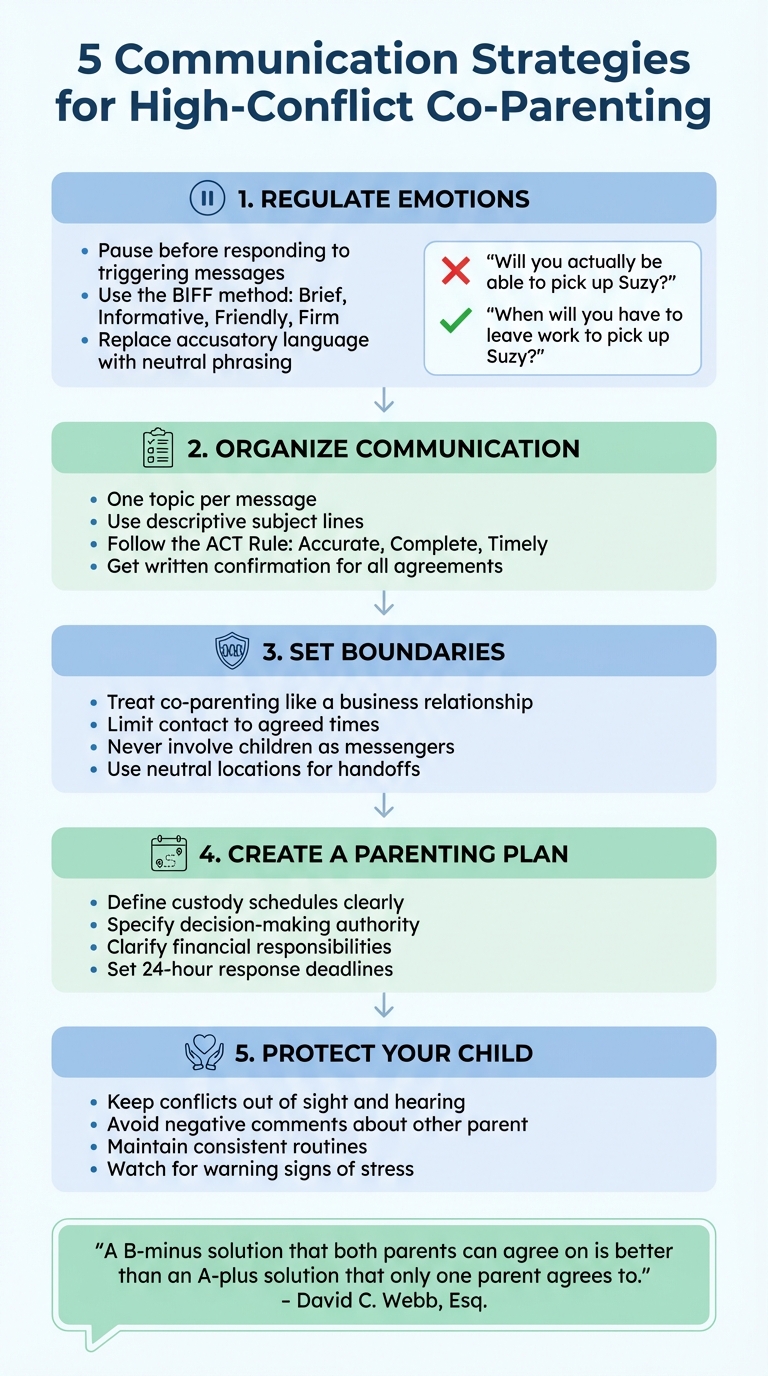
5 Communication Strategies for High-Conflict Co-Parenting
Problem 1: Emotional Reactions During Conversations
Discussions about finances, child support, schedule changes, or missed parenting time often trigger defensive reactions in high-conflict co-parenting situations. When one parent revisits past grievances or uses phrases like "You always" or "You never", conversations quickly shift from problem-solving to blame.
How Emotional Responses Derail Conversations
What starts as a simple complaint can spiral into criticism, defensive responses, and even contempt - marked by sarcasm or belittling comments - before ending in stonewalling. At that point, meaningful dialogue grinds to a halt.
"Judgmental language can make you feel better in the moment, but it makes your co-parent feel worse and less likely to agree with you."
- Michael Reddington, Certified Forensic Interviewer
When a parent's ego feels attacked, the natural reaction is often to counterattack. For instance, a question like "Will you actually be able to pick up the child?" might come across as accusatory, prompting defensiveness instead of cooperation. Addressing these emotional reactions is key to creating space for calmer, solution-focused conversations.
Solution: Learn to Regulate Your Emotions
When faced with a triggering message, take a moment to pause. Breathe deeply, step away from your phone, and give yourself time before responding. This short break helps prevent escalation and sets the tone for a more constructive exchange, keeping the focus on your shared goal: your child.
Before sending a message, draft it and review it carefully. Remove accusatory language and avoid absolute statements. For example, instead of saying, "You never help with homework", try, "When will you be available to review the homework schedule with me?"
The BIFF method - keeping messages Brief, Informative, Friendly, and Firm - is a helpful tool for maintaining productive communication. Here’s how rephrasing can make a difference:
| Accusatory Phrasing | Neutral Phrasing |
|---|---|
| "Will you actually be able to pick up Suzy?" | "When will you have to leave work to pick up Suzy?" |
| "Did you remember to pay the tuition?" | "Has the school received the tuition payment this month?" |
| "Why didn't you pay the doctor's bill?" | "What other bills need to be paid before the doctor's bill?" |
Keep the Focus on Your Child
Beyond managing your emotions, shifting the focus of your conversations can further ease conflict. Make every message about your child's needs rather than your frustrations. For example, instead of saying, "You're always late", reframe it as, "Our child gets anxious when pickup times change. Can we confirm the exact time you'll arrive?"
"A B-minus solution that both parents can agree on is better than an A-plus solution that only one parent agrees to."
- David C. Webb, Esq., Lawyer and Mediator
This approach reduces conflict because it’s harder for the other parent to argue against what benefits your child. Using "I" statements - like "I'd prefer to stick to the schedule to minimize conflict" - can also communicate your needs without sounding accusatory. By keeping every exchange focused on your child's well-being, you minimize control struggles and make co-parenting smoother for everyone involved.
sbb-itb-a09457a
Problem 2: Disorganized and Confusing Messages
A message like "We need to talk about Bobby" leaves everything up in the air - are we discussing grades, behavior, or scheduling an appointment? When parents send scattered messages that jump between unrelated topics - like mixing financial disputes with schedule changes or revisiting old arguments - the outcome is almost always the same: confusion, missed details, and rising frustration.
What Happens When Messages Lack Structure
When unrelated issues - like unpaid bills, schedule changes, and personal critiques - are crammed into a single message, critical points often get lost. Combining financial matters with parenting topics can also create defensiveness, making productive communication even harder. Without clear, written agreements, it’s easy to fall into a cycle of arguments and distrust. Verbal plans and fragmented texts lack accountability, paving the way for frequent misunderstandings and disputes.
Taking the time to organize your messages not only makes your intentions clearer but also lays the groundwork for effective problem-solving.
Solution: Write Clear, Organized Messages
Stick to one topic per message. If you need to address multiple issues, use separate messages or a numbered list to keep everything clear. Start with a descriptive subject line or opening statement. For example, instead of writing a vague "Thursday", try "Schedule change for Thursday, January 2." This makes messages easier to search later and avoids unnecessary confusion.
"The subject heading is also critical to each parent's ability to organize and refer back to particular topics of email discussion. Be specific. For example: 'Bobby's summer camp dates for June, 2015,' rather than 'Bobby.'"
- Jeanne Coleman, Family Law Attorney
Follow the ACT Rule: make sure your messages are Accurate, Complete, and Timely. If you’re sharing multiple details, bullet points can help make your message easier to read and respond to. Always get written confirmation for agreements—following a custody schedule implementation checklist ensures accountability and avoids future disputes.
Use Tools to Simplify Communication
Technology can help reduce the back-and-forth that often leads to conflict. Shared digital calendars, for instance, make it easier to manage parenting schedules, school breaks, and holidays without constant renegotiation. Apps that provide timestamped, unchangeable records can also prevent arguments by offering a clear, permanent record of what was said and agreed upon - something standard texts and emails can’t always guarantee. This structured approach keeps conversations focused on your child and minimizes unnecessary conflict.
Coflo offers an even more proactive solution by helping parents make custody decisions with confidence before disagreements arise. Instead of endless debates over schedules, Coflo lets you adjust priority sliders based on what’s most important to your family - such as stability, equal time, or school consistency. It then generates personalized custody schedule recommendations ranked by suitability. Each recommendation includes insights from developmental psychology tailored to your child’s age, along with detailed benefits, considerations, and a step-by-step implementation guide. By turning custody planning into a collaborative, data-driven process, Coflo allows you to focus on what truly matters: your child’s well-being.
Problem 3: Crossed Boundaries and Excessive Contact
When one parent sends texts at odd hours or shows up unannounced, the co-parenting relationship can quickly crumble. Overstepping boundaries - whether through constant messaging, late-night calls, or involving children as messengers - creates a toxic cycle of conflict. This makes it nearly impossible to focus on what truly matters: your child's well-being.
Common Boundary Issues to Look Out For
Some parents use communication to provoke emotional reactions or invade physical space by entering the other parent's home without permission or even changing locks without notice. The most damaging violations, however, involve the children. Asking kids to pass on messages between parents puts them in an incredibly stressful position.
"One of the most common mistakes separated parents make is to tell the children to tell the other parent some piece of information... it can be very stressful for the child, who is rightfully afraid he or she will suffer the other parent's anger,"
says Bill Eddy, LCSW, Esq., from the High Conflict Institute. Other harmful behaviors include "gatekeeping" (limiting the other parent's access to the child), questioning children about the other parent's household, or openly criticizing the other parent in front of them.
These behaviors drain emotional energy, increase the chances of legal disputes, and often lead to parental exhaustion. Such breaches make managing emotions and communication even harder, further damaging the co-parenting relationship. High-conflict personalities tend to latch onto minor mistakes, using them as "evidence" of the other parent's shortcomings instead of working together constructively.
Solution: Set and Enforce Clear Boundaries
Think of your co-parenting relationship as a business partnership - keep it professional, respectful, and focused on shared goals for your kids. Start by agreeing on practical communication rules. For example, decide that non-urgent emails will be answered within 24 hours and that phone calls will only happen during pre-scheduled times, like Tuesdays and Thursdays between 7:00 PM and 7:30 PM.
Limit discussions to parenting topics such as health, education, and scheduling. Use the BIFF method (Brief, Informative, Friendly, and Firm) for written communication to keep things calm and on track.
Physical boundaries are just as important. Never enter the other parent's home without prior agreement, and handle custody exchanges in neutral, public spaces - like schools or curbside pick-ups. If your co-parent continues to overstep, set clear consequences: ignore messages sent outside agreed times, document boundary violations, and, if necessary, seek legal advice.
And remember, don’t involve children in adult issues. Asking them to deliver messages or mediate conflicts only adds unnecessary stress to their lives. By maintaining firm boundaries, you not only create a respectful co-parenting environment but also shield your child from unnecessary drama. If boundaries alone don’t resolve the conflict, it might be time to explore a different approach.
When Parallel Parenting Is the Better Option
If setting boundaries still doesn’t work, it may be time to shift to parallel parenting. This approach is ideal when every interaction becomes a battleground. Unlike traditional co-parenting, which relies on frequent communication and shared rules, parallel parenting minimizes interaction and allows each parent to set their own rules during their parenting time.
Communication is limited to written formats, such as email or specialized apps, and focuses strictly on essential logistics like medical appointments or school schedules. Parents might even attend events like school plays or sports games separately, either sitting in different areas or alternating attendance based on the parenting schedule. Each parent has full decision-making authority within their own household, avoiding disputes over bedtimes, chores, or discipline.
While parallel parenting requires letting go of control over what happens during the other parent's time, it significantly reduces conflict and protects children from being caught in the middle.
"Parallel parenting should only be implemented when you've been unable to make co-parenting work. But that doesn't mean you've failed,"
explains the Weinberger Divorce & Family Law Group. The ultimate goal is to ensure children receive support from both parents without being exposed to ongoing tension.
Problem 4: Disagreements About Parenting Decisions
Parenting decisions can quickly become a flashpoint in high-conflict co-parenting situations. Choices about school, healthcare, holidays, or extracurricular activities often escalate into heated disputes. Even seemingly small decisions - such as who pays for braces or which parent hosts Thanksgiving - can spiral out of control without a clear framework in place. This constant back-and-forth highlights the need for a structured approach to decision-making.
"Imagine a scenario where every decision, from school activities to medical appointments, becomes a battleground",
- Heather Grammatico, Conflict Resolution Coach and Mediator
Everyday matters like bedtimes, screen time, or dietary preferences can also trigger arguments. Add financial disagreements into the mix, and the tension only grows. These unresolved conflicts not only drain energy but can also leave children caught in the middle, overshadowing the goal of effective parenting.
Why Decision-Making Without a Plan Fails
Without a well-thought-out parenting plan, every decision demands direct communication and negotiation. This creates endless opportunities for disagreements, especially when one parent thrives on conflict. Simple tasks, like scheduling a dentist appointment or finalizing holiday plans, can devolve into prolonged debates. This constant friction disrupts decision-making and can take an emotional toll on children, who often feel the ripple effects of the conflict.
Solution: Build a Detailed Parenting Plan
A detailed parenting plan is essential to sidestep these challenges. It acts as a preemptive guide, addressing common areas of disagreement before they arise. With a solid plan in place, parents can minimize direct negotiations and reduce opportunities for conflict. The goal is to keep discussions centered on the child’s needs rather than personal grievances. Key elements to include in a parenting plan are:
- Schedules and Logistics: Define clear custody arrangements, including school week routines, alternating holidays, birthdays, summer vacations, neutral pickup/drop-off points, and clauses like "right of first refusal" for third-party care.
- Decision-Making Authority: Specify which parent has the final say on critical matters such as education, healthcare, and daily routines.
- Financial Allocations: Clarify how costs for extracurricular activities, medical expenses, and other child-related needs will be divided.
Vanessa Vasquez de Lara, Founder and Managing Partner of Vasquez de Lara Law Group, emphasizes the importance of this approach:
"A solid, legally binding parenting plan acts as a comprehensive road map for navigating the co-parenting minefield."
Additional tools can help reduce friction. For example, creating a 12-month, child-focused calendar allows parents to address potential disagreements well in advance. Setting deadlines for communication - such as requiring a response within 24 hours for non-urgent matters - can keep conversations timely and on track. Written proposals, whether through email or co-parenting apps, provide a clear, unchangeable record of discussions. Some parents also find a "child news report" helpful - this shared digital log includes updates on medical care, school, diet, and behavior, allowing for effective communication without direct interaction.
Let AI Help You Make Better Decisions
Even with a thorough plan, unexpected situations will arise. AI-powered tools like Coflo can step in to provide data-driven recommendations when adjustments are needed. These tools analyze custody patterns and allow parents to prioritize factors like stability, equal time, or school consistency. Coflo then offers tailored suggestions, complete with benefits, considerations, and actionable steps, helping parents understand not just what works best, but why.
AI tools can also improve communication. For instance, they can flag potentially inflammatory language in messages and suggest neutral alternatives before sending. This helps keep the focus on the child’s well-being, reducing the likelihood of unnecessary conflict and making co-parenting a little less stressful in high-conflict situations.
Problem 5: Shielding Children from Parental Conflict
It's essential to protect children from the emotional fallout of parental conflict, especially during separation or divorce. While structured communication and clear boundaries are crucial, shielding kids from the tension between parents can make a significant difference in their emotional well-being.
When parents clash, children often become unintended witnesses. They may overhear arguments, pick up on tension during handoffs, or even see negative comments on social media. In some cases, parents use children as messengers, putting them in an uncomfortable position of relaying information between households. This dynamic creates a heartbreaking dilemma for kids, who may feel that showing affection to one parent could hurt the other.
The Impact of Conflict on Children
The effects of parental conflict on children are far-reaching. Studies reveal that divorce and separation are linked to increased risks of anxiety and depression in children and teens. Children in high-conflict environments often experience elevated stress, sadness, and behavioral challenges. This can manifest as aggressive outbursts, social withdrawal, or struggles in school, all of which can harm their overall development and happiness.
"If you and your child's other parent can sort out disagreements in calm, consistent and respectful ways, it can be very reassuring for your child."
On the flip side, children in cooperative co-parenting arrangements thrive. When parents work together to create a safe and supportive environment, kids often enjoy better mental health, higher self-esteem, and fewer behavioral issues. However, when children feel trapped in the middle of parental disputes, academic struggles and disruptive behaviors often follow.
These findings highlight the importance of strategies that shield children from parental conflict.
Solution: Keep Conflict Away from Your Children
One of the most effective ways to protect children is to keep adult problems out of their sight and hearing. Handle sensitive discussions through email or text rather than in front of your kids. Avoid making negative remarks about the other parent, whether in person or on social media. Remember, your child loves both parents, and hearing hurtful comments can be deeply upsetting.
Neutral locations like libraries, museums, or daycare centers can help reduce visible tension during handoffs. If you notice warning signs like a sudden loss of interest in favorite activities, declining grades, or increased aggression, it may be time to seek professional help. These behaviors could indicate that your child is struggling with the family situation.
Create Predictable Routines to Reduce Tension
In addition to keeping conflict out of sight, establishing predictable routines can provide children with a sense of security. A consistent schedule helps kids feel grounded during times of change. Dr. Kathryn Jones, a pediatric psychologist at Cleveland Clinic, emphasizes the importance of routines:
"The more you iron out in advance, the better it will be for your child... when you have a steady routine, when something has to change... it's not going to necessarily feel as big of a deal."
- Dr. Kathryn Jones
Tools like Coflo can help parents create age-specific custody schedules that prioritize stability. When both parents follow a shared calendar, last-minute disputes are minimized, reducing stress for everyone involved. A shared communication log - whether physical or digital - can be used to exchange essential details about meals, medications, or activities. This eliminates the need for face-to-face interactions during handoffs and keeps the focus on what truly matters: your child's well-being.
Conclusion
High-conflict co-parenting doesn’t change overnight. The patterns of tense communication take time to shift, but every small adjustment you make - whether it’s switching to written messages, adopting neutral language, or setting clearer boundaries - brings you closer to a calmer, more child-centered dynamic.
Gradual changes lead to lasting improvements. Start small. Maybe commit to the 24-hour rule for non-emergency responses or move scheduling to a shared calendar. Once these steps feel natural, you’ll find it easier to introduce more structure into your interactions.
Tools like Coflo can make this process smoother by helping you base custody decisions on your child’s developmental needs rather than emotions or conflict. A clear, research-backed schedule reduces the potential for daily disputes, creating a more stable environment where your child can thrive. This kind of structure helps reduce stress for everyone involved.
"Because I'm able to regulate my responses and take a little bit more control of the communication with my ex-husband, my kids aren't suffering like they used to."
- Meghan Kelly, Real Co-Parent
The goal isn’t perfection - it’s progress. Each thoughtful conversation, neutral message, and upheld boundary moves you closer to healthier co-parenting. Even if the other parent doesn’t change, your children will feel the calm you bring to the relationship. Every effort you make strengthens the foundation for a more child-focused future.