
BIFF Method for Co-Parenting Communication
The BIFF method - Brief, Informative, Friendly, Firm - simplifies co-parenting communication by reducing conflict and staying focused on your child’s needs. Created by Bill Eddy, it’s a structured way to handle emotionally charged conversations without escalating tension. Here’s the core idea:
- Brief: Keep messages short, ideally 3-5 sentences, to avoid unnecessary back-and-forth.
- Informative: Stick to facts, not opinions or past grievances.
- Friendly: Use a calm, respectful tone to de-escalate hostility.
- Firm: Set clear boundaries and avoid endless debates.
This approach helps parents manage tough conversations about schedules, medical decisions, and more, while protecting their mental health and creating a professional communication record. By focusing on logistics and avoiding emotional triggers, BIFF ensures your child’s well-being remains the priority.
Want to avoid unnecessary stress and arguments? Keep reading to learn how to apply BIFF and improve co-parenting communication.
What Is the BIFF Method? The 4 Core Components
The BIFF method is a framework for co-parenting communication that emphasizes professionalism, focuses on the child, and minimizes conflict. It consists of four essential principles, each designed to help you navigate difficult conversations effectively. Together, these principles create responses that defuse tension and keep the focus where it belongs - on your child.
Brief: Keep Messages Short and Focused
Being "brief" means keeping your messages concise - ideally one paragraph with just three to five sentences. Short responses help avoid introducing multiple issues that could spark unnecessary arguments. Long, detailed messages often give the other person more opportunities to engage in conflict.
"By being brief, you reduce the risk of triggering more hostility back or including some point that the other person will feel compelled to argue with."
- Bill Eddy, LCSW, JD
Informative: Stick to Facts Only
Focus on sharing only the necessary facts, especially those directly related to your child. Avoid opinions or rehashing past grievances. For instance, instead of saying, "You never tell me about doctor appointments", you could say, "The pediatrician appointment is Tuesday at 3:00 PM." This keeps the conversation productive and free of emotional triggers.
Friendly: Use a Respectful Tone
"Friendly" communication means maintaining a tone of professional courtesy, similar to how you’d interact with a coworker. Start with a polite greeting - like "Thanks for the update" - and end with a neutral closing, such as "Have a good weekend." This approach helps set a calm tone and can even de-escalate anger.
"A friendly greeting calms tense exchanges... This often helps a lot in terms of calming someone who has written to you in anger."
- Bill Eddy
Being respectful doesn’t mean being passive. Instead, it fosters cooperation and reduces defensiveness, which ultimately benefits your child.
Firm: Set Clear Boundaries
"Firm" communication involves setting limits that prevent endless back-and-forth debates. Clearly state your position, provide specific options, or set a deadline for a response. For example: "Please let me know yes or no by Thursday at 5:00 PM." This keeps the conversation focused on decisions rather than drawn-out discussions.
"Firm doesn't mean harsh. Ideally, there is nothing further to be said by either person."
- Bill Eddy
To reinforce boundaries, you can reference established guidelines like your Parenting Plan or professional recommendations. Framing requests as yes-or-no questions further reduces unnecessary dialogue, helping to maintain clarity and focus on your child’s needs. This approach ensures that conversations remain productive and child-centered.
sbb-itb-a09457a
When and How to Apply the BIFF Method
Using the BIFF method effectively means understanding when a response is appropriate and how to craft it. Not every message from your co-parent demands a reply, and figuring out which ones do can help you save time and avoid unnecessary stress.
Focus on Child-Centered Issues That Require Action
The BIFF method is most effective when addressing messages about child-related logistics - things like schedule changes, medical appointments, school events, or shared expenses. These are the kinds of topics that directly impact your child and often require acknowledgment or a decision.
High-conflict co-parents often include "emotional bait" in their messages, such as insults, false accusations, or irrelevant past grievances. The key is to filter out these distractions and focus solely on the facts that pertain to your child. For instance, if a message says, "You never communicate, and you're always late. By the way, soccer practice is now on Thursdays at 4:00 PM", address only the updated practice schedule and ignore the personal attacks.
"Rule #1 is always to ask: 'Do I need to reply to this at all?'"
- Tammy Valentine, Attorney
Skip messages that don’t involve deadlines, decisions, or specific appointments. By focusing only on child-related logistics or decisions, you can avoid being drawn into unnecessary conflict. Once you’ve identified the key details, take a moment to reflect before responding to ensure your reply is clear and concise.
Take Time Before Responding to Avoid Emotional Reactions
When faced with a frustrating message, it’s natural to feel the urge to respond immediately. However, taking a pause can help you craft a more thoughtful reply.
"Unless there is a dire emergency, do not feel that you need to respond immediately. Take some time to compose your response, or sit on it overnight before sending."
- Tammy Valentine, Attorney
This “overnight rule” ensures your response aligns with the BIFF approach and avoids escalating the situation. Before sending your reply, ask yourself, "Would I want a judge to read this?" Hostile or reactive messages can harm custody cases, so maintaining a calm and professional tone is essential.
Leverage Tools to Manage and Document Communication
Co-parenting apps can help you track and organize interactions. Platforms like Talking Parents create permanent, uneditable records of communication, which encourage careful responses and can serve as documentation in court if needed.
Some tools, like the BestInterest app, even include AI-powered features like "Tone Guardian", which scans your draft messages for emotional language and suggests edits to keep them aligned with BIFF principles. Another option, Coflo (https://blog.coflo.app), offers AI-driven guidance to streamline age-specific custody schedules and ensure child-focused decisions. Combining the BIFF method with these tools not only keeps communication organized but also fosters a more cooperative co-parenting dynamic that prioritizes your child’s well-being.
How to Write a BIFF Response: Step-by-Step
Writing a BIFF response becomes more manageable when you follow a structured approach. The goal is to stay focused on your child's well-being while steering clear of the emotional traps that high-conflict communication often creates. Here's how to do it:
Step 1: Decide If the Message Needs a Response
Start by asking yourself: "Is a reply even necessary?" Many hostile messages are just emotional outbursts and hold no legal significance unless you give them weight.
"Much of hostile e-communication does not need a response. Letters from (ex-) spouses... do not usually have legal significance. The letter itself has no power, unless you give it power."
- Bill Eddy, LCSW, Esq., High Conflict Institute
Focus on identifying actionable points related to your child's schedule, health, or education. If the message is filled with insults, baseless accusations, or recycled arguments, it likely doesn't need a reply. However, if it contains inaccuracies that could be seen by a judge, attorneys, or family members, consider providing a brief factual correction for the record. Use the "newness" test - respond only to fresh, concrete issues. If the message rehashes a demand you've already addressed, there's no need to engage. Once you've decided a response is necessary, move on to crafting a concise, fact-based reply.
Step 2: Write a Brief, Fact-Based Response
Keep your reply short and to the point - three to five sentences max. A concise message minimizes the chance of escalating conflict. Stick to the facts: times, dates, locations, and specific details about your child's needs. Avoid explanations, justifications, or any language that could spark further argument. Keep your tone neutral and professional.
For instance, instead of saying, "You're wrong about the field trip - it's actually required by the school, and you should have read the email", you could write: "The school has made this a required field trip. My share was $30, so I'm requesting reimbursement for your half". Once you've drafted your reply, refine it to ensure it's polite and sets clear boundaries.
Step 3: Add Polite Language and Clear Boundaries
This step emphasizes the Friendly and Firm aspects of BIFF. Start with a neutral greeting, like "Thanks for the update", and close with a polite sign-off, such as "Have a great weekend". A friendly tone helps reduce tension but avoids being overly inviting.
End your message in a way that discourages further debate. If you need a response, ask a yes-or-no question with a clear deadline, such as, "Please let me know yes or no by Thursday at 5:00 PM". When appropriate, reference an authority - like your parenting plan, court orders, or professional advice - to keep the focus on objective standards rather than personal disagreements. Before sending, review your message as if a judge or attorney might read it, and remove anything that could be interpreted as hostile or argumentative.
BIFF Response Examples for Common Co-Parenting Situations
Seeing the BIFF method in action helps clarify how to use its principles in your co-parenting conversations. These examples show how concise, factual responses can keep the focus on your child's needs. Below are practical scenarios where the BIFF method is applied effectively.
Responding to Last-Minute Schedule Changes
Imagine your co-parent sends a hostile message requesting a last-minute schedule change, perhaps accusing you of being "unreliable" or treating parenting time like "babysitting." A BIFF response avoids addressing the accusations and focuses only on the logistics. Here's how you might reply:
"Hi [Name], thanks for reaching out. I cannot accommodate a last-minute change. The original plan for Saturday pickup still works for me. Please let me know by 5:00 PM today if this works."
This type of response is straightforward and reduces the chance of escalating the conflict.
Communicating About Medical Appointments
Medical issues can often stir up emotions, especially if one parent feels left out of decisions. If you receive a message with complaints like "you never tell me anything", stick to the facts and avoid engaging with the emotional tone. A BIFF response might look like this:
"Hello [Co-parent's Name]. To answer your question, the kids' doctor's appointment is confirmed for Tuesday at 10:00 AM. I will update you after the appointment to discuss next steps. Have a nice weekend."
This reply provides the necessary information while steering clear of unnecessary conflict.
Coordinating Extracurricular Activities
Coordinating activities can become challenging when past grievances resurface in communication. If you receive a lengthy email about a ballet recital that dives into unrelated family conflicts, focus on the event details and ignore the rest. A BIFF response could be:
"I will have Emily at her recital at 7:00 PM. I'll be in attendance with my parents. Have a good weekend."
Or, if there's a scheduling conflict:
"The children have a scheduled school event on Saturday, so I will not be able to switch this weekend. Our parenting plan states we alternate weekends, and I am following that schedule."
Each of these examples highlights how brief, informative, friendly, and firm communication can help de-escalate tensions and keep the focus on what truly matters - your child's well-being.
How BIFF Benefits Co-Parents and Children
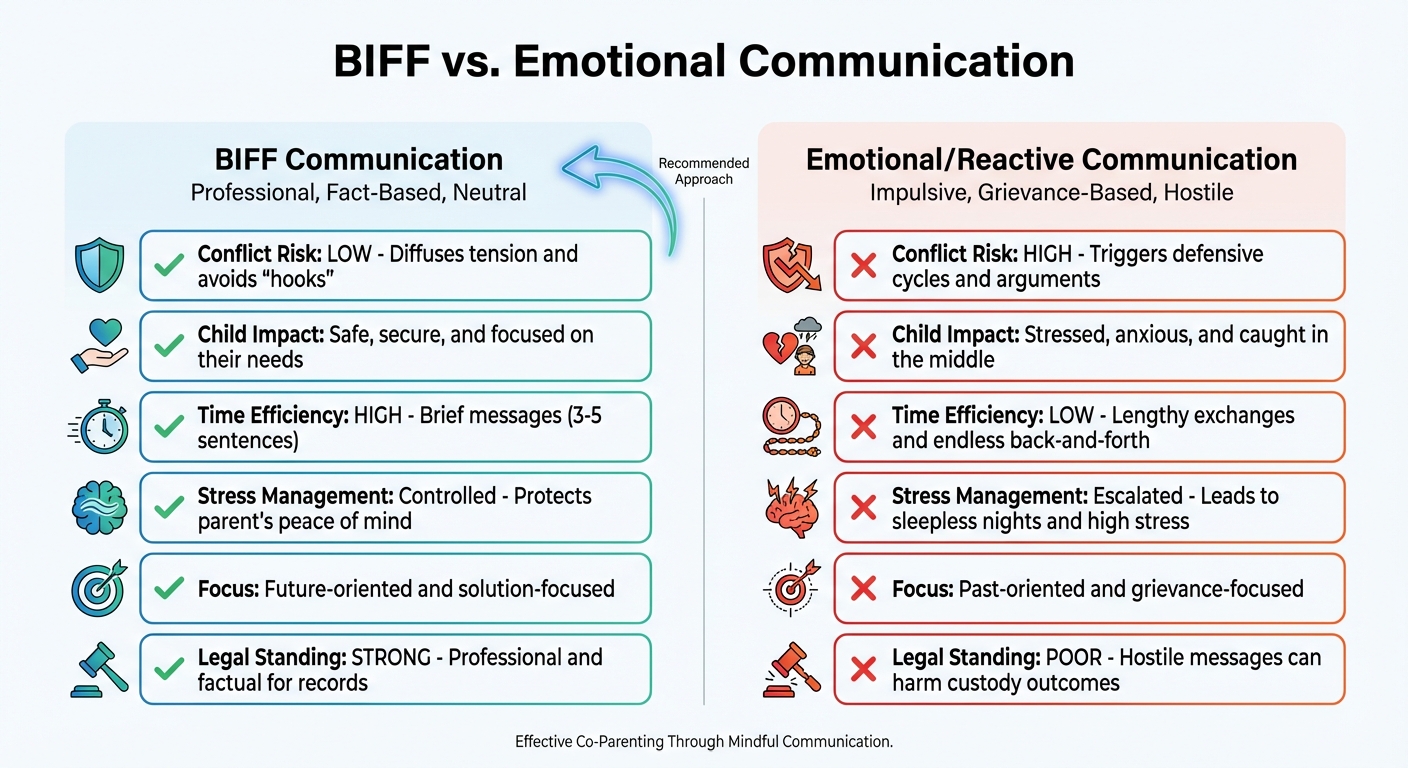
BIFF vs Emotional Communication in Co-Parenting
The BIFF method helps reduce conflict and creates a predictable communication environment. By keeping a neutral, professional tone, parents avoid emotional triggers that could escalate arguments. This approach fosters a calmer, more cooperative co-parenting relationship and minimizes the risk of future court disputes, as communication breakdowns are often a major cause of litigation.
For children, the advantages are even greater. By preventing prolonged digital arguments and easing parental tension, BIFF protects kids from the emotional strain of witnessing hostility between their parents. It also eliminates triangulation - the harmful habit of using children as go-betweens - by promoting direct communication between adults. This not only shields children from unnecessary stress but also supports healthier interactions overall.
On a broader scale, BIFF reshapes the parental relationship. It encourages parents to adopt a "business partner" mindset, focusing solely on their child's needs. This emotional detachment allows parents to move past personal grievances and concentrate on practical matters like school schedules, sports practices, and medical appointments. The result is a stable, supportive environment that fosters resilience in children and sets an example of healthy relationship dynamics they can carry into adulthood.
From a legal perspective, BIFF responses provide a professional record that can improve legal outcomes and help avoid costly litigation caused by hostile communication.
Comparison Table: BIFF vs. Emotional Communication
| Feature | BIFF Communication | Emotional/Reactive Communication |
|---|---|---|
| Conflict Risk | Low; diffuses tension and avoids "hooks" | High; triggers defensive cycles and arguments |
| Child Impact | Safe, secure, and focused on their needs | Stressed, anxious, and caught in the middle |
| Time Efficiency | High; brief messages (3-5 sentences) | Low; lengthy exchanges and endless back-and-forth |
| Stress Management | Controlled; protects parent's peace of mind | Escalated; leads to sleepless nights and high stress |
| Focus | Future-oriented and solution-focused | Past-oriented and grievance-focused |
| Legal Standing | Strong; professional and factual for records | Poor; hostile messages can harm custody outcomes |
Tips for Getting Better at Using BIFF
Getting the hang of BIFF techniques takes practice, but every message you write is a chance to improve. Instead of aiming for perfection right away, focus on learning and refining your approach over time. Here's how you can sharpen your BIFF communication skills:
Review Your Messages Before Sending
Before you send any message, imagine it being read by a judge, attorney, or mediator. This "Judge" mindset helps you ensure your message is clear, factual, and free of unnecessary emotional language. Specifically, avoid the "Three A's" - admonishments, unsolicited advice, and excessive apologies - that can negatively affect custody-related outcomes. As Holmes wisely put it, "Speak clearly and choose your words carefully."
If the situation isn't urgent, take a pause - whether it's a few minutes or overnight - before sending your message. This gives you time to let your emotions settle and review your draft for any language that could spark unnecessary back-and-forth arguments. Focus on the facts, remove opinions or emotional commentary, and keep things concise. If you've already stated your position clearly, there's no need to respond to repetitive follow-ups.
Once you've mastered reviewing individual messages, take things a step further by evaluating your overall communication habits.
Track Your Communication Patterns Over Time
Looking back at your past messages can reveal patterns and highlight areas for improvement. Co-parenting platforms are especially helpful for this, as they keep an unalterable record of interactions and often include tools like tone-checkers to flag potentially aggressive language before you hit send.
By reviewing your message history, you can ensure you're consistently maintaining boundaries and keeping your responses short - ideally between three and five sentences. As Tammy Valentine from TDG Family Law advises:
"Respond with the mindset that the Judge, attorneys, or other professionals involved in your case may read your message. Hostile communications can impact the outcome of your case."
If you're ever unsure whether a message aligns with BIFF principles, consider sharing the communication thread with a lawyer or mediator to get their input. Their feedback can help you refine your approach further.
Apply BIFF to Other Relationships
The beauty of BIFF is that it works beyond co-parenting. Whether you're dealing with workplace disagreements, extended family disputes, or even tricky customer service situations, BIFF encourages calm, non-reactive communication. Practicing these techniques in everyday interactions helps solidify the habit, making it easier to apply in high-stakes scenarios.
Paralegal Raesha de Ruiter Zylker points out:
"Once you master this technique it will become second nature and you might find yourself implementing it in other situations, such as work or family communications."
Start small. Before replying to a minor work or family conflict, ask yourself if a response is even necessary. If it's not, skip it. If it is, draft a BIFF-style reply, and then review it to eliminate any advice, admonishments, or apologies. Practicing in these low-pressure situations prepares you for more challenging exchanges, ensuring you respond with clarity and composure instead of emotion.
Conclusion
The BIFF method - Brief, Informative, Friendly, Firm - offers co-parents a straightforward way to keep conversations focused on what truly matters: their children's well-being. By steering clear of blame and avoiding unnecessary arguments, this approach transforms emotional exchanges into constructive, child-centered discussions. As Lake Harriet Law explains, "The goal of a BIFF Response is to move the conversation into a productive and problem-solving form of communication".
What makes BIFF so effective is its simplicity. It gives you the ability to control your tone and responses, which can significantly influence the outcome of your interactions. Consistently applying BIFF principles not only reduces conflict but also sets an example of healthy communication for your children, fostering a calmer and more supportive environment for them.
To enhance BIFF's effectiveness, modern tools provide additional support. Platforms like Coflo complement the method by organizing communications around logistics and child-focused decisions. These tools help maintain professionalism and accountability, which is particularly useful when your exchanges might be reviewed by judges or attorneys.