
2-2-3 vs. Alternating Weeks: Age-Based Pros and Cons
When deciding on a custody schedule, it’s all about what works best for your child’s age and needs. The 2-2-3 schedule is ideal for younger kids, offering frequent transitions to maintain close contact with both parents. Meanwhile, the alternating weeks schedule is better for older kids and teens, providing longer, uninterrupted time with each parent, which helps with school routines and busy schedules.
Here’s a quick breakdown:
-
2-2-3 Schedule:
- Best for infants, toddlers, and preschoolers (under 6 years old).
- Frequent transitions (every 2-3 days) help younger kids feel secure.
- Works well if parents live close to each other and the child’s school.
- Requires more coordination due to frequent handoffs, though you can reduce conflict with AI-generated custody schedules.
-
Alternating Weeks Schedule:
- Ideal for school-age children and teenagers (6+ years).
- Fewer transitions (once a week) provide stability for school and activities.
- Better for families with longer distances between homes.
- Simplifies planning but may feel too long for younger kids.
Quick Comparison
| Age Group | 2-2-3 Schedule | Alternating Weeks Schedule |
|---|---|---|
| Infants | Frequent contact supports bonding. | Too long for attachment needs. |
| Toddlers | Helps manage separation anxiety. | Risk of insecurity due to long gaps. |
| Preschoolers | Balances time but may feel busy. | May require midweek visits. |
| School Age | Can disrupt routines and activities. | Provides stability for school schedules. |
| Teens | May interfere with independence. | Aligns with busy social and school life. |
Choosing the right plan depends on your child’s developmental stage, your proximity to each other, and your ability to coordinate. Both schedules have their strengths, but matching the plan to your child’s age and needs is key to their well-being.
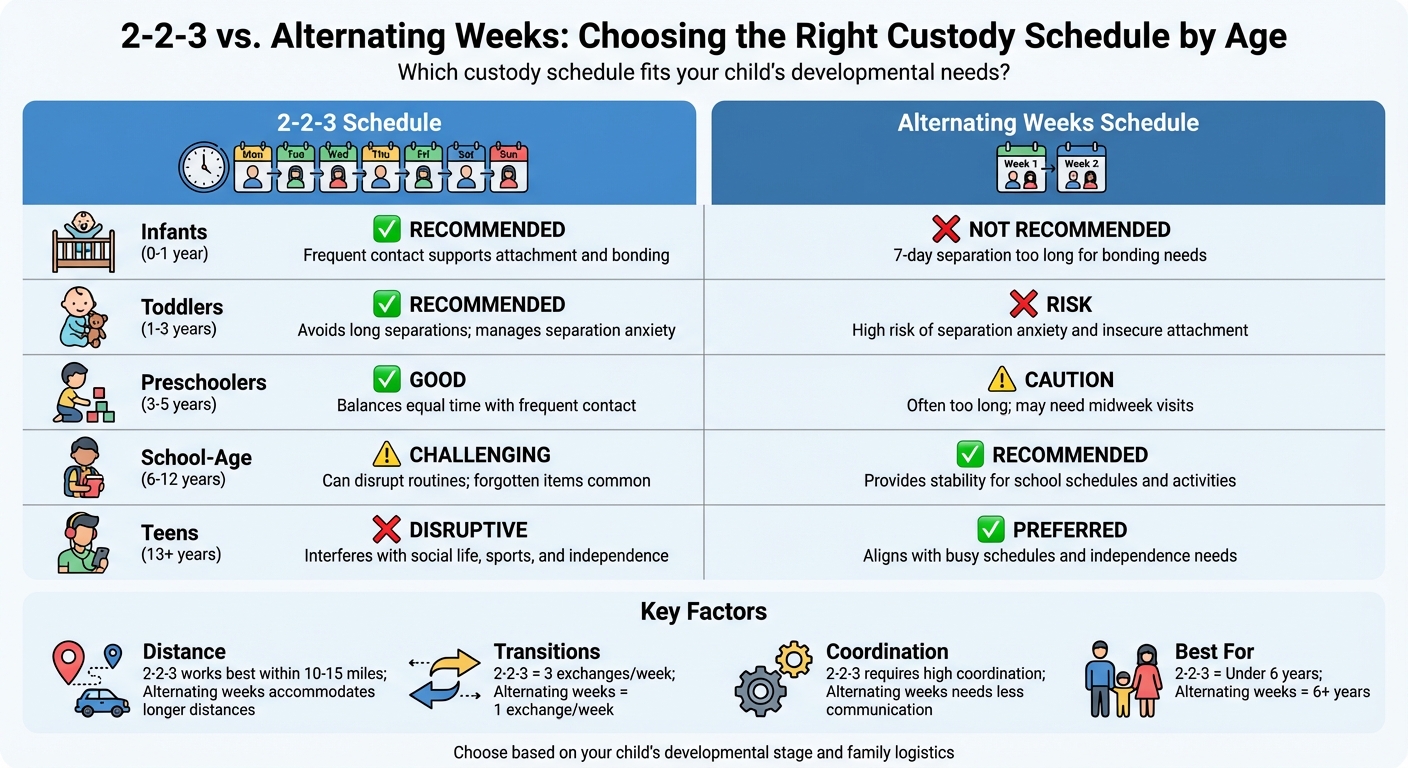
2-2-3 vs Alternating Weeks Custody Schedule Comparison by Child Age
What Is the 2-2-3 Custody Schedule?
The 2-2-3 custody schedule is a type of 50/50 joint physical custody plan. It divides parenting time equally over a two-week cycle: in Week 1, the child spends two days with Parent A, two days with Parent B, and then three days back with Parent A. In Week 2, the pattern flips, giving Parent B the longer three-day stretch.
This setup ensures the child is never away from either parent for more than three days at a time, offering a balance of weekdays and alternating three-day weekends.
"This schedule is especially helpful for children under the age of 4, who are adjusting to co-parenting and may have a harder time separating from one or both parents."
- Michelle Dempsey-Multack, Certified Divorce and Co-Parenting Specialist
Frequent transitions in this schedule help young children maintain close and secure bonds with both parents. For toddlers and preschoolers who may struggle with extended separations, the predictability of seeing each parent every few days can be a source of comfort and reassurance.
How the 2-2-3 Schedule Works
The schedule’s structure is straightforward but requires coordination, often involving AI tools for custody planning. Over 14 days, the child alternates between parents, with transitions usually happening on Monday, Wednesday, and Friday mornings. Many families time these handoffs around school drop-offs or pickups to make the process smoother.
| Week | Monday | Tuesday | Wednesday | Thursday | Friday | Saturday | Sunday |
|---|---|---|---|---|---|---|---|
| Week 1 | Parent A | Parent A | Parent B | Parent B | Parent A | Parent A | Parent A |
| Week 2 | Parent B | Parent B | Parent A | Parent A | Parent B | Parent B | Parent B |
Notice how the schedule alternates weekly. For instance, in Week 1, Parent A has Monday and Tuesday, while in Week 2, those days belong to Parent B. This rotation ensures both parents share responsibilities for weekday routines and weekend activities. However, the frequent changes mean families need to stay organized to manage schoolwork, extracurriculars, and other commitments effectively.
What Is the Alternating Weeks Custody Schedule?
The alternating weeks custody schedule, also known as the 7/7 or week-on, week-off schedule, splits parenting time into seven-day blocks with each parent. Transitions typically happen once a week - often on Fridays, Mondays, or over the weekend - making it straightforward for families to coordinate. This predictable rhythm not only simplifies planning for parents but also helps children adjust more smoothly to the routine.
"The 7/7, or alternating week schedule, provides the easiest way to split time 50/50."
- Elle Barr, Guardian ad Litem
With a full week spent in one home, the parent on duty handles all aspects of daily life, from getting kids to school and managing homework to attending extracurricular activities. To make things easier, many families opt to keep basic necessities - like clothes and school supplies - at both homes, reducing the need for constant packing.
One of the standout advantages of this schedule is the reduced number of exchanges. This allows children to settle into each home without feeling like they’re constantly moving back and forth.
"Fewer exchanges will also allow for a child to become settled and adjusted to each parent's home, reducing the chance that the children will feel bounced back and forth."
- Brendan Hammer, Mediator and Arbitrator, Matador ADR
2-2-3 vs. Alternating Weeks by Age Group
Choosing the right custody schedule often depends on your child's age and developmental stage. Kids' needs change as they grow, and understanding how different schedules impact their emotional and social well-being can help you make informed decisions. Let’s break down how the 2-2-3 and alternating weeks schedules align with the needs of children at various ages.
Infants and toddlers thrive on frequent contact with both parents to build secure attachments. For infants, even brief separations can be stressful as their brains are rapidly forming neural connections during their first year. The 2-2-3 schedule works well here, as it ensures regular interaction with both parents, avoiding long gaps that could disrupt attachment. On the other hand, alternating weeks - with its seven-day separations - can feel like an eternity for babies who haven’t yet developed the cognitive ability to remember an absent parent.
"Young children lack the ability to really hold a relationship in their mind when that person is not with them... a child should not be away from either parent longer than the child's number of years."
- Maria Curran, Licensed Clinical Mental Health Counselor Supervisor
As kids transition to school age, their priorities shift. The frequent handoffs in a 2-2-3 schedule might cause confusion, leading to misplaced schoolbooks, sports gear, or other essentials. For preteens and teens, alternating weeks often provides the consistency they need for school routines and extracurricular activities. Longer, uninterrupted time blocks in the alternating weeks model can help older children establish stability and focus on their busy schedules.
Teenagers, in particular, tend to benefit from the predictability of week-long arrangements. This setup aligns well with their growing independence and packed calendars of school, sports, and social activities.
"Teenagers can often thrive under this schedule [alternating weeks] because it can be very compatible with a teen's already demanding school, athletic, and extracurricular schedule."
- Brendan Hammer, Mediator and Arbitrator, Matador ADR
Comparison by Age Group
The table below highlights how each custody schedule matches the developmental needs of children at different ages:
| Age Group | 2-2-3 Schedule | Alternating Weeks Schedule |
|---|---|---|
| Infants (0-1 year) | Frequent contact supports attachment; overnights may disrupt breastfeeding/sleep | Not recommended; seven-day separation is too long for bonding |
| Toddlers (1-3 years) | Recommended; avoids long separations and helps manage separation anxiety | High risk of separation anxiety and insecure attachment |
| Preschoolers (3-5 years) | Good balance of equal time and frequent contact | Often too long; a midweek visit might be needed |
| School-Age (6-12 years) | Can feel disorienting with frequent midweek moves and forgotten items | Recommended; provides stability for school routines |
| Teens (13+ years) | Too disruptive for social schedules, sports, and part-time jobs | Preferred; offers predictable, independent blocks of time |
This breakdown makes it easier to align custody arrangements with your child’s developmental stage, ensuring their emotional and practical needs are met. For more help, see our step-by-step custody plan guide.
sbb-itb-a09457a
How to Choose Between 2-2-3 and Alternating Weeks
Picking the right custody schedule involves balancing practical logistics with your child's developmental needs. Here's a closer look at the key factors that can help guide your decision.
Factors to Consider
Geographic proximity plays a major role in choosing a custody schedule. The 2-2-3 arrangement works best when parents live within 10–15 miles of each other and the child's school. In California, distances over 20 miles are often considered "long-distance parenting", which can make maintaining a 50/50 split more challenging. On the other hand, alternating weeks can accommodate longer distances since transitions only happen once a week.
Work schedules are another critical consideration. The 2-2-3 setup requires flexibility for frequent mid-week exchanges, which can be tough for parents with rigid work hours or unpredictable responsibilities. Alternating weeks, however, simplifies things by requiring each parent to handle all tasks - school drop-offs, pickups, homework, and activities - for an entire week at a time.
"Although a 2-2-3 schedule doesn't make sense for all families, it is a great option for co-parents whose work schedules allow for it, who have the ability to share in the parenting responsibilities equally, and who live near the other parent." - Michelle Dempsey-Multack, Certified Divorce and Co-Parenting Specialist
Communication and conflict levels are also key. The 2-2-3 schedule demands frequent coordination - parents need to communicate regularly about schoolwork, clothing, and daily routines. Using the school as a neutral exchange point can reduce direct interactions. Meanwhile, alternating weeks require fewer exchanges, which can help minimize potential conflicts between parents.
Your child's preferences should be factored in, especially as they grow older. By the time children reach upper elementary school, they often have a sense of what works best for them. Studies show that consistent routines can lower the risk of depression, impulsivity, and aggression in children. It's important to choose a schedule that aligns with your child's developmental stage and emotional needs.
Lastly, consider the practicalities of your commute. If driving between homes and school takes more than 20–30 minutes during rush hour, a 2-2-3 schedule may not be sustainable. These logistical details are crucial for finding a workable solution.
Getting Personalized Schedule Recommendations with Coflo
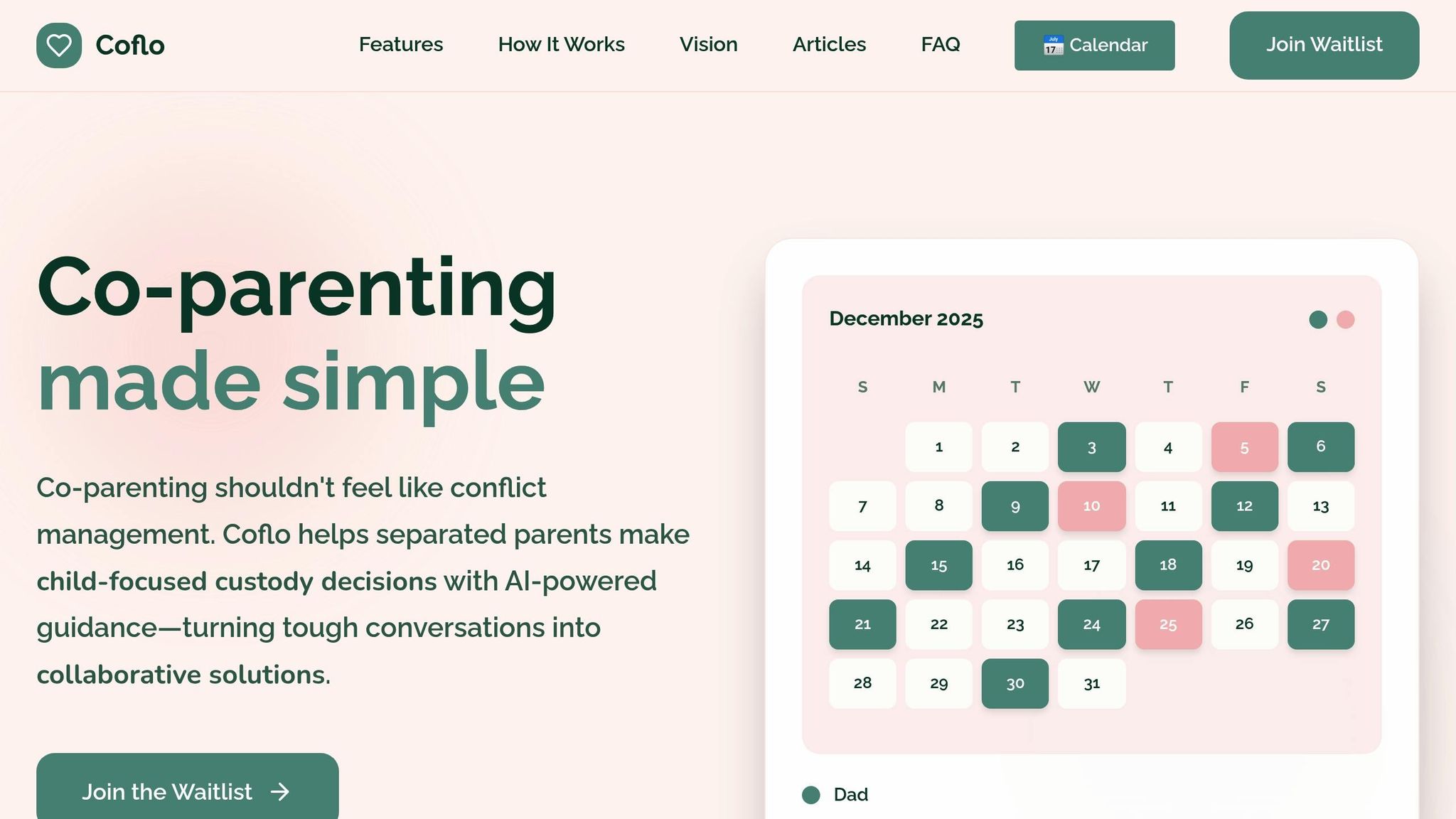
Coflo makes it easier to navigate these complex decisions by combining expert developmental insights with your specific circumstances. The platform evaluates factors like your child's age, work schedules, and home locations to recommend custody arrangements tailored to your priorities.
With Coflo, you can adjust sliders to prioritize stability, equal time, school consistency, flexibility, or minimal transitions. The system then analyzes over 10 proven custody patterns - including 2-2-3, alternating weeks, and variations like 2-2-5-5 - and ranks them based on how well they suit your family's needs. Each recommendation includes detailed, age-specific insights on how the schedule supports your child's emotional and social well-being.
What makes Coflo stand out is its comprehensive implementation roadmap. Every recommendation comes with a breakdown of benefits, potential challenges, and a step-by-step guide to introducing the new schedule smoothly. This eliminates much of the guesswork and research often involved in custody planning.
Coflo also prioritizes privacy with end-to-end encryption and client-side processing to protect your family's sensitive information. As your family dynamics evolve - whether due to a child's developmental changes or a parent's relocation - you can adjust your preferences and receive updated recommendations instantly. By focusing on data-driven solutions, Coflo turns custody planning into a collaborative process centered on your child's well-being.
Conclusion
When deciding on a custody schedule, consider your child's age, developmental stage, and your family's logistical needs. For younger children, the 2-2-3 schedule helps maintain strong connections with both parents, fostering a sense of security. However, this arrangement works best when parents live within 10–15 miles of each other, as it involves three exchanges per week, which can be challenging to manage.
On the other hand, the alternating weeks schedule offers a more predictable routine, making it a better fit for school-aged children and teenagers. These older kids can handle longer stretches between visits and benefit from a consistent weekly structure that aligns with their school, social, and extracurricular commitments.
Each approach serves different developmental needs and family dynamics. As attorney Jeralyn Lawrence emphasizes, "The driving force behind the structure of any parenting schedule should be the best interests of the child". A schedule that works well for a toddler may not suit a teenager, and arrangements that are practical for nearby parents may not work for those living farther apart.
This is where Coflo steps in to simplify the process. By aligning your priorities with evidence-based custody patterns, Coflo offers personalized recommendations. These include insights tailored to your child’s developmental stage, step-by-step implementation guidance, and practical tips to make the schedule work for your family. This turns what might feel like an overwhelming task into a thoughtful, research-backed process that prioritizes your child's well-being.
Choosing the right schedule is about supporting your child's development while balancing your family’s logistics. Above all, let your child's best interests guide your final decision.