
How Custody Plans Evolve With Age
When parents separate, custody plans must change as children grow. Kids' needs vary greatly by age, and schedules that work for a toddler won't suit a teenager. Research shows that age-specific custody arrangements can reduce stress, improve emotional well-being, and help maintain strong relationships with both parents. Here's a quick breakdown of how custody plans shift through different stages of childhood:
- Infants (0-12 months): Short, frequent visits are better than long separations to support secure attachment. Overnight stays are often avoided unless both parents are equally involved in caregiving.
- Toddlers (1-3 years): Frequent transitions with short visits help maintain emotional security. Routines across both homes are essential.
- Preschoolers (3-5 years): Children can handle longer stays with each parent. Structured schedules like 2-2-3 or 4-3 work well.
- School-aged kids (6-12 years): Stability for school, friendships, and extracurricular activities becomes key. Week-on/week-off or 2-2-5-5 schedules are common.
- Teenagers (13-18 years): Flexibility is critical to accommodate their busy lives and growing independence. Teens often have a say in custody decisions.
Tailoring custody plans to match developmental needs ensures children feel secure and supported at every stage. Regularly revisiting these plans as kids grow helps families adjust smoothly to new challenges and priorities.
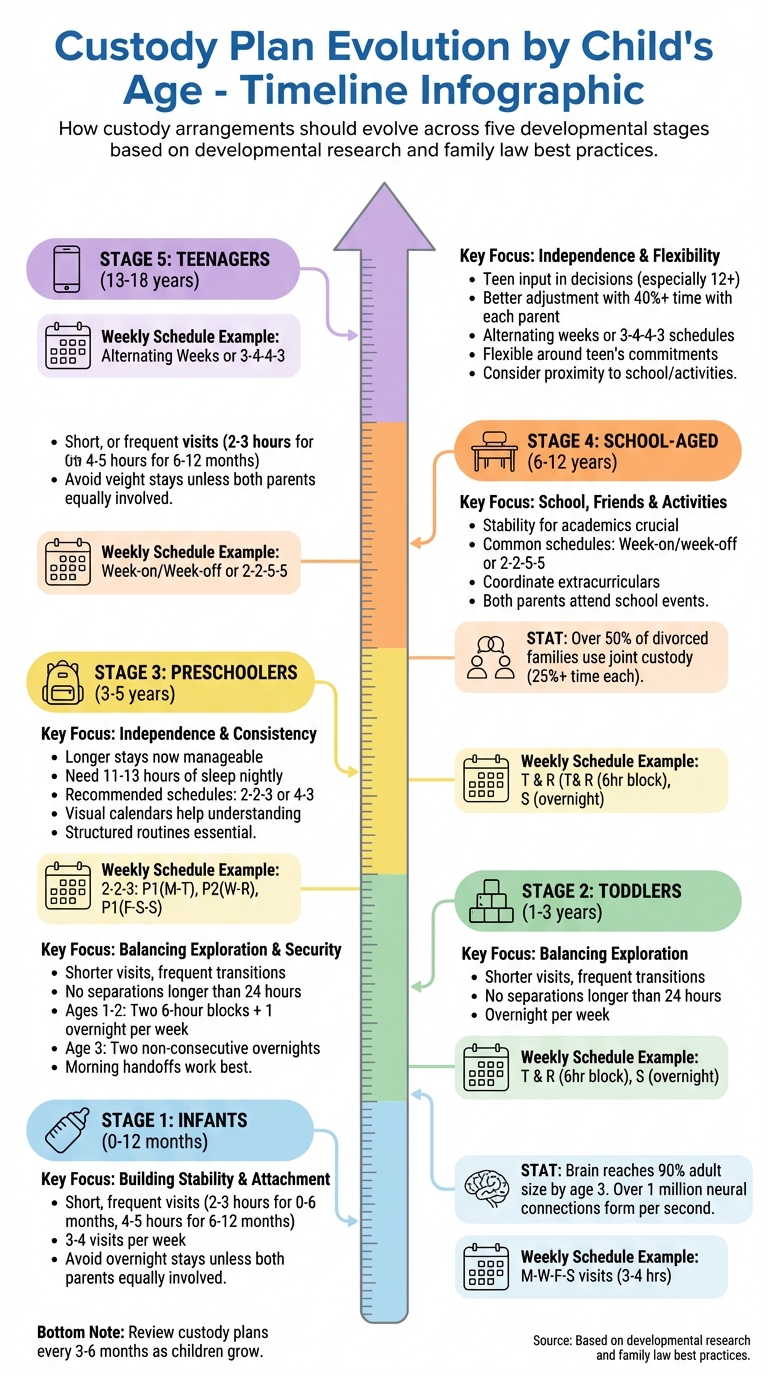
Age-Appropriate Custody Schedule Guidelines from Infancy to Teens
Infants (0-12 Months): Building Stability and Attachment
During the first year of life, an infant's brain develops at an astonishing pace. At birth, it's only about 25% of its adult size, but by age three, it reaches 90% of that size, with over one million neural connections forming every second. These early connections depend heavily on consistent and responsive caregiving, making secure attachment relationships a cornerstone of healthy development.
The Role of Bonding and Primary Caregivers
Infants rely on a primary caregiver to establish a secure base. This relationship not only helps them explore their world but also teaches them how to regulate emotions. Developmental expert Bruce Perry highlights the importance of this early bonding:
"There are critical periods during which bonding experiences must be present for the brain systems responsible for attachment to develop normally. These critical periods appear to be in the first year of life."
While infants can form attachments with multiple caregivers, they typically show a strong preference for one primary figure who consistently meets their needs. When separated from this caregiver, even if they appear calm, their bodies may release cortisol, a stress hormone.
Unpredictable custody schedules or inconsistent caregiving can disrupt this attachment process. In fact, disorganized attachment patterns are seen in roughly 50% of high-risk cases, compared to just 10% in more typical situations. Such disruptions can affect emotional regulation and empathy as the child grows.
Building a Routine-Based Schedule
For infants, short and frequent visits are better than long separations. Experts suggest visits of 2–3 hours for babies aged 0–6 months, increasing to 4–5 hours for those 6–12 months old, with three to four visits per week. Scheduling these visits during the baby's alert periods - like 9:00–11:00 AM or 2:00–4:00 PM - can make interactions more meaningful.
Consistency is key. Both households should maintain regular routines for feeding, sleeping, and diapering to reduce stress. Familiar comfort items, like a special blanket or stuffed animal, can also help the infant feel secure between homes. Many experts advise waiting until after the first year before introducing overnight stays, unless both parents have been actively involved in overnight care since birth. Starting with short daytime visits and gradually increasing their length allows the baby to build trust and security with both parents without overwhelming their developing attachment system. These early efforts lay the foundation for smoother custody transitions as the child grows.
sbb-itb-a09457a
Toddlers (1-3 Years): Balancing Exploration and Emotional Security
Between the ages of one and three, toddlers grow at an incredible pace. They’re eager to explore the world around them, yet they still crave the reassurance that their parents are close by. This mix of growing independence and a need for emotional safety is key when shaping custody schedules. Building on the secure attachments formed during infancy, schedules for toddlers must now strike a balance between encouraging exploration and providing the comfort they need.
Shorter Visits and Frequent Transitions
For toddlers, shorter but more frequent visits work better than long separations. Research highlights that children under three experience increased stress when separated from a parent for more than 24 hours.
"Children under three experience heightened stress during parent separations lasting more than 24 hours, making shorter, more frequent visits crucial." - New York Family Law Group
For children aged 1–2, a good structure might include two six-hour blocks and one overnight visit per week. As they approach age 3, introducing two non-consecutive overnights can help ensure that neither parent is absent for more than two days.
The timing of transitions also matters. Morning handoffs tend to go smoother since toddlers are usually better rested and less cranky. Experts suggest that the parent finishing their time with the child should handle the drop-off, as this approach avoids making the toddler feel like one parent is “taking them away” from the other. These thoughtful adjustments reflect toddlers' unique needs and set the stage for more flexibility as they grow, including age-appropriate holiday custody plans.
Supporting Exploration Through Consistent Environments
As toddlers begin to explore more, having consistent routines across both homes becomes increasingly important. These little adventurers thrive in environments where they feel safe and know what to expect. Simple things like matching wake-up times, meal schedules, naps, and bedtime rituals between homes can make transitions smoother and reduce stress.
There are also small but effective ways to help toddlers adjust between homes. Using the same comfort items, like a favorite stuffed animal, and creating photo books that show both homes can provide a sense of continuity. When saying goodbye, keeping it brief and upbeat is better than prolonging the farewell, which can sometimes increase anxiety.
Pay attention to signs of stress, such as disrupted sleep or difficulties with eating that persist for more than two days. To keep the bond strong with the other parent, short video calls between visits can be a great way to ease separation anxiety and maintain emotional connections.
Preschoolers (3–5 Years): Building Independence and Consistency
At ages three to five, kids begin asserting their independence while still finding comfort in predictable routines. Custody arrangements should adapt to their emotional growth, offering more structure than during the toddler years. This stage allows for schedules that accommodate longer periods away from each parent since preschoolers are better equipped to handle such changes.
Structured Schedules for Predictability
Preschoolers thrive when life feels predictable. Regular routines for meals, sleep, and bedtime across both households give them a sense of stability, which is crucial for their growing independence. At this age, most children need 11–13 hours of sleep each night, and many start to phase out their afternoon naps during this period.
"Preschoolers do well with consistency and predictability. Your plan should allow your preschooler to keep a consistent routine." – Custody X Change Research Team
Visual tools, like a color-coded calendar that shows which days they’ll spend with each parent, can help preschoolers grasp the concept of time and feel more in control. While transitions between homes might sometimes lead to emotional outbursts, most children settle in quickly once the handoff is complete. A helpful tip: have the parent finishing their time handle the drop-off, rather than having the other parent pick the child up. This approach often makes transitions smoother.
Introducing Longer Stays Between Homes
By the preschool years, children generally have the emotional readiness to manage longer separations from a parent compared to their toddler years. This opens the door to more flexible custody arrangements. A popular choice for this age group is the 2-2-3 schedule (two days with Parent A, two days with Parent B, followed by three days with Parent A). This setup ensures frequent contact with both parents while avoiding extended separations. Another option is the 4-3 schedule, which allows for slightly longer stays while maintaining a consistent weekly rhythm.
For families considering alternating weeks, adding a midweek overnight visit with the other parent can help maintain the parent-child bond. Transition objects, family photos, and short video calls are also great tools to provide a sense of continuity during longer stays. These strategies lay the groundwork for custody plans that will support the more complex needs of school-aged children.
School-Aged Children (6-12 Years): Balancing School, Friends, and Family
Children between 6 and 12 thrive when their custody arrangements support their academic, social, and extracurricular lives. At this stage, kids understand time better and benefit from structured routines, making it possible to create more detailed schedules compared to those for younger children. A 2010 Wisconsin study revealed that over half of divorced families adopt joint physical custody, where each parent has at least 25% of parenting time. These arrangements aim to minimize disruptions and foster a sense of stability.
Prioritizing Academic Stability
School-aged children tend to excel academically when their custody schedules provide consistent routines. For instance, week-on/week-off schedules offer stability without frequent transitions. Another option, the 2-2-5-5 schedule, alternates two days with each parent followed by five days with each, ensuring predictable and regular contact.
"School-age children do better in school when both parents are involved in schooling." – Custody X Change
Active involvement from both parents - attending parent-teacher conferences, assisting with homework, and communicating with teachers - can significantly impact a child’s academic success. For families living in different school districts, the child usually enrolls in one, and custody schedules should accommodate practical drop-offs and after-school logistics. Consistent routines across both homes, like similar bedtimes and homework schedules, help children adjust smoothly. Beyond academics, custody plans should also leave room for friendships and extracurricular activities, which are increasingly important at this age.
Managing Social and Extracurricular Activities
In addition to academic needs, custody schedules should consider the child’s social life and extracurricular commitments, such as sports or clubs. A practical approach is to start with the child’s fixed activities - like practices, games, or social events - and then structure custody time around these priorities.
"Your family now has three packed schedules to contend with, so you might have no other option than to design a more fragmented custody schedule that keeps your kid conveniently located for every event of the week." – Divorce.com
For longer custody rotations, such as week-on/week-off, midweek dinners can keep the parent-child connection strong without disrupting school routines. Tools like shared digital calendars or co-parenting apps can make it easier to coordinate school projects, practices, and other events in real time. As children near the upper end of this age range, involving them in scheduling decisions can acknowledge their growing independence and preferences. Many families also adjust custody schedules during summer breaks, allowing for longer vacations or extended time with a parent who lives farther away.
Teenagers (13-18 Years): Building Independence and Flexibility
Teenagers need custody arrangements that respect their growing independence while keeping both parents actively involved. As they develop their own identities, custody schedules designed for younger children can sometimes create unnecessary tension. Research highlights that teens show better social and behavioral adjustment when they spend at least 40% of their time with each parent.
Including Teenagers in Custody Decisions
Courts give significant weight to teenagers' preferences, especially for those 12 and older. Ignoring these preferences can damage parent-child relationships. To ensure honesty, judges often conduct private interviews to understand the teen's genuine wishes.
"Courts usually consider the preferences of teenagers more seriously than those of younger children when making custody decisions." – Kathryn L. Beeman, Attorney at Law
While teens may have a strong voice in custody decisions, parents still play a vital role in providing structure. Consistent rules across both households - covering curfews, driving, dating, and discipline - are essential. These agreements help create schedules that fit teens' increasingly busy lives.
Flexible Schedules for Busy Lives
Custody plans for teenagers should prioritize their commitments over parental convenience. Alternating week schedules often work well, as they reduce transitions and provide stability during school weeks. Other options include a 3-4-4-3 schedule or a "home base" model, where the teen primarily stays with the parent closer to school, work, or social activities, while maintaining flexible visits with the other parent.
"Demanding that a teen rigidly follow a parenting plan provision when that teen has another important commitment makes little sense and will only serve to alienate the teen from the parent demanding such inflexibility." – Peter Van Aulen, Attorney at Law
Parents can strengthen their relationship with teens by attending their events and activities. Trial periods for new schedules can help families find what works best before making permanent changes. Proximity is key - teens often prefer living with the parent who minimizes travel stress in their daily routines.
Step-Up Parenting Time: Gradual Custody Transitions Over Time
A step-up parenting plan gradually increases the time a noncustodial parent spends with their child, making transitions smoother and fostering stronger bonds over time. This method allows children to adjust at a pace that feels natural, minimizing stress and creating opportunities for parents to build trust and connection. Typically, these plans start with shorter, more frequent visits and eventually progress toward joint physical custody as the child becomes more comfortable and the parent demonstrates readiness. By tailoring the schedule to each family's specific needs, this approach lays the groundwork for future custody arrangements.
Step-up parenting plans are especially common for infants and toddlers, cases involving estranged parents, or situations where one parent has a history of substance abuse or violence and needs to show consistent improvement. For infants and toddlers, this method is particularly important. In states like Ohio and Texas, this type of arrangement is referred to as "phased-in parenting time". Research supports the idea that gradual transitions help reduce stress and maintain secure attachments in these scenarios.
As the plan evolves to meet the child’s changing needs:
"A child's needs change as they get older, and a step-up parenting plan evolves with them." – Custody X Change
Each stage of the plan includes specific milestones - such as completing parenting classes, attending counseling, or passing random drug tests - that must be met before advancing to the next phase. For example, one case followed a seven-stage plan, beginning with supervised visits and gradually moving to twice-weekly visits once the parent met all required conditions. These clear, structured steps help avoid misunderstandings and ensure both parents know exactly what is required to progress.
Children with Special Needs: Customizing Custody Plans
About 17% of children - roughly one in six - experience developmental disabilities like ADHD or ASD. Standard custody arrangements often fall short when it comes to addressing the unique challenges these children face. Instead of relying on generic templates, parents should carefully consider specific factors that can help create a plan tailored to their child's needs, or even use AI-generated custody schedules to minimize friction. Here are some strategies to adapt custody plans for children with developmental or medical challenges.
Adjusting Schedules for Developmental or Medical Needs
For children with special needs, maintaining identical routines in both homes is key to providing a sense of security. While consistency is important for all children, those with special needs often require routines that are mirrored exactly. For instance, children with ASD may need the same meal times, bedtime practices, and disciplinary methods in each household. As Melone Hatley, P.C. explains:
"Children with ASD, in particular, thrive on routines and schedules. As you dissolve your marriage, co-parenting such a child requires duplication of routines in each parent's home."
Both homes should also be equipped with any specialized equipment or daily medications the child requires. Parents need to be trained in their use to ensure continuity of care. A shared communication notebook can help track medication schedules, therapy updates, and the child's emotional well-being. Additionally, custody plans should prioritize proximity to the child's healthcare providers, ensuring that both parents live close enough to maintain regular appointments with doctors, therapists, and specialists.
For children who struggle with frequent transitions, a "bird nesting" arrangement may work well. In this setup, the child stays in one home while the parents take turns living there, reducing the stress of constant travel. Parents should also alternate attending medical and therapy appointments. This approach ensures both parents stay informed about the child's treatment plan and allows healthcare providers to observe how the child responds in both environments. These adjustments can make custody plans more responsive to the child's evolving needs over time.
Providing Emotional and Behavioral Support
Consistency in routines isn't just about physical habits - it’s also vital for emotional stability. Children with emotional or behavioral challenges often benefit from predictable routines for meals, sleep, and transitions. In fact, predictability can sometimes matter more than the physical location itself. For example, when teachers recommend "consistency", they may mean uniform homework rules and disciplinary approaches across both homes, rather than keeping the child in one place.
Parents should stay alert for signs that a custody schedule may not be working. Persistent sleep issues, resistance to eating, or increased distress during transitions could indicate that adjustments are needed. Reviewing the custody plan every three to six months helps ensure it continues to meet the child's changing needs. In cases where parents disagree on diagnoses, treatments, or education plans like IEPs, involving a parenting coordinator or family therapist can provide guidance and help resolve conflicts.
How Coflo Supports Age-Based Custody Planning
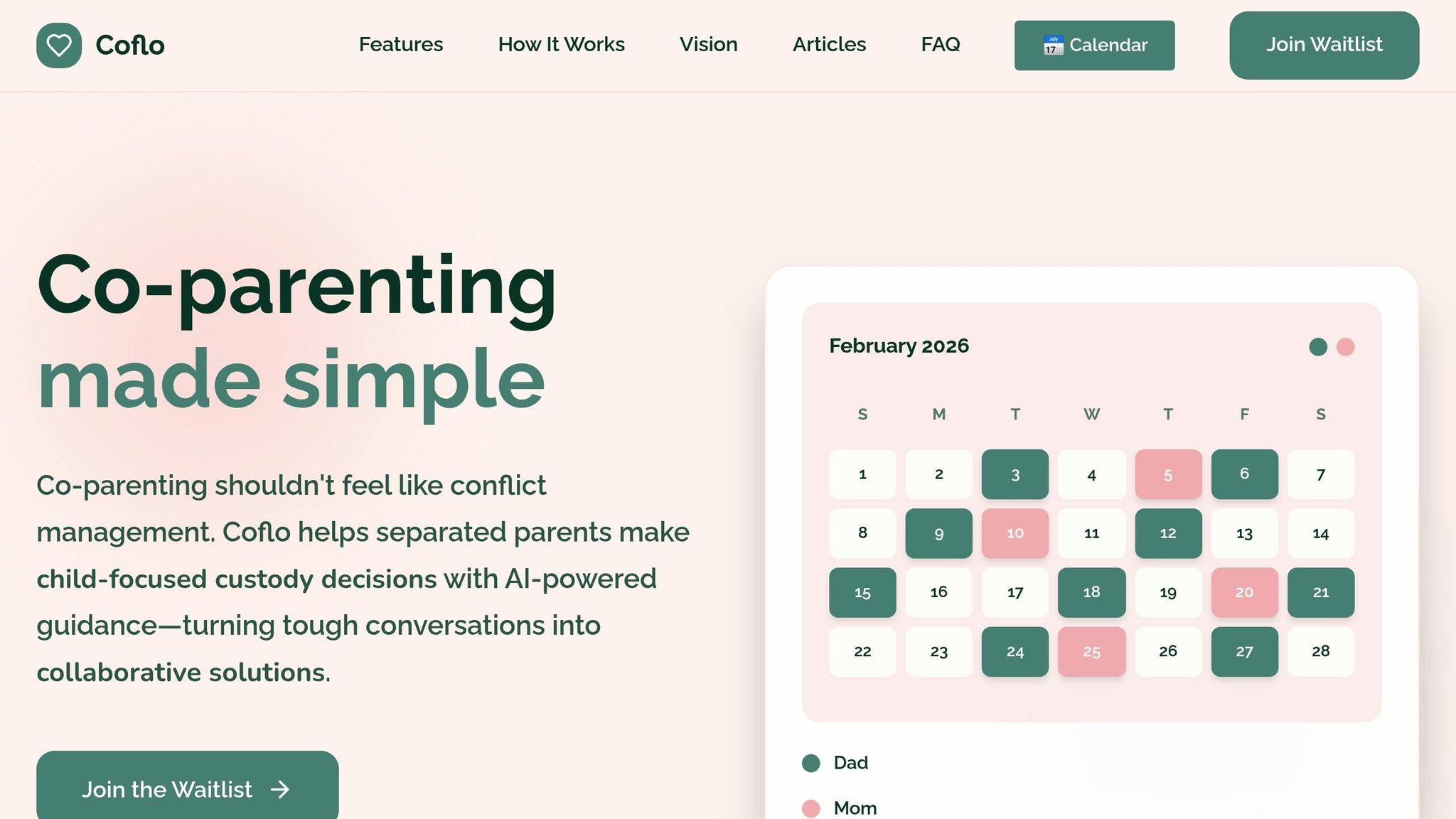
Adjusting custody plans to suit your child's changing needs is now easier with AI-driven guidance. Coflo uses artificial intelligence to evaluate factors like your child’s age, the distance between homes, work schedules, and family priorities. This analysis delivers personalized custody recommendations rooted in developmental research. Instead of relying on guesswork, you’ll receive options tailored to your family’s unique circumstances, all supported by science-based insights into childhood development and custody practices.
AI-Powered Custody Schedule Recommendations
Coflo begins by focusing on what’s most important to your family. Using adjustable sliders, you can set priorities such as stability, equal parenting time, academic consistency, and flexibility. The AI then reviews well-established custody patterns and ranks them based on how effectively they align with your preferences while addressing logistical realities. Each recommendation includes a clear explanation of its suitability for your child’s developmental stage, along with an outline of potential trade-offs. As Coflo describes:
"Our AI analyzes hundreds of factors to suggest custody schedules that balance fairness with practicality".
Developmental Guidance for Each Age Group
Coflo’s recommendations are based on research into the needs of children at different developmental stages. For infants and toddlers, the AI prioritizes frequent, shorter visits to foster secure attachments. When it comes to school-aged children, the focus shifts to maintaining consistent academic routines while minimizing disruptions to extracurricular activities and friendships. For teenagers, the system suggests more flexible schedules that respect their growing independence and busy social lives. Parents can also develop step-up plans, which gradually increase transition times as their child grows and their needs evolve.
Tools for Cooperative Co-Parenting
Coflo goes beyond schedules by offering tools to reduce conflict and encourage collaboration. The platform includes AI-driven tone coaching to help parents navigate tough conversations in a way that keeps the focus on their child’s needs. Each custody recommendation comes with a detailed, step-by-step guide for implementation. By giving both parents access to the same research-based information, Coflo shifts the focus from disputes over "who gets what days" to decisions centered on the child’s well-being. With its integration of developmental research and practical tools, Coflo supports a child-first approach to custody planning. Early access is available through a simple waitlist sign-up that only requires an email - no payment details needed.
Conclusion
Children’s needs change dramatically from infancy to their teenage years, and custody plans must evolve to keep up. For instance, while a one-year-old benefits from frequent, short visits to maintain attachment, that same arrangement might feel overly restrictive for a 15-year-old. Research consistently shows that custody plans tailored to a child’s developmental stage can reduce anxiety, improve academic outcomes, and foster stronger, lasting relationships with both parents.
To address these shifting needs, many parents now turn to tools grounded in developmental research. These resources take the guesswork out of custody planning by offering insights tailored to a child’s age and unique family dynamics. Platforms like Coflo provide specific, science-backed guidance, empowering parents to make confident, child-centered decisions. Regularly revisiting custody arrangements - every three to six months or during significant transitions - helps ensure they remain aligned with a child’s growth. Key milestones, such as starting school, reaching driving age, or gaining a legal say in custody decisions (often around ages 12–14), are moments when plans often need adjustments.
Effective co-parenting hinges on treating custody plans as adaptable frameworks rather than rigid agreements. This flexibility allows families to navigate transitions - whether it’s the attachment-focused early years or the independence-seeking teenage phase - while maintaining stability and fostering meaningful relationships with both parents.
Families that thrive after separation understand that custody planning is an ongoing journey. With the right tools and a commitment to adapt as children grow, co-parenting challenges can transform into opportunities for collaboration, always keeping the child’s well-being at the center.