
Data Retention vs. Anonymization: What Parents Should Know
Using co-parenting apps means sharing sensitive family data, but how that data is handled - stored indefinitely or anonymized - affects your privacy and safety. Here's what you need to know:
- Data Retention: Apps store identifiable information (like schedules, messages, and financial records) for functionality and legal needs. This can help in custody disputes but increases risks of breaches, exposing private details like locations or medical records.
- Anonymization: Removes personal identifiers from data, reducing risks in case of breaches. However, anonymized data can still be re-identified through techniques like the Mosaic Effect, especially when combined with other datasets.
- Key Risks: Long-term data storage raises security concerns, while anonymization limits app features like personalized custody plans and legal utility.
- Legal Factors: Laws like GDPR and COPPA enforce limits on data retention, but anonymized data is generally exempt from these regulations.
Bottom Line: Choose apps based on your family’s needs - retention-focused tools for legal documentation and privacy-first platforms to minimize risks. Review privacy policies, avoid unnecessary permissions, and enable security features like two-factor authentication.
What Is Data Retention?
Data retention refers to the temporary storage of personal data for operational or legal purposes. For instance, when using a co-parenting app, the platform collects and keeps information such as custody schedules, expense logs, messages, and other family-related details. Let’s dive into how this process works in co-parenting apps.
How Data Retention Works
Co-parenting apps store various types of data - calendars, expense records, messages, and personal identifiers - to ensure the app functions properly and provides legal documentation when needed. This setup allows users to access a complete history of interactions, financial records, and custody agreements. Courts often rely on this documented history as evidence in custody disputes.
While these records serve practical purposes, keeping data for extended periods also comes with serious security concerns.
Risks of Storing Data Long-Term
The longer data is stored, the more vulnerable it becomes to breaches. By 2025, cybercrime is expected to cost the global economy $10.5 trillion annually. For families using co-parenting apps, a breach could reveal private messages, financial details, custody schedules, and even location data embedded in shared photos.
Jonathan D. Steele, a divorce attorney based in Chicago, highlights the potential consequences:
"If sensitive information is leaked, it can affect custody arrangements and other legal matters, potentially leading to further complications in court".
Location metadata in stored photos presents an added risk, especially for individuals in sensitive or precarious situations. Metadata can include GPS coordinates and timestamps, potentially exposing private locations.
The Safety Net Project underscores this issue:
"Keeping data when it is no longer needed, or using poor cybersecurity practices in storing it, creates a risk if the app developer is ever hacked".
Legal Requirements for Data Retention
Data retention laws, including GDPR, CCPA/CPRA, and COPPA, impose strict limits on how long personal data can be stored. These regulations enforce the "storage limitation principle", which mandates that apps keep identifiable data only for as long as it serves the original purpose of collection. As one legal analysis explains:
"Retention must be limited to what is reasonably necessary for the purposes disclosed at the time of collection".
For apps handling children’s data, the rules are even more stringent. The updated Children's Online Privacy Protection Rule (COPPA) requires companies to have a written data retention policy with specific deletion timelines. Starting April 22, 2026, companies must adhere to these requirements. The Federal Trade Commission has clarified:
"indefinite retention will rarely, if ever, satisfy COPPA's Reasonable Retention Requirement".
When evaluating a co-parenting app, it’s crucial to review its privacy policy. Look for clear retention timelines or specific criteria for data deletion. Vague terms like "as long as necessary" could indicate non-compliance with privacy laws. Understanding these legal guidelines is key when considering data retention policies versus anonymization options.
sbb-itb-a09457a
What Is Anonymization?
After discussing data retention, let’s dive into anonymization - a process designed to reduce long-term privacy risks.
Anonymization works by permanently removing personal identifiers, making it impossible to trace data back to an individual. Unlike other privacy measures, this method is irreversible. Once data is anonymized, it’s no longer linked to the person it originally described.
The Information Commissioner's Office (ICO) sums it up well:
"Anonymisation is the way in which you turn personal data into anonymous information, so that it then falls outside the scope of data protection law."
For instance, instead of storing specific information like "Sarah picks up her daughter every Tuesday at 3:00 PM from Lincoln Elementary", an app could aggregate data to show general patterns, such as average pickup times, without revealing any personal details.
How Anonymization Works
Anonymization relies on techniques like data masking, aggregation, and generalization to remove identifying details.
- Data masking hides parts of the information, such as displaying a phone number as xxxx-xxx-1234.
- Aggregation combines individual records into larger datasets, such as calculating average response times rather than showing individual responses.
- Generalization replaces specific details with broader categories, like reporting an age range (e.g., 30–40) instead of an exact age.
More advanced methods include noise addition and differential privacy, which obscure individual data points while maintaining overall trends. To ensure the data is thoroughly anonymized, organizations often apply the "Motivated Intruder" test, which evaluates whether a determined individual could still re-identify someone.
Next, let’s explore how anonymization differs from pseudonymization and what that means for privacy.
Anonymization vs. Pseudonymization
It’s crucial to understand the distinction between anonymization and pseudonymization, especially when dealing with sensitive data in co-parenting apps.
- Pseudonymization replaces personal data with reversible tokens, allowing the original information to be retrieved if needed.
- Anonymization, on the other hand, permanently removes all connections to personal identities.
Under GDPR, anonymized data is no longer considered personal data and is exempt from data protection laws. However, pseudonymized data remains subject to these regulations because it can still be linked back to individuals. For co-parenting apps, pseudonymization might be used to maintain functionality, like associating data with a specific parent. Anonymization, however, is better suited for long-term storage or sharing data for research purposes.
Privacy Benefits of Anonymization
For families using co-parenting apps, anonymization provides a layer of protection. In case of a data breach, the absence of personal identifiers makes it harder for attackers to misuse the information. Still, anonymized data isn’t entirely risk-free, especially when multiple datasets are combined.
The Screenwise Parent Guide offers a cautionary perspective:
"Digitally anonymized is tech-speak for 'we took your name off the file, but we can still probably figure out it's you.' In 2026, with AI pattern-matching being what it is, true anonymity is a rare bird."
For co-parenting families, anonymization should be seen as a way to reduce exposure rather than a guarantee of complete privacy. To stay safer, review app permissions carefully and avoid using social login options, which could inadvertently link anonymized activity back to your identity.
Data Retention vs. Anonymization: Key Differences
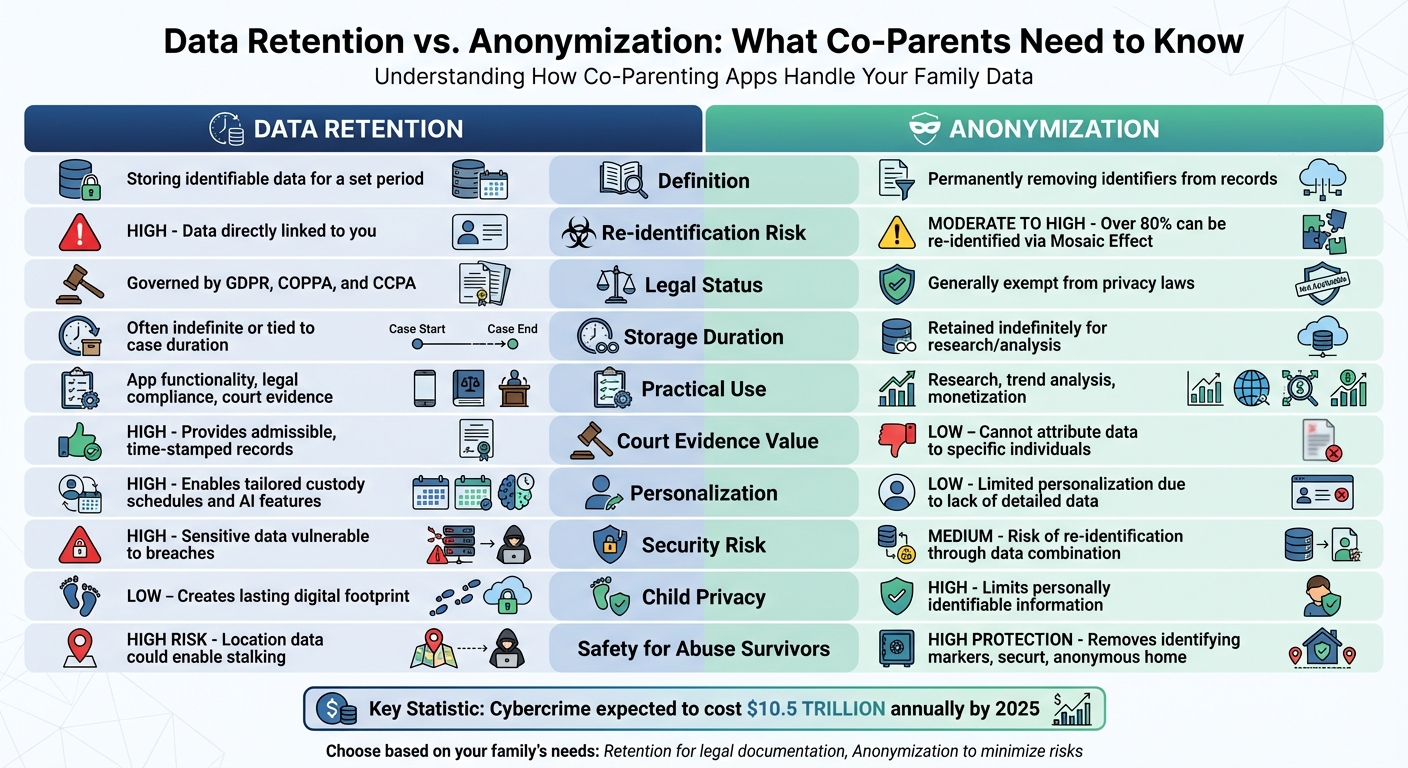
Data Retention vs Anonymization in Co-Parenting Apps: Complete Comparison
Building on our earlier discussion about privacy concerns in co-parenting apps, let's break down how data retention and anonymization differ in practice - and what those differences mean for your family's privacy.
Purpose and Function
Data retention involves keeping identifiable information to ensure app functionality and provide legal evidence. This creates a detailed record of your family's interactions, which can be critical for accountability and even court proceedings.
Anonymization, on the other hand, removes personal identifiers to prioritize privacy while still allowing for aggregate data analysis. However, it's important to note that anonymized data isn't entirely risk-free. The Mosaic Effect - where different datasets are combined to re-identify individuals - remains a concern.
Legal and Practical Differences
These two approaches also carry distinct legal implications.
Under GDPR, anonymized data is no longer classified as personal data and is typically exempt from such regulations. In contrast, retained data remains fully subject to laws like GDPR, COPPA, and CCPA. Retained data can also be subpoenaed and used in legal disputes. Family law attorney Rebecca Palmer highlights that co-parenting platforms often handle sensitive family data, such as educational and medical records.
Retention keeps your data tied to your identity, often indefinitely. Meanwhile, anonymization aims to permanently erase identifying details. CISA-certified expert Keri Bowman explains that true anonymization removes all personal identifiers. However, the Mosaic Effect can still allow data brokers to piece together anonymized datasets and identify individuals.
The following table provides a snapshot of these differences:
Comparison Table: Data Retention vs. Anonymization
| Feature | Data Retention | Anonymization |
|---|---|---|
| Definition | Storing identifiable data for a set period. | Permanently removing identifiers from records. |
| Re-identification Risk | High – data is directly linked to you. | Moderate to high – over 80% of anonymized data can be re-identified via the Mosaic Effect. |
| Legal Status | Governed by GDPR, COPPA, and CCPA. | Generally exempt from privacy laws. |
| Storage Duration | Often indefinite or tied to case duration. | Retained indefinitely for research or analysis. |
| Practical Use | Supports app functionality, legal compliance, and court evidence. | Used for research, trend analysis, and sometimes monetization. |
| Implications for Parents | Can be used in custody disputes or subpoenas. | Limits exposure of personal information but isn't foolproof. |
Pros and Cons for Co-Parenting Apps
This section takes a closer look at how different approaches to managing data impact co-parenting apps and the privacy of your family.
Data Retention: Pros and Cons
Data retention lies at the heart of co-parenting apps, powering key features like shared calendars, expense tracking, and messaging. Keeping everything centralized reduces confusion and ensures critical details aren’t missed. These apps also provide a permanent, time-stamped record, which courts often use to assess patterns of behavior and compliance. As Chicago divorce attorney Jonathan D. Steele puts it:
"Navigating the digital co-parenting landscape resembles walking through a crowded street while juggling fragile items; one misstep could lead to a catastrophic spill of personal data."
Additionally, retained data helps fuel AI-driven features, such as age-appropriate custody plans tailored to your child’s needs and family routines. Knowing that communications are preserved can also encourage parents to stay factual and focused on their child’s well-being.
However, the same data retention poses risks. Sensitive information like medical records, financial details, and addresses could be exposed in a data breach. For survivors of domestic abuse, stored location data or metadata in photos could be exploited for stalking. Family law attorney Rebecca Palmer highlights another concern:
"Relying on an algorithm to moderate tone can prevent parents from confronting the underlying emotional drivers of conflict... substituting a curated, 'artificial calm' for genuine behavioral growth."
Anonymization: Pros and Cons
Anonymization offers a layer of privacy by removing personal identifiers from data. This approach minimizes the impact of potential breaches - hackers can’t misuse what they can’t identify. For families worried about creating a digital footprint that could affect their children’s future opportunities, anonymization provides a safeguard.
However, there’s a trade-off: less functionality. Without detailed personal data, these apps lose the ability to offer personalized features like AI-driven custody plans. Courts also can’t use anonymized data as evidence, since it doesn’t meet the standards needed to identify specific individuals.
Interestingly, even anonymized data isn’t foolproof. Studies show that over 80% of people can be re-identified using just three or four anonymous data points, such as birthdate, zip code, and gender.
Comparison Table: Retention vs. Anonymization in Co-Parenting Apps
Here’s a side-by-side look at how data retention and anonymization affect co-parenting apps:
| Feature | Data Retention | Anonymization |
|---|---|---|
| Personalization | High: Enables tailored custody schedules and tone moderation. | Low: Limited personalization due to lack of detailed data. |
| Legal Utility | High: Provides admissible, time-stamped records for court use. | Low: Anonymized data doesn’t meet legal evidentiary standards. |
| Security Risk | High: Sensitive data is vulnerable to breaches. | Medium: Risk of re-identification through the Mosaic Effect. |
| Child Privacy | Low: Creates a lasting digital footprint. | High: Limits personally identifiable information (PII). |
| Safety for Survivors | High risk: Location data could be exploited by abusive partners. | High protection: Removes identifying markers that could enable stalking. |
| Court Evidence | Provides unalterable, time-stamped messages. | Cannot attribute data to specific individuals. |
Why This Matters for Co-Parenting Families
When it comes to co-parenting, the stakes go beyond convenience. These apps directly affect privacy, legal outcomes, and even personal safety, especially in contentious situations.
Co-parenting platforms often store years of highly sensitive information - everything from medical records and school schedules to financial details and real-time location data. Following a custody schedule implementation checklist can help manage these details securely. If this data is ever compromised, the fallout can be devastating. For instance, even something as simple as a shared photo can inadvertently reveal precise location details. For families with a history of domestic violence, this could open the door to stalking or other harmful actions. A breach doesn't just threaten privacy; it can have far-reaching consequences, including legal and financial risks on a global scale.
The legal side is equally complex. While these apps can provide useful evidence in court, they can also present sensitive moments out of context. Chicago divorce attorney Jonathan D. Steele highlights the importance of staying vigilant:
"The juxtaposition of efficiency and privacy is more crucial than ever... vigilance is not just a choice; it's a necessity".
Striking the right balance between functionality and safety is critical. Privacy-focused platforms like Coflo aim to address these concerns by using anonymization and data minimization. Instead of creating a lasting digital trail, these platforms analyze factors like ages, distances, and schedules using AI tools for custody planning without storing information that could jeopardize your child’s future or your family’s security.
The choice between apps that retain extensive data and those prioritizing privacy isn't just technical - it’s deeply personal. Some platforms claim joint ownership of all uploaded information and refuse to delete data upon request. Others empower users to control what’s collected and stored. Before committing to any app, it’s essential to review its permissions, retention policies, and security features like multi-factor authentication to protect against unauthorized access.
Conclusion: Choosing the Right Approach for Your Family
Deciding between data retention and anonymization isn’t an either-or choice. For families, it often means applying both approaches thoughtfully. Use retention-focused tools for critical logistics like expense tracking, custody schedules, or formal communications that might serve as legal evidence. These records provide a "paper trail" that could protect you in court. On the other hand, for sensitive matters like your child’s health, behavior, or emotional well-being, it’s wiser to lean on privacy-first platforms that reduce your digital footprint. This balance highlights the importance of tailoring security measures to fit your family’s unique needs.
The stakes are high. Information shared today - such as details about a child’s temperament or learning challenges - could follow them into adulthood, potentially influencing things like insurance rates or job prospects. And with cybercrime expected to cost $10.5 trillion annually by 2025, the need for caution is more urgent than ever.
Start by taking simple but effective steps. Audit the tools you currently use. Look for co-parenting apps that might request unnecessary permissions, such as location tracking or microphone access. Enable multi-factor authentication wherever possible. Strip metadata from photos and documents to avoid revealing sensitive details like your location. And always ask yourself: Is this information truly necessary to share?
Platforms like Coflo aim to strike this balance. By combining AI-driven custody guidance with a privacy-first design, Coflo avoids storing years of sensitive family data. Instead, it analyzes factors like your child’s age and developmental needs to deliver research-backed age-specific custody schedules while keeping personal data to a minimum. This approach offers clarity and structure for co-parenting without compromising long-term security.
Ultimately, the approach you choose should align with your family’s specific needs. But one principle remains constant: be deliberate about what you share and where you share it. Every digital interaction leaves a trace, so prioritize platforms that value your privacy and weigh the trade-offs carefully. After all, "anonymous" rarely means invisible.