
Age-Appropriate 50/50 Custody Schedules
When it comes to shared custody, choosing the right schedule for your child’s age and needs is critical. Following a custody schedule implementation checklist can help ensure a smooth transition. Research shows that children benefit greatly when they spend at least 40% of their time with each parent. However, the success of a 50/50 custody plan depends on tailoring it to your child’s developmental stage. Here’s a quick guide:
- Infants and Toddlers (0-3 years): Frequent, short visits (e.g., 2-2-3 schedule) to maintain secure attachments.
- Preschoolers (3-5 years): Slightly longer stays with each parent, with schedules like 2-2-3 still working well.
- School-Age Children (6-9 years): Stable routines with fewer transitions, such as 5-2-2-5 or 3-4-4-3 schedules.
- Preteens (10-12 years): Alternating weeks provide stability while accommodating busier lives.
- Teenagers (13+ years): Week-on/week-off schedules work best, offering flexibility for their growing independence.
The key to success is consistency, low-stress transitions, and meaningful involvement from both parents. Platforms like Coflo can help create personalized custody plans that align with your family’s unique needs.
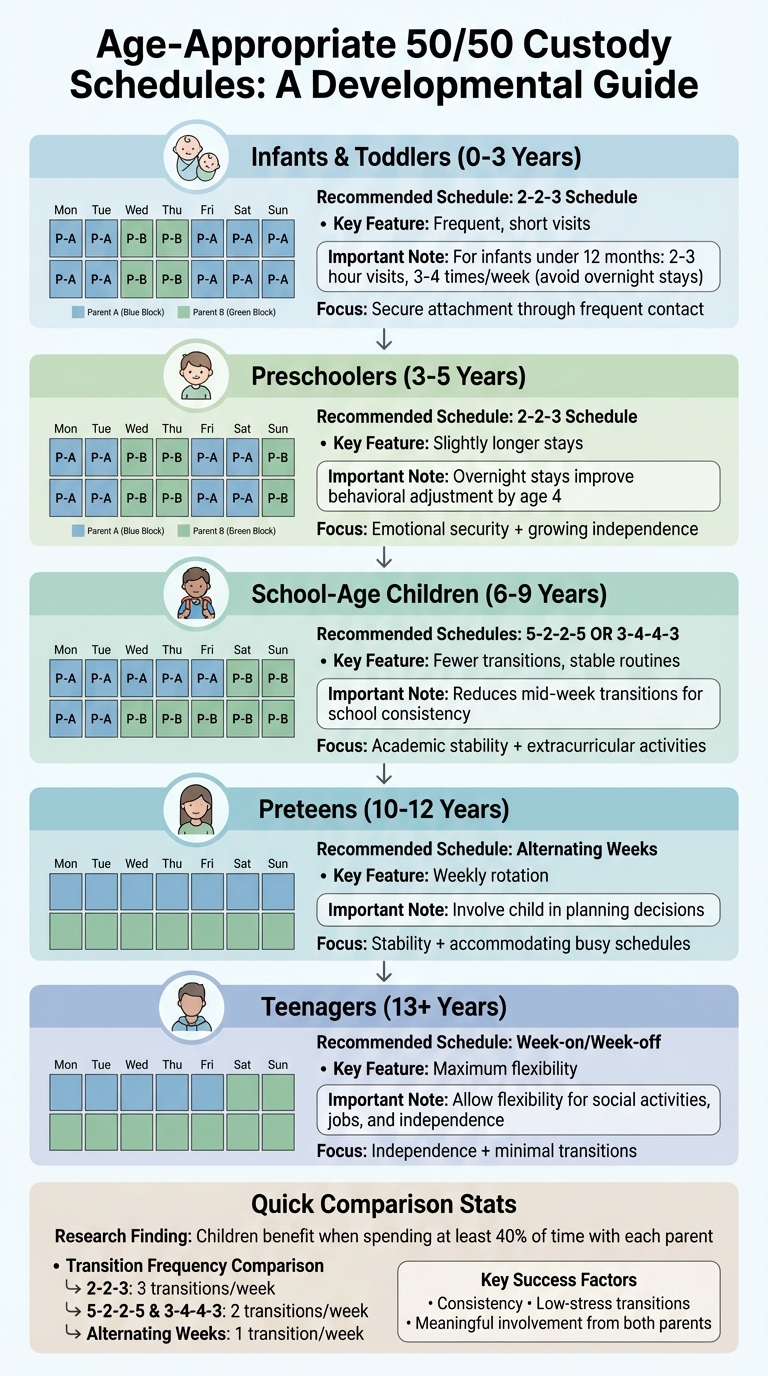
Age-Appropriate 50/50 Custody Schedules Guide by Child Development Stage
50/50 Custody Schedules by Age Group
Infants and Toddlers (0-3 Years)
For babies and toddlers, time perception and memory are still developing, making frequent and short visits essential to maintain secure attachments with both parents. A 2-2-3 schedule (two days with one parent, two days with the other, followed by three days with the first parent) is a good option to ensure regular contact. For infants under 12 months, shorter visits of 2–3 hours, three to four times a week, are often more effective than overnight stays. Studies suggest that frequent overnight stays (one or more per week) for babies under one year old can lead to attachment insecurity.
Consistency is key at this stage. Both households should align on routines for feeding and sleep to help the child feel secure and develop internal regulation. As the child grows, longer visits can gradually be introduced, creating a smoother transition to preschool-age schedules.
Preschoolers (3-5 Years)
By age three, children begin to understand time better and can handle slightly longer separations. The 2-2-3 schedule remains a good choice, balancing their need for emotional security with growing independence. By age four, research shows that children who experience overnight stays tend to have better behavioral adjustment and stronger relationships with their non-residential parent.
Minimizing parental conflict is especially important during this stage. Preschoolers are learning social skills and emotional regulation, so calm transitions between households can make a big difference. As they approach school age, the focus shifts to creating schedules that support academic consistency and reduce mid-week interruptions.
Early School-Age Children (6-9 Years)
Once children start school, their priorities expand to include academics, homework, and friendships. Custody schedules like 5-2-2-5 or 3-4-4-3 can help by reducing mid-week transitions while ensuring regular time with both parents. These schedules also support consistent routines for school and extracurricular activities.
Children in this age group value fairness and clear boundaries, making it important to avoid loyalty conflicts during exchanges. Keeping school attendance consistent and maintaining stable extracurricular and social activities in both homes can help ease the transition between households. Calm, low-stress transitions are especially important to help children focus on their growing responsibilities.
Preteens (10-12 Years)
As children approach adolescence, alternating week schedules often work well, offering stability while accommodating their increasingly busy lives. Preteens are juggling social activities, sports, and other commitments, so a week-on/week-off rotation can provide the consistency they need while allowing for flexibility.
At this stage, involving the child in custody planning becomes important. Research shows that children feel more satisfied with shared custody arrangements when they have a say in the process. While parents ultimately make the final decisions, listening to the child’s preferences can lead to a plan that works better for everyone.
Teenagers (13+ Years)
Teenagers require even more flexibility and independence in their custody arrangements. A week-on/week-off schedule is often effective, minimizing frequent transitions and giving teens the freedom to manage their social lives, part-time jobs, and extracurricular activities.
"As children get older, most (depending on their temperament and other factors) require greater flexibility in the arrangements."
– Department of Justice, Canada
Including flexibility in the plan is essential to accommodate last-minute changes, such as a game, performance, or social event. This approach ensures teens maintain strong relationships with both parents while supporting their growing independence and ability to manage their own schedules.
Common 50/50 Custody Schedules Compared
Choosing a 50/50 custody schedule means balancing how often transitions happen, the child's age, and logistical considerations. The four most common schedules - 2-2-3, 5-2-2-5, 3-4-4-3, and alternating weeks - each cater to different developmental and family needs. Here's a breakdown of how these schedules work and what makes each one unique.
The 2-2-3 schedule involves three exchanges every week. This setup works well for infants and toddlers because it ensures frequent contact with both parents, helping them build secure attachments. On the flip side, this frequent back-and-forth can be tiring for parents and only works well if both live nearby.
"For very young children, we often start with a 2-2-3 schedule" – Lisa Zeiderman, New York Family Law Attorney
The 5-2-2-5 and 3-4-4-3 schedules reduce transitions to twice a week, making them great options for elementary-age children. The 5-2-2-5 schedule is particularly convenient because parents have the same weekdays every week (e.g., Parent A always has Monday and Tuesday), making it easier to plan around work and childcare.
"Between kindergarten and 2nd or 3rd grade, we recommend the 5-2-2-5" – Lisa Zeiderman
The 3-4-4-3 schedule also involves two transitions per week but provides a more even split of time between parents. However, depending on how it's structured, one parent might end up with less weekend time, which could be a drawback.
For teenagers, the alternating weeks (7-7) schedule simplifies things by limiting transitions to just once a week. This setup is ideal for teens with busy lives, as it minimizes disruptions and avoids the hassle of constantly packing and unpacking. That said, it may not work as well for younger kids, who often need more regular contact with both parents.
Schedule Comparison Table
| Schedule | Transition Frequency | Best Age Suitability | Advantages | Disadvantages |
|---|---|---|---|---|
| 2-2-3 | High (3 per week) | Birth to 5 years | Frequent contact supports attachment | Exhausting transitions; requires close proximity |
| 5-2-2-5 | Moderate (2 per week) | 5 to 12 years | Consistent weekdays; alternates weekends | Five-day stretch may feel long for younger kids |
| 3-4-4-3 | Moderate (2 per week) | 5 to 12 years | Balanced split; easy to follow | One parent might lose out on weekend time |
| Alternating Weeks | Low (1 per week) | 13+ years | Simple; fewer transitions; stable for teens | Seven days apart may feel too long for younger children |
For schedules with longer gaps, a mid-week visit can help maintain more consistent contact.
sbb-itb-a09457a
Creating Personalized Custody Plans with Coflo

Navigating custody planning can feel overwhelming, especially when trying to balance your child’s developmental needs with logistical realities. That’s where Coflo steps in. Using AI-generated custody schedules, Coflo evaluates your family’s priorities and delivers personalized recommendations, ranked by how well they suit your unique situation.
The platform features priority sliders that let you weigh factors like stability, equal time, school consistency, and flexibility. As you adjust these sliders, Coflo’s AI recalculates in real-time, matching your preferences to one of 10+ proven custody patterns. Instead of settling for generic templates or guesswork, you get recommendations grounded in your priorities and backed by developmental research. The result? Schedules that not only reflect your family’s needs but also align with your child’s developmental stage and cognitive needs.
Coflo doesn’t stop at schedules - it integrates developmental insights into its recommendations. For example:
- Infants and toddlers: The focus is on attachment theory, emphasizing frequent contact (ideally daily) to support their limited sense of time and memory.
- School-age children (6-12): Stability takes center stage, promoting consistency to nurture their growing desire for mastery and peer relationships, while minimizing loyalty conflicts.
- Teenagers: The emphasis shifts to flexibility and autonomy, allowing them to manage their social lives and independence while moving more fluidly between households.
"The absolute amount of parenting time should be emphasized less than a plan that allows for a schedule that enables both parents to feel and act engaged and responsible." – Encyclopedia on Early Childhood Development
Coflo also provides implementation roadmaps to help you put the recommended schedule into action. These roadmaps include clear success indicators, potential challenges to anticipate, and strategies for smoother transitions. For families dealing with high-conflict dynamics, Coflo suggests "parallel parenting" approaches. This method maintains a 50/50 balance while reducing direct interactions between parents, shielding children from unnecessary tension.
Choosing the Right Custody Schedule for Your Child
Once you've explored the research and compared different custody schedules, the next step is selecting the custody plan that works best for your child. A 50/50 custody schedule can be a great option, but it needs to match your child's developmental stage, personality, and daily routine. Studies suggest that dual-residence arrangements can promote children's overall well-being and sense of stability. However, the success of such a plan hinges on how well it aligns with your child's unique needs at different ages.
"The challenge for parents... is to not assume a specific plan will always be the best fit. It is important to carve out a plan that could work best for their family circumstances, their child's ages and stages of development." - Michael Saini, Ph.D., Professor and Chair in Law and Social Work at the University of Toronto
Customizing a custody schedule to fit your child’s specific situation is crucial for fostering their emotional and physical well-being.
Practical factors like geographic distance can play a big role. Long commutes - whether between parents' homes or to school - can add unnecessary stress. Additionally, smooth communication and reducing conflicts during transitions are essential for making a 50/50 arrangement work. In cases where conflict between parents is high, children may feel stuck in the middle, making dual-residence plans less effective unless strategies like parallel parenting are used.
What matters most is the quality of time spent together, not just the number of hours. Being actively involved in your child's daily life - helping with homework, eating meals together, and maintaining consistent routines - has a bigger impact on their emotional adjustment than simply splitting time evenly. As children grow, their preferences and social activities should also influence the schedule. For example, teenagers often favor alternating weekly schedules, which provide a sense of stability while allowing for increased independence.
To help families navigate this process, platforms like Coflo offer tools to create personalized custody schedules. These tools adapt as your child's needs change, ensuring that the focus remains on their well-being rather than convenience or conflict. By combining research-based strategies with your family’s unique circumstances, you can design a custody plan that supports your child at every stage of their development.