
AI vs. Mediators for Custody Plans
Navigating custody decisions after a divorce is tough. Parents must decide on legal custody (decision-making for education, healthcare, etc.) and physical custody (where children live). Both AI tools and mediators offer solutions, but they serve different needs. Here's a quick breakdown:
- AI Tools: Cost-effective (around $100-$500/month), fast (minutes to hours), and data-driven. They create schedules based on priorities like stability or equal parenting time. Best for low-conflict cases and routine logistics.
- Mediators: Costlier ($5,000–$9,000), slower (3–6 months), but offer emotional support and legal expertise. Ideal for high-conflict situations or complex family dynamics.
Quick Comparison
| Factor | AI Tools | Mediators |
|---|---|---|
| Cost | $100–$500/month | $5,000–$9,000 |
| Speed | Minutes to hours | 3–6 months |
| Customization | Data-driven recommendations | Personalized, emotion-sensitive |
| Legal Compliance | Standardized, automated | Tailored to state-specific laws |
| Conflict Management | Automated sentiment analysis | Human empathy and de-escalation |
Best Approach: Use AI for efficiency and mediators for emotional or legal complexities. Combining both can save time and money while ensuring a child-focused outcome.
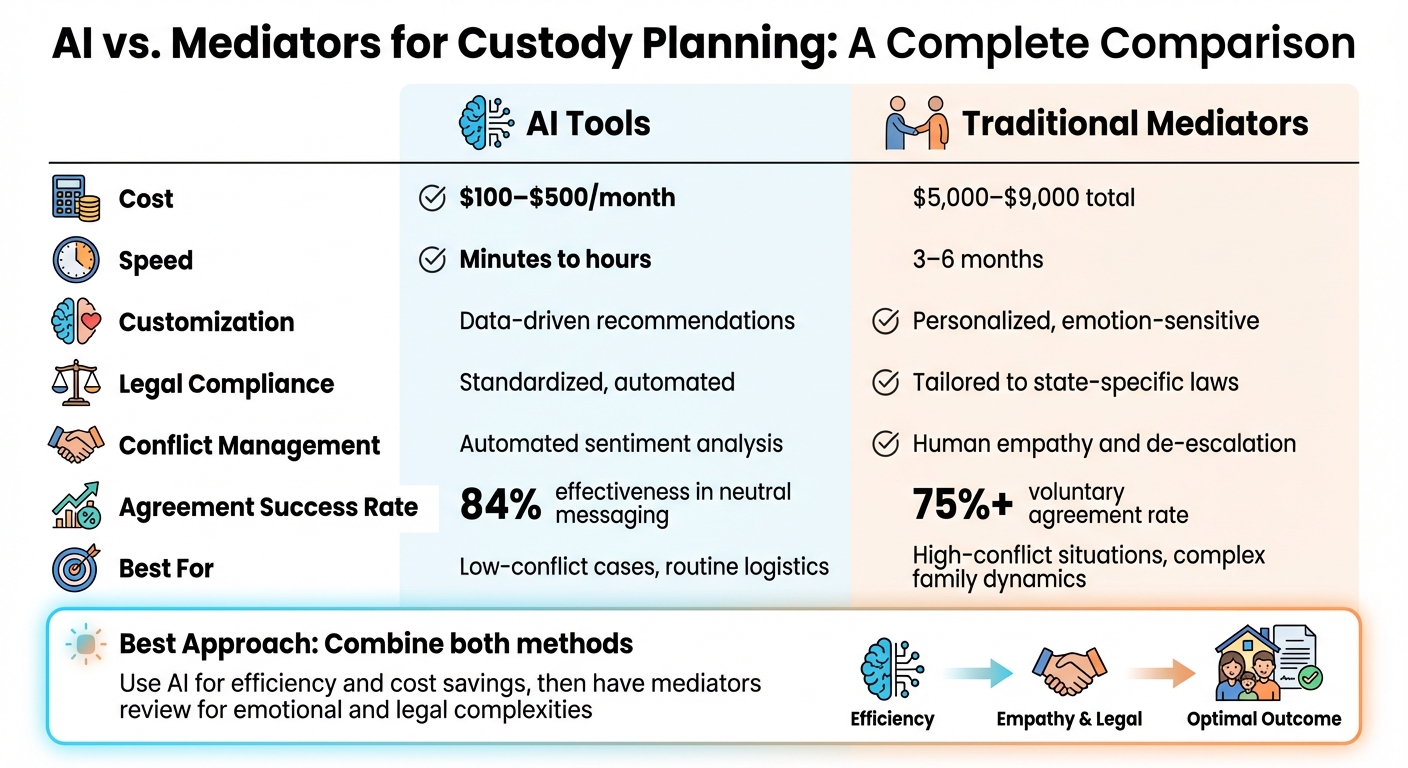
AI Tools vs Traditional Mediators for Custody Planning Comparison
How We Compare AI and Mediators
When it comes to custody planning, there are five key factors to consider: cost, speed, customization, legal compliance, and conflict management. Each of these elements shapes your experience and influences the final outcome.
Let’s start with cost. In Pennsylvania, traditional mediation typically costs between $5,000 and $9,000, with mediators charging hourly rates from $125 to $350, depending on their location and expertise. On the other hand, AI tools significantly reduce expenses by automating many time-consuming tasks, eliminating the bulk of billable hours.
Next is speed. AI platforms are incredibly efficient, completing tasks like document reviews and scheduling in minutes. In contrast, traditional mediation often requires multiple sessions spread over 3 to 6 months, with each session lasting 1.5 to 2 hours.
Customization is another crucial factor. AI relies on data-driven insights to provide tailored suggestions, whereas mediators bring a human touch, adapting to complex family dynamics, legal intricacies, and emotional challenges.
Legal compliance ensures that your custody plan meets the necessary legal standards. AI tools apply standardized legal principles, while mediators can pinpoint subtle legal nuances that might otherwise be overlooked.
Finally, conflict management plays a big role in the emotional side of custody planning. AI uses tools like automated sentiment analysis and message filtering to manage disputes. However, mediators offer something AI cannot: human empathy and the ability to de-escalate tense situations through direct emotional support.
Here’s a quick comparison of these factors:
Comparison Table: AI vs. Mediators
| Factor | AI Tools | Traditional Mediators |
|---|---|---|
| Cost | Lower; automation reduces billable hours | $5,000–$9,000; hourly rates up to $350 |
| Speed | Minutes to hours; near-instant processing | 3–6 months with multiple sessions |
| Customization | Data-driven suggestions | Highly personalized for complex needs |
| Legal Compliance | Standardized legal principles | Expert handling of nuanced legal issues |
| Conflict Management | Sentiment analysis and filtering | Human empathy and emotional support |
Benefits of AI for Custody Planning
Lower Costs and Faster Results
AI tools are transforming custody planning, offering a budget-friendly and efficient alternative to traditional methods. Most AI-powered platforms charge between $100 and $500 per month for their services, a fraction of the cost of traditional mediation, which can quickly add up during a divorce.
Take Coflo, for example. This platform generates personalized custody recommendations in just minutes, cutting planning time by an impressive 50–70% compared to the lengthy process of traditional mediation, which often involves multiple sessions over several months.
"AI amplifies these efficiencies by performing tasks in minutes rather than weeks." - Brett Carlson, Family Law Adviser
But it’s not just about speed and cost. AI also provides solutions tailored to your family’s specific needs, ensuring a more personalized approach.
Personalized Plans Based on Your Priorities
AI platforms like Coflo allow you to create custody plans that align with your family’s unique priorities. Using interactive tools, such as sliders, you can emphasize what matters most - whether it’s stability, equal parenting time, or maintaining school consistency. From there, the platform analyzes over 10 proven custody patterns and suggests schedules that best fit your goals. For example, if minimizing transitions is important, it will prioritize routines with fewer handoffs. If equal time is your focus, it might recommend a balanced 50/50 schedule, like the 3-4-4-3 arrangement.
What makes this even more effective is the platform’s ability to integrate real-life factors into its recommendations. It cross-references parent availability with school calendars, extracurricular activities, and medical appointments to create schedules that actually work for your family. For children with special medical or therapeutic needs, the system ensures these commitments are accounted for while maintaining stability during transitions between homes.
Age-Appropriate Guidance for Children
AI doesn’t just focus on logistics - it also considers the developmental needs of your children. Platforms like Coflo adjust custody recommendations based on your child’s age, ensuring younger kids benefit from stability and predictability, while teens are given room to develop independence.
"Young children need stability and predictability in their relationships with their caretakers since their first attachment relationships are still developing." - OurFamilyWizard
Each recommendation comes with detailed guidance, including the benefits of the proposed plan, potential challenges, and an actionable roadmap for implementation. This thoughtful approach keeps the child’s well-being at the center of custody planning.
Benefits of Traditional Mediators
Emotional Support and Conflict Management
Human mediators bring a unique ability to interpret nonverbal cues and respond to emotions in real time. They can detect subtle power imbalances, calm heightened emotions, and ensure that both parents feel heard during negotiations.
"When parties agree on algorithmic justice, are they giving up the nuance of emotional intelligence, ability to read the room and building of trust through rapport that human mediators can provide?" - Lawrence Kolin, mediator and arbitrator at UWWM Mediation Group
Mediators often act as "calmers of the water", using their interpersonal skills to shift the focus from personal grievances to the child’s best interests. In situations involving high conflict or abuse, mediators can employ shuttle mediation, where parents meet separately. This approach ensures safety while still working toward an agreement.
In addition to managing emotions, mediators bring legal expertise to the table, making sure custody plans are practical and enforceable.
Legal Knowledge and Compliance
One of the key roles of a mediator is to draft custody plans that comply with state-specific legal requirements. They clarify the difference between legal custody (decision-making authority for education, health, and religion) and physical custody (where the child resides).
For example, in California, parents are required to go through mediation before a judge will hear their custody case. In New York, a mediated parenting plan only gains legal weight after a judge approves it and converts it into a court order. Mediators ensure these agreements are formatted properly, so they can easily become binding court orders. They also identify potential legal issues, such as histories of abuse or neglect, which could impact joint custody arrangements.
This combination of legal expertise and understanding of family dynamics allows mediators to create custody solutions that address both legal and emotional needs.
Understanding Complex Family Situations
Mediators are particularly skilled at navigating intricate family dynamics. Many hold qualifications as psychologists, marriage and family therapists, or social workers, which they use to address challenges like parental relocation, incarceration, military deployment, or chronic health conditions. They help uncover underlying emotional issues and guide parents toward balanced, long-term agreements.
"The primary role of a family mediator is to assist the participants to gain a better understanding of their own needs and interests and the needs and interests of others." - Association of Family and Conciliation Courts (AFCC)
While AI tools might identify inflammatory language, they lack the intuition and flexibility to adapt in real time to the emotional dynamics of a session. Human mediators rely on professional judgment to address deeper marital issues and encourage compromise in ways that algorithms simply cannot.
sbb-itb-a09457a
Comparing Results: AI vs. Mediators
Comparison Table: Results and Risks
When deciding between AI tools and traditional mediators, parents often weigh which approach is better at crafting custody plans that work. Success can mean quickly reaching an agreement, ensuring long-term adherence, or minimizing conflict. These factors build on earlier comparisons of cost, speed, and personalization.
In September 2024, a study called "Robots in the Middle" was conducted by researchers from the Cyberjustice Laboratory at the University of Montreal and the Maastricht Law and Tech Lab. The study assessed GPT-4o's performance in 50 hypothetical disputes. Interestingly, AI-generated mediation messages were rated as highly as or better than human-written ones in 84% of cases. Evaluators preferred AI interventions in 22 scenarios compared to 19 for humans. AI also showed fewer judgment errors and maintained a more consistent neutral tone throughout.
Traditional mediation, on the other hand, boasts an impressive voluntary agreement rate of over 75%. This success is largely attributed to the voluntary nature of the process and the shared costs, which often lead to higher commitment from both parties.
Another study, conducted between November 2020 and August 2021 at the 20th Circuit Court Friend of the Court in Ottawa County, Michigan, revealed that using an online dispute resolution platform made parties more than four times as likely to reach an agreement. In child support disputes, these platforms nearly halved the time it took to resolve issues.
The table below outlines the findings across key measures like speed, success rates, and conflict management:
| Measure | AI Tools | Traditional Mediators |
|---|---|---|
| Immediate Results | High speed; generates neutral schedules in minutes | Slower; requires multiple sessions and manual scheduling |
| Agreement Success Rate | 84% effectiveness in drafting neutral, clear messages | 75%+ voluntary agreement rate across the industry |
| Accuracy | High; less prone to fatigue or misinterpreting intentions | Variable; may suffer from fatigue or misreading emotional cues |
| Compliance Drivers | Data-driven neutrality and objective "reality-testing" | Built on trust, rapport, and shared ownership |
| Conflict Management | Flags inflammatory language and suggests constructive phrasing | Handles high-emotion dynamics and power imbalances effectively |
| Child Wellbeing Focus | Emphasizes stability, school attendance, and extracurricular participation | Prioritizes emotional safety, parent-child bonds, and overall family dynamics |
| Compliance Risk | Higher if plans lack emotional engagement or human "buy-in" | Lower due to voluntary participation and mutual agreement |
| Best For | Routine logistics, low-conflict situations, and data-heavy tasks | High-conflict cases, complex emotions, and situations with power imbalances |
Both methods deliver positive outcomes, but they come with unique risks. For AI-generated plans, the main challenge lies in the absence of face-to-face emotional interactions. While AI excels at producing neutral, data-driven schedules, it struggles with intangible factors like emotional readiness, loyalty, or heartbreak - key elements for ensuring long-term success. On the flip side, traditional mediation can sometimes fall short due to power imbalances. A disadvantaged party might feel pressured into an agreement that doesn’t serve their best interests, potentially leading to future disputes.
When it comes to outcomes for children, AI platforms analyze behavioral trends, academic performance, and emotional indicators to propose arrangements that aim to minimize stress. By automating logistical tasks, AI helps reduce misunderstandings and last-minute changes that could cause anxiety for kids. However, human mediators excel at keeping the focus on the child’s needs rather than the parents' personal grievances. This is particularly crucial in high-conflict scenarios involving issues like domestic violence or severe mental health challenges.
Using AI and Mediators Together
How AI Can Support Mediators
AI tools are transforming the mediation process by handling routine tasks like document review, case triage, and scheduling in just minutes. This allows mediators to dedicate their time to the more nuanced and emotional aspects of conflict resolution. As Brett Carlson, an accredited family law mediator, puts it:
"AI amplifies these efficiencies by performing tasks in minutes rather than weeks... freeing participants and neutrals to focus on substantive issues".
One particularly useful application is sentiment analysis. AI can evaluate communication between co-parents, flagging inflammatory language to prevent conflicts from escalating. Think of it as an "emotional spellcheck" that pinpoints areas of tension - often called "emotional hotspots" - and alerts mediators to where their involvement is most needed. Beyond that, AI can analyze historical case data to predict likely outcomes, helping mediators set realistic expectations grounded in precedent rather than speculation.
By automating these tasks, AI creates a framework where machine efficiency complements human empathy, allowing mediators to focus on what they do best.
Combining Personal Support with Speed
The blend of AI and human expertise takes mediation to the next level. AI provides quick, data-driven insights at a lower cost, while mediators bring the emotional intelligence and conflict resolution skills that technology simply can’t replicate.
In high-conflict cases, AI can play a calming role. Sentiment analysis tools, for instance, can filter out hostile language in messages and reframe them in neutral, child-centered terms. Imagine an angry text being transformed to focus solely on practical details - like pickup times - minimizing emotional reactions and keeping the conversation productive. This approach allows mediators to step in only when deeper issues require their attention.
However, human oversight remains essential. AI has its limitations; it might overlook critical safety concerns or produce errors in its analysis. That’s why every AI-generated plan should be thoroughly reviewed by a mediator or legal professional before moving forward. By combining AI’s logistical efficiency with the mediator’s emotional insight, this hybrid approach makes custody agreements more effective, affordable, and enduring.
Choosing the Right Approach
Selecting the best approach for custody planning depends on your family's specific needs, the level of conflict, and your budget. AI tools can simplify scheduling by offering efficient, data-driven recommendations tailored to your priorities and your child's developmental stage. On the other hand, mediators are invaluable when dealing with emotional complexities, intricate family dynamics, or high-conflict situations where empathy and trust-building are crucial.
Start by assessing your family dynamics and the level of conflict involved. If your situation involves straightforward logistics, low conflict, and routine scheduling, AI can streamline the process and reduce costs. But in cases involving domestic violence, severe mental health challenges, or ongoing hostility, human involvement becomes essential. AI tools are not equipped to address crises or ensure physical safety.
Each method has its strengths, and many families benefit from combining both approaches. For example, you could use an AI platform like Coflo to create a baseline schedule, covering logistical details such as holiday rotations, school pickups, and extracurricular activities. Then, take the AI-generated plan to a mediator or attorney for review. This ensures the plan meets legal standards and accounts for the emotional nuances unique to your family. This hybrid strategy blends the speed and affordability of AI with the personalized support and insight that only a human professional can provide.
Whatever approach you choose, always have a legal professional review any AI-generated plan to ensure it aligns with your state's "best interests of the child" standard. Additionally, verify the platform's encryption and privacy policies before uploading sensitive information. By prioritizing your child's well-being and minimizing conflict, you can create a custody framework that works for everyone involved.